
Olympic National Park from Pacific shore to glacier peaks
Published on 09/09/2026 at 13:34 | Editorial responsibility: Rafael Müller, Editor-in-Chief AD HOC NEWS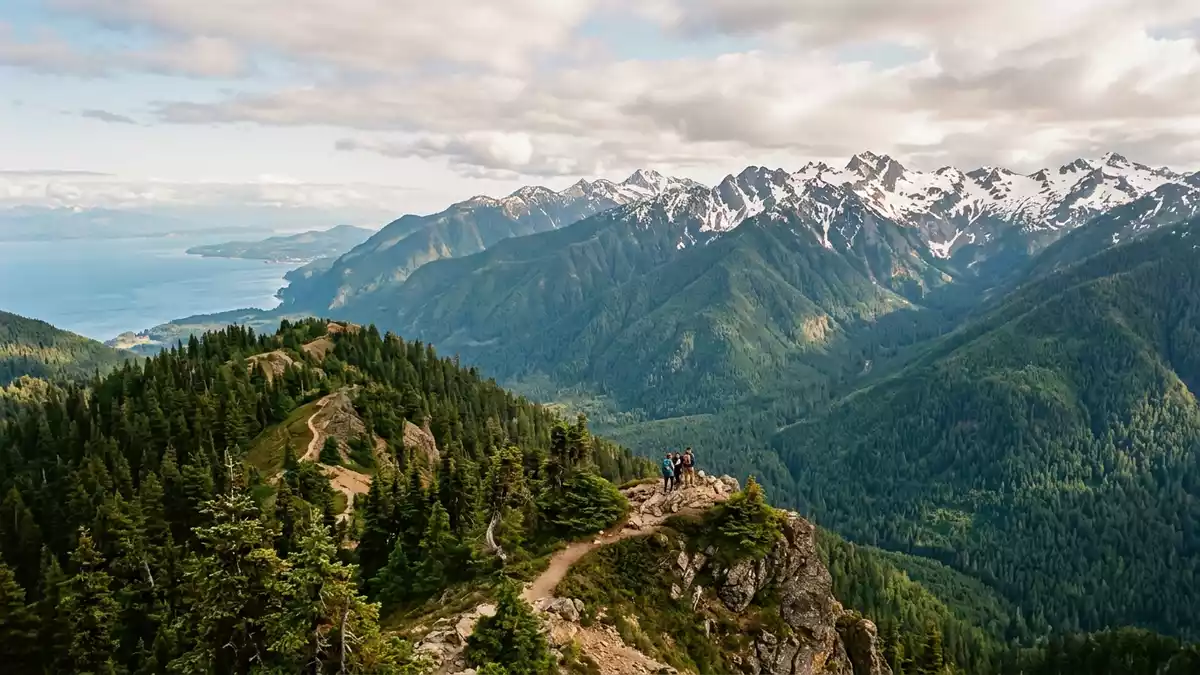
Olympic National Park in Washington State brings ocean coast, deep forest and glacier peaks together in a single protected landscape west of Port Angeles. It was established as a national park on 29 June 1938 under President Franklin D. Roosevelt, drawing earlier protected lands on the Olympic Peninsula into one large unit. Within its boundaries, visitors move from tide-washed beaches to temperate rainforest valleys and up into an alpine core dominated by Mount Olympus and its neighbouring summits.
From Roosevelt’s signature to international recognition
The modern story of Olympic National Park begins with the abolition of Mount Olympus National Monument and the creation of the park by an act signed by Franklin D. Roosevelt on 29 June 1938.Roosevelt signed the park bill after Congress authorised a new protected area of 634,000 acres, with scope for later expansion towards a larger acreage figure that was eventually reached in the mid twentieth century.Congress authorised creation in 1938 Earlier protection on the peninsula had taken the form of forest reserves and the Mount Olympus monument, but the 1938 act gathered them into a single national park focused on both high mountains and surrounding forests.
International recognition followed in the late twentieth century. In 1976 Olympic National Park was designated an International Biosphere Reserve under UNESCO’s Man and the Biosphere Programme, identifying it as a significant area of ecosystem diversity in the temperate zone.UNESCO listed the Olympic Biosphere Reserve In 1981 UNESCO inscribed the park on the World Heritage List under natural criteria vii and ix, recognising both its scenic qualities and the ecological processes expressed across its range of habitats from sea edge to high glaciated summits.Olympic National Park World Heritage listing These designations locate the park within a small group of protected areas that carry both biosphere reserve and World Heritage status.
Coastline, rainforest and alpine core in one park
Olympic National Park occupies much of the Olympic Peninsula in north-western Washington State, including an inland block and a separate coastal strip along the Pacific shore.The park lies on the Olympic Peninsula The coastal section runs along a series of beaches and rocky headlands, broken by stacks and small islands where erosion has detached harder rock from the mainland. Inland, the main body of the park extends from lowland forest through river valleys up to cirque basins and glacier-clad ridges centred on Mount Olympus.
The park’s combination of Pacific coast, temperate rainforest and alpine zones makes it one of the most diverse protected landscapes in the temperate latitudes. Along the shore, visitors encounter sandy reaches, driftwood, tidepools and offshore rock formations shaped by a receding and changing coastline. Behind the coast, river systems such as the Hoh and Quinault cut deep canyons and wide valleys into the peninsula, flanked by stands of coniferous trees that include some of the largest species on earth.One of the world’s largest temperate rainforests Higher up, alpine meadows and glacier basins surround the central peaks, giving the upper park a landscape of craggy summits, snowfields and sculpted cirques.
Temperate rainforest and glaciated mountains
Olympic National Park is particularly known for its temperate rainforests, where high rainfall supports lush vegetation and substantial living biomass. Valley floors carry dense stands of Sitka spruce, western hemlock, Douglas fir and other conifers, interspersed with moss-covered trunks, ferns and understorey plants that thrive in the moist conditions. These forests form part of one of the largest remaining tracts of virgin temperate rainforest in the world and are a central reason for the park’s international designations.Intact temperate rainforest in the Pacific Northwest The protected status allows ecological processes such as natural succession, nutrient cycling and disturbance regimes to continue with limited direct human alteration.
Above the forests, the Olympic Mountains rise to a compact alpine massif dominated by Mount Olympus. Glaciers occupy north-facing and sheltered slopes, creating cirques and carving valleys that descend toward the forests below.Glaciated peaks and cirques Olympic National Park holds a distinction as the lowest latitude location in the world where glaciers form below about 2,000 m and occur below about 1,000 m, a reflection of the region’s maritime climate and heavy precipitation. Alpine meadows, rocky ridges and subalpine woodland surround the ice, forming a contrasting zone to the shaded rainforest valleys and the open shorelines of the coastal strip.
Visiting Olympic National Park: what travellers from Western Europe should know
- Olympic National Park occupies much of the Olympic Peninsula in north-western Washington State. Port Angeles, on the peninsula’s northern side, functions as an important gateway community and lies outside the park boundary.
- Travel from Western Europe generally involves flights to Seattle-Tacoma International Airport followed by onward travel by road or ferry to Port Angeles and the surrounding Olympic Peninsula.
- Terrain in the park ranges from level coastal beaches and riverside paths to steep mountain trails. Some routes climb through forested slopes into alpine basins, and mountain sections can involve prolonged ascents.
- Weather on the Olympic Peninsula reflects its maritime location. Lowland areas can be wet, and higher elevations experience snow cover in colder months, influencing access to some mountain routes.
- The official language is English and the currency is the United States dollar. Entry requirements depend on your nationality; UK travellers can check the FCDO travel advice at gov.uk/foreign-travel-advice, Irish travellers the Department of Foreign Affairs at ireland.ie.
Searching for Olympic National Park on social platforms
These links open searches for Olympic National Park on each platform.
Frequently asked questions about Olympic National Park
Where is Olympic National Park and how is it related to Port Angeles?
Olympic National Park occupies much of the Olympic Peninsula in north-western Washington State, with Port Angeles on its northern edge functioning as a nearby gateway town.
What kind of landscapes can visitors expect inside the park?
Visitors encounter Pacific beaches with offshore rock formations, deep temperate rainforest valleys and an alpine core of cirques, glacier basins and rugged mountain ridges.
What makes Olympic National Park distinctive among protected areas?
The park combines ocean shore, intact temperate rainforest and glaciated mountains in one protected area, and holds both UNESCO Biosphere Reserve and World Heritage designations recognising its ecological diversity and scenic qualities.


