
Osaka-jo: stone walls, golden tigers and a skyward keep
Published on 08/23/2026 at 14:27 | Editorial responsibility: Rafael Müller, Editor-in-Chief AD HOC NEWS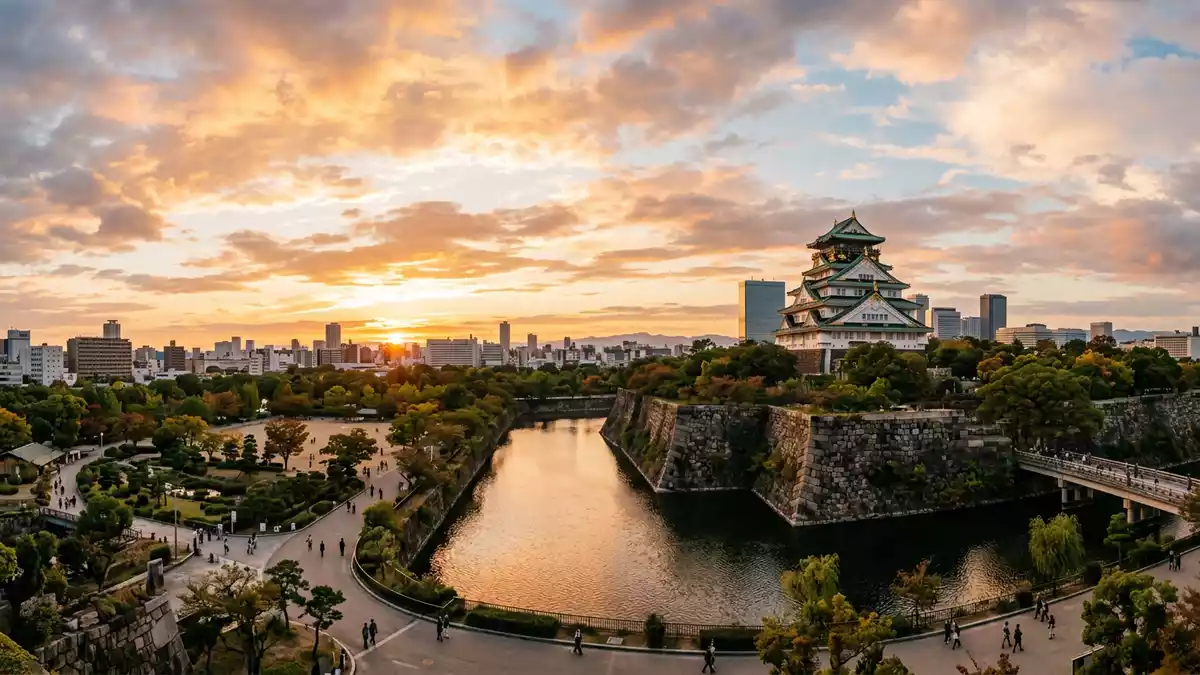
Osaka-jo, known in English as Osaka Castle, crowns an artificial hill in central Osaka with high stone ramparts, defensive moats and a multi-storey main keep that dominates the surrounding park. First built for Toyotomi Hideyoshi in 1583, it has been destroyed, rebuilt and restored several times, leaving a layered complex where samurai-era fortifications frame a twentieth-century reconstruction of the tower.
From Toyotomi Hideyoshi’s stronghold to symbol of Osaka
The story of Osaka-jo begins in 1583, when warlord Toyotomi Hideyoshi ordered a vast new castle on a strategic site in Osaka during the Azuchi–Momoyama period.Built in 1583 This early complex featured massive stone walls, moats and an imposing main tower that served as Hideyoshi’s power base during the final campaigns of Japan’s age of civil war.Built in 1583 by Toyotomi Hideyoshi
After Hideyoshi’s death, Osaka-jo became the scene of the Siege of Osaka in 1614–1615, when Tokugawa Ieyasu’s forces overcame the Toyotomi clan and took control of the castle. In the 1620s, Tokugawa Hidetada ordered a large-scale rebuilding that expanded the defences, raised the ground level and left the complex with the broad stone bases and moats that define much of its layout.The Tokugawa Shogunate rebuilt the complex in the 1620s Lightning destroyed the wooden main tower in 1665, and for centuries the central keep did not stand above the stone foundations.The main tower was destroyed by lightning in 1665
A twentieth-century keep on samurai foundations
The main tower visitors see at Osaka-jo dates from 1931 and rises in ferroconcrete above the earlier stone base, combining historical form with modern structure.The present ferro-concrete reconstruction was built in 1931 Architecturally, the tower follows the outlines of an Edo-period tenshu, with stacked, receding storeys, sweeping tiled roofs and decorative gables that give it a striking vertical profile against the Osaka skyline. Copper roofing, renewed during a major restoration in 1997, carries ornamental shachi and golden tiger reliefs that gleam against the pale walls.A comprehensive restoration in 1997 updated the exterior
Inside, the tower functions as a museum space, with exhibition floors stacked above each other and an observatory at the top level. Modern materials and climate control sit within a shell that reproduces the appearance of a seventeenth-century keep, while lifts and stairways handle the vertical circulation through the floors. From the upper levels, glazing on the observation deck frames views across the concentric moats, baileys and the high-rise districts of contemporary Osaka beyond.
Stone walls, moats and the surrounding park
The wider Osaka-jo complex extends across a large green park in central Osaka, encircled by moats and monumental stone ramparts built from huge quarried blocks.The steep walls rise close to 30 metres These walls form angular bastions and terraces that step down towards the water, with sloping faces that were designed to be difficult to scale. Gates and turrets punctuate the defences, giving vantage points over the water and into the inner baileys.
Within the outer moats, Osaka Castle Park spreads around the central hill, with broad lawns, tree-lined paths and sports facilities occupying former military land.The fortress stands within a park of over 100 hectares Seasonal planting, including large numbers of cherry trees, turns sections of the park into dense blossom in spring, while ponds and smaller gardens create quieter pockets away from the main approach routes. The contrast between the stone envelope of the historic citadel and the open parkland around it is one of the defining experiences of a walk through the grounds.
Visiting Osaka-jo: what travellers from Western Europe should know
- Osaka-jo stands in Osaka Castle Park east of central Osaka, with JR Osaka-jo Koen Station and Osaka Metro stations such as Tanimachi 4-chome providing rail access to the park.
- Reaching the main keep from the nearest stations involves walking through the park and then ascending sloping approaches and stairways up the stone embankment to the inner bailey.
- The grounds include extensive paved and unpaved paths, with some routes involving long, gently rising ramps along the top of the stone walls.
- The official language is Japanese and the currency is the yen. Entry requirements depend on your nationality; UK travellers can check the FCDO travel advice at gov.uk/foreign-travel-advice, Irish travellers the Department of Foreign Affairs at ireland.ie.
Searching for Osaka-jo on social platforms
These links open searches for Osaka-jo on each platform.
Frequently asked questions about Osaka-jo
Where is Osaka-jo?
Osaka-jo stands in Osaka Castle Park in the Chuo ward of Osaka, in the Kansai region of Japan, surrounded by moats and urban districts.
What can visitors expect inside the main keep?
Inside the ferroconcrete main keep, visitors find exhibition floors presenting the castle’s history and an observation deck at the upper level with views over Osaka.
What makes Osaka-jo distinctive among Japanese castles?
Osaka-jo combines intact stone ramparts and moats from the Tokugawa reconstruction with a 1931 ferroconcrete tower, creating a rare blend of samurai-period fortifications and twentieth-century engineering in a central city park.


