
Palacio da Pena: a Romantic palace above Sintra
Published on 08/15/2026 at 14:45 | Editorial responsibility: Rafael Müller, Editor-in-Chief AD HOC NEWS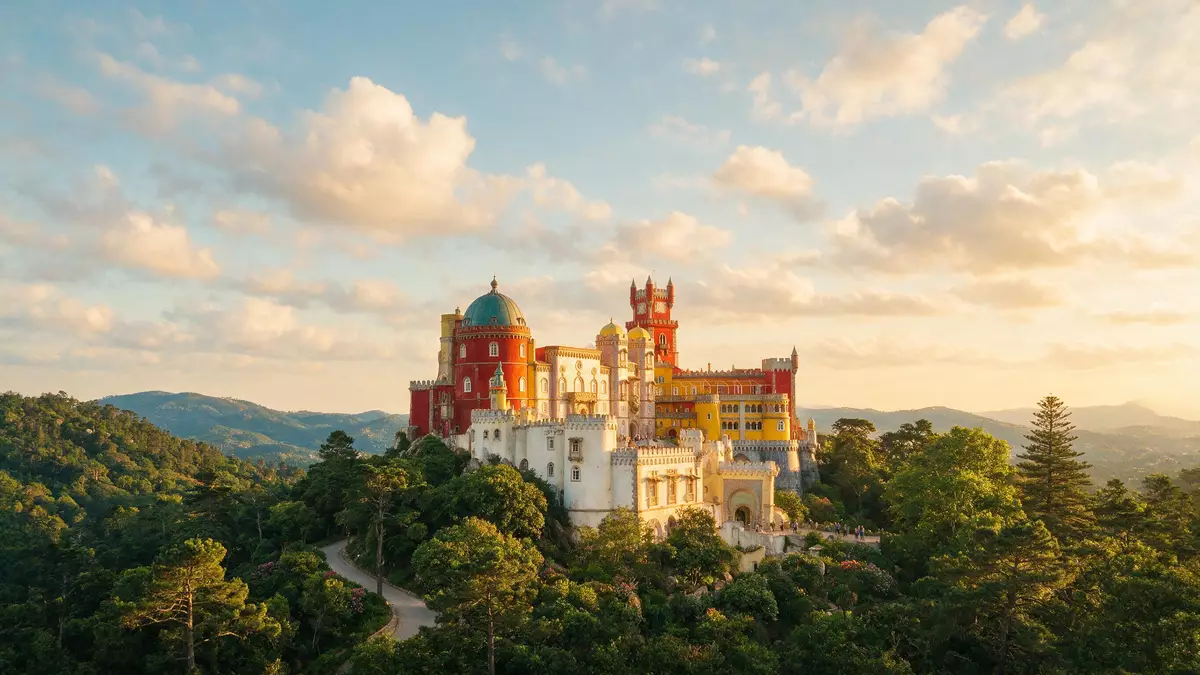
Palacio da Pena crowns a rocky hill above Sintra, west of Lisbon, where a 19th?century Romantic palace rises over dense forest in a sweep of colour and towers. Built around an earlier monastery and reshaped in the nineteenth century, it became a royal summer residence and later a landmark of the Cultural Landscape of Sintra.
A Romantic palace on the Sintra hills
Palacio da Pena stands in the Serra de Sintra, on a high spur above the town, surrounded by a landscaped park of trees, paths and viewpoints that descend the slopes.Sintra Mountains From a distance the palace appears as a compact mass of terraces, towers and walls, arranged on different levels to follow the uneven terrain. Strong colours distinguish the main volumes and give each wing a clear presence against the greenery.
The site carries a long religious history. In the early sixteenth century King Manuel I ordered a monastery for the Order of Saint Jerome here, raised above Sintra as a quiet retreat for monks.Royal Monastery of Our Lady of Pena That convent became the core around which the later palace grew, and parts of its cloister, chapel and dependencies remain embedded in the northern section of the complex.
From convent to royal summer residence
The transformation of the hilltop site into Palacio da Pena began in the nineteenth century, when Ferdinand II, a German prince who became king of Portugal through his marriage to Queen Maria II, purchased the ruined monastery in 1838.Ferdinand II purchase in 1838 He first repaired the existing buildings, adapting the former cells and service rooms for the royal family, then commissioned a substantial extension that turned the restored convent into a palace complex. The engineer and architect Wilhelm Ludwig von Eschwege, an officer and mineralogist of German origin, oversaw much of this work in the mid?nineteenth century.Baron Ludwig von Eschwege
The building phase extended across several decades and was only completed in 1885, the year of Ferdinand II’s death.completion in 1885 After the proclamation of the Portuguese Republic in 1910 the palace passed to the state and was opened to the public as a historic monument. In 1995 it was included in the UNESCO World Heritage listing of the Cultural Landscape of Sintra, underlining both its Romantic architecture and its relationship to the surrounding park and hills.World Heritage in 1995
Eclectic architecture and the surrounding park
Architecturally, Palacio da Pena is a deliberate collage of styles. Neo?Manueline details refer back to Portugal’s maritime age, while Moorish and neo?Gothic motifs appear in arches, tilework and battlements.Manueline and Moorish influences Alongside these are elements drawn from Renaissance and Baroque forms, creating a building whose Romantic character comes from its contrasts as much as from any single style. An entrance with pronounced Moorish decoration leads into a courtyard where sculpted stone, coloured surfaces and ornamental tiles sit close together.
The palace exterior is shaped by terraces and walkways that link the older convent wing to the nineteenth?century additions, including a prominent tower beside the kitchens and larger reception rooms known as the New Palace.former convent and New Palace Around it spreads Pena Park, laid out under Ferdinand II as a Romantic garden with winding paths, pavilions and stone benches set among planted trees from different regions of the world.Pena Park romantic garden The combination of palace and park turns the entire hilltop into a composed landscape, where viewpoints open towards Sintra and the Atlantic coast.
Visiting Palacio da Pena: what travellers from Western Europe should know
- Palacio da Pena stands above Sintra in western Portugal, in the Serra de Sintra, reached by road Estrada da Pena from the town below.
- The palace occupies a steep hilltop, and movement between the terraces and courtyards involves climbs on stone steps and sloping paths.
- The surrounding Pena Park covers a broad area of wooded hillside, so exploring the grounds involves longer walks on uneven paths and tracks.
- The official language is Portuguese and the currency is the euro.
- Sintra lies within the European Union, so the fixed entry?requirements sentence for travel outside the EU does not apply here.
Searching for Palacio da Pena on social platforms
These links open searches for Palacio da Pena on each platform.
Frequently asked questions about Palacio da Pena
Where is Palacio da Pena?
Palacio da Pena stands on a hill in the Serra de Sintra, above the town of Sintra in western Portugal, west of Lisbon.
What can visitors expect at Palacio da Pena?
Visitors encounter an eclectic 19th?century Romantic palace combining an earlier monastery, colourful terraces and towers, and a surrounding landscaped park of trees and winding paths.
What makes Palacio da Pena distinctive?
Its mixture of neo?Manueline, Moorish and other revival styles, combined with its hilltop setting and origins in a sixteenth?century convent, gives Palacio da Pena a striking character.


