
Palati tou Megalou Magistrou and its fortress courtyards
Published on 09/24/2026 at 06:54 | Editorial responsibility: Rafael Müller, Editor-in-Chief AD HOC NEWS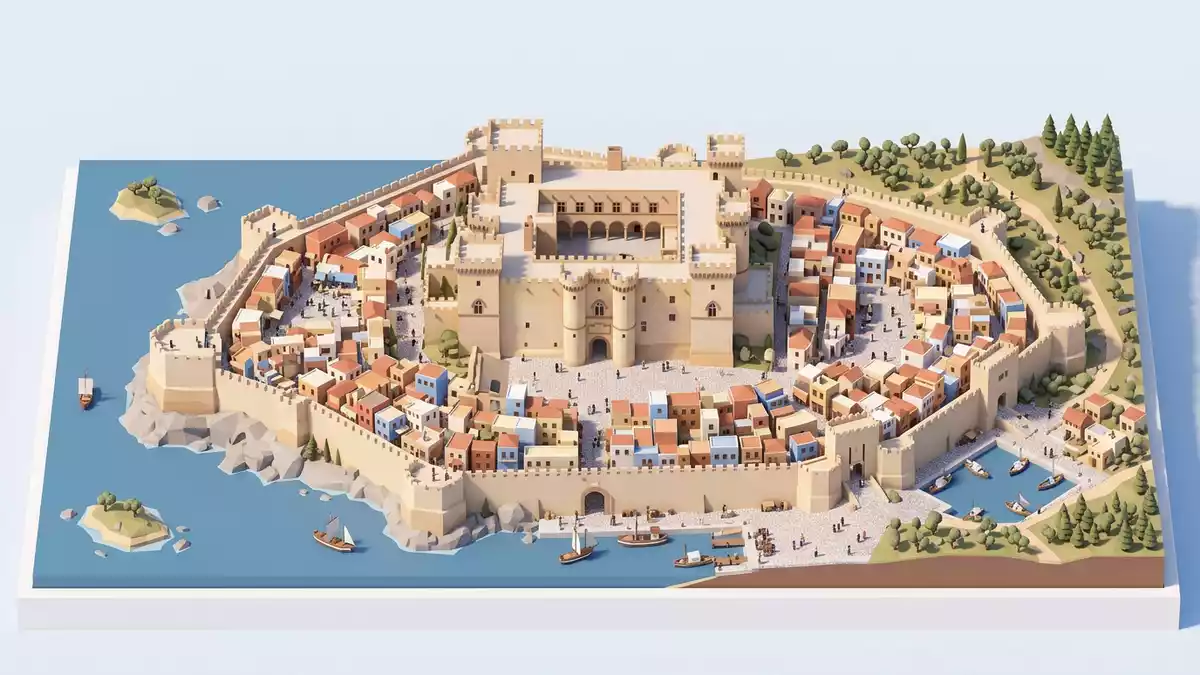
Palati tou Megalou Magistrou rises above the Medieval City of Rhodos as a fortress-palace of heavy masonry, towers and courtyards. Its visible form brings together Byzantine origins, the fourteenth-century rule of the Knights Hospitaller and a twentieth-century reconstruction.
Palati tou Megalou Magistrou: a castle above the Medieval City
The palace stands at the north-western part of the walled old town, at the end of Ippoton, the Street of the Knights. Its mass belongs to the defensive landscape of Rhodos, where gates, ramparts and narrow streets surround the former centre of Hospitaller power.
The building is also known as the Kastello. Its exterior has the character of a fortified Gothic residence, with thick walls, battlements, towers and a substantial entrance. The palace occupies the upper part of the medieval town and is associated with the harbour-facing fortifications. The Gothic palace description reflects the building’s combination of domestic and military forms.
From Byzantine citadel to Hospitaller residence
The site began as a Byzantine citadel, traditionally dated to the late seventh century. In 1309, the Knights Hospitaller took control of Rhodos and established the island as the centre of their eastern Mediterranean state.
During the fourteenth century, the Order of St John rebuilt and expanded the fortress. Palati tou Megalou Magistrou became the residence of the Grand Master and an administrative centre for the order’s government. The palace therefore combined private rooms, official spaces and a role within the town’s military system. The Hospitaller history of Rhodos places its main development after the order’s arrival in 1309.
The Knights Hospitaller ruled Rhodos until 1522, when Ottoman forces captured the island. The palace then passed through different uses connected with Ottoman administration and military control. Damage in the nineteenth century left the historic structure requiring extensive reconstruction.
Stone interiors, courtyards and a museum collection
The palace’s internal spaces are arranged around courtyards and large halls. Masonry, vaulted rooms, stairways and stone details give the building an architectural language distinct from the smaller houses lining the surrounding streets.
The twentieth-century reconstruction took place under Italian administration, with Vittorio Mesturino associated with the work carried out between 1937 and 1940. The rebuilt palace contains medieval references alongside later finishes and museum displays. Its present form therefore records more than a single construction period.
The museum presents objects connected with the history and archaeology of Rhodos. Mosaics, architectural fragments and decorative elements form part of the interior experience, while the surrounding old town supplies the wider setting of walls, gates and the Street of the Knights. The Italian reconstruction period explains the appearance of many rooms seen inside the palace.
Palati tou Megalou Magistrou also belongs to the Medieval City of Rhodos, a UNESCO World Heritage Site inscribed in 1988. The designation covers the historic urban ensemble, including fortifications and civic buildings. The palace is best understood as part of that connected medieval town rather than as an isolated monument.
Visiting Palati tou Megalou Magistrou: what travellers from Western Europe should know
- Palati tou Megalou Magistrou stands on Ippoton, the Street of the Knights, inside the Medieval City of Rhodos. The old town is reached through its historic gates.
- The approach runs through a dense medieval quarter with paved streets, stone surfaces and changes in level. Interior routes include stairs and substantial masonry thresholds.
- The palace is in Rhodos on the island of Rhodes, in Greece. The official language is Greek and the currency is the euro.
- The wider setting includes the medieval fortification walls, harbour-facing defences and the Street of the Knights.
Searching for Palati tou Megalou Magistrou on social platforms
These links open searches for Palati tou Megalou Magistrou on each platform.
Frequently asked questions about Palati tou Megalou Magistrou
Where is Palati tou Megalou Magistrou?
It stands on Ippoton, the Street of the Knights, within the Medieval City of Rhodos on the island of Rhodes in Greece.
What can visitors expect inside?
Visitors encounter courtyards, vaulted rooms, stone architectural details and museum displays connected with the history of Rhodos.
What makes the palace distinctive?
Its fortress-like exterior combines Byzantine foundations, fourteenth-century Hospitaller architecture and a reconstruction associated with Vittorio Mesturino.


