
Palau de l'Almudaina, Palma’s Gothic royal palace above the harbour
Published on 09/07/2026 at 12:11 | Editorial responsibility: Rafael Müller, Editor-in-Chief AD HOC NEWS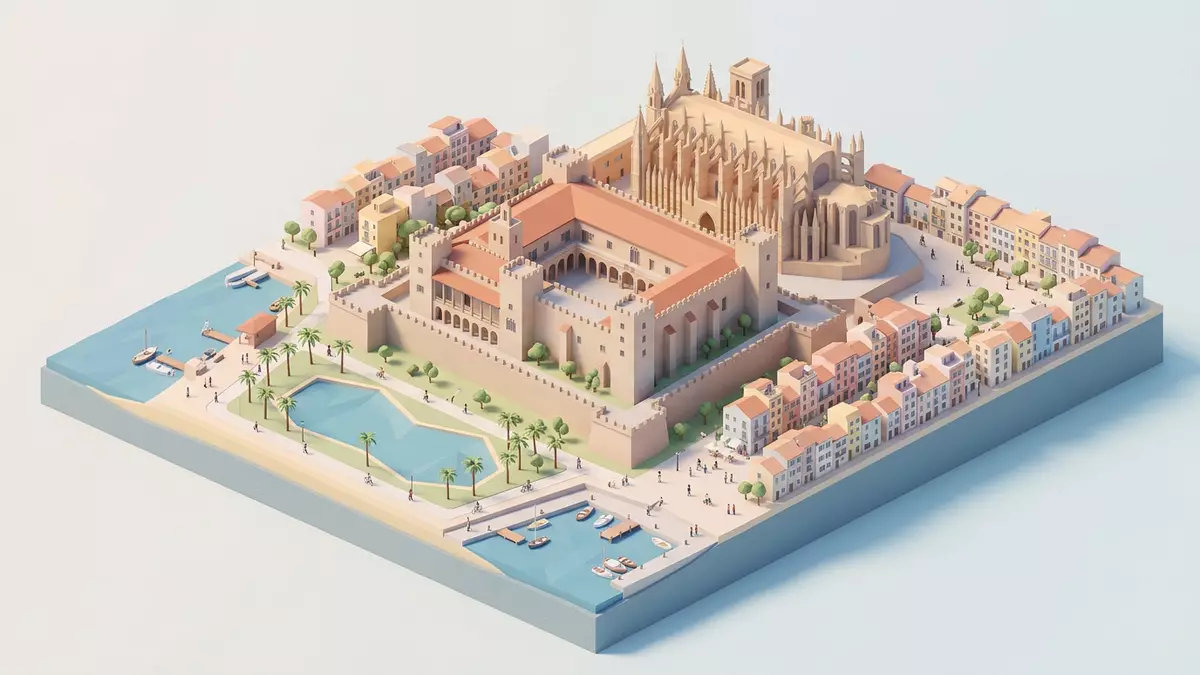
Palau de l'Almudaina in Palma is a stone royal palace that grew out of an Islamic fortress and was reshaped in the early fourteenth century into a Gothic residence for the kings of Majorca. Set on a terrace above the harbour and facing Palma Cathedral, it brings together layers of Roman, Muslim and Christian power in one fortified complex.
A fortress turned royal palace beside the cathedral
Palau de l'Almudaina stands on the edge of Palma’s old town, on the same site where Roman settlers established a fortified stronghold and later Muslim governors built their own stone citadel when Mallorca formed part of the Caliphate of Córdoba.Roman and Muslim phases Under Islamic rule in the tenth century, the complex became an alcazaba, a defended residence from which the walis administered Madina Mayurqa, the city that preceded modern Palma.tenth-century Arabian fortress
In 1229 Jaume I of Aragon conquered Mallorca, and the fortress began a gradual transformation into a Christian royal palace for the newly formed Kingdom of Majorca.conversion after the conquest The position opposite Palma Cathedral, known as La Seu, gives the palace and the great church a shared monumental front towards the sea, with the harbour at the foot of the terrace and the old town stretching inland.
Gothic rebuilding under the kings of Majorca
The appearance visitors see today is shaped above all by rebuilding in a Gothic style between 1305 and 1314, when James II of Majorca ordered major works to turn the fortress into a royal residence with ceremonial halls and chapels.Gothic transformation under James II This programme produced a rectangular palace with towers and rib-vaulted interiors that followed the defensive outline of the earlier citadel while introducing more regular halls.
Inside, one of the most significant surviving elements of this Gothic phase is the palatial chapel of Santa Anna, dated to the early fourteenth century and regarded as a clear example of classical Gothic architecture.Santa Anna chapel Sculptural work on the tympanum, corbels and vault keystones has been linked to Pierre de Guines and the Campredon workshop, tying the chapel into wider Mediterranean Gothic traditions.early-fourteenth-century works
Royal residence and ceremonial setting through the centuries
After the kingdom of Majorca was absorbed into the Crown of Aragon in the fourteenth century, Palau de l'Almudaina continued to serve royal and administrative functions, with monarchs of Majorca, Aragon and later Spain holding court within its walls.seat of successive monarchs From the sixteenth century onwards the complex housed courts, the residence of the viceroy and the captain general, making it a centre of island government as well as a royal residence.viceroy and captain general
In the early sixteenth century the upper floor was constructed on the orders of Charles V, Holy Roman Emperor, adding another layer to the palace’s architectural history.upper floor under Charles V The building later accommodated the Capitainerie General of the Balearic Islands and continues to function as an official royal residence for ceremonies and receptions, linking its medieval origins with contemporary state use.official royal residence
Visiting Palau de l'Almudaina: what travellers from Western Europe should know
- Palau de l'Almudaina stands in Palma’s historic centre on Carrer Palau Reial, directly opposite the Cathedral of La Seu and above the city’s harbour terraces.
- The palace occupies a raised stone platform with interior staircases and fortified passages; visiting involves walking over uneven surfaces and climbing steps between levels.
- Palma is served by Palma de Mallorca Airport to the east of the city, with road links and public transport connecting the airport to the central area around Palau de l'Almudaina.
- Spain’s official language is Spanish and the currency is the euro.
Searching for Palau de l'Almudaina on social platforms
These links open searches for Palau de l'Almudaina on each platform.
Frequently asked questions about Palau de l'Almudaina
Where is Palau de l'Almudaina?
Palau de l'Almudaina stands in the historic centre of Palma, the main city of Mallorca in Spain, on a terrace above the harbour opposite Palma Cathedral.
What can visitors expect inside the palace?
Visitors encounter fortified Gothic halls, royal apartments and the Santa Anna chapel, all set within a former Islamic citadel that retains elements of its earlier defensive layout.
What makes Palau de l'Almudaina distinctive among Mediterranean palaces?
Its character comes from the way a Roman and Islamic fortress was reshaped under James II of Majorca into a Gothic royal palace that still serves ceremonial functions for the Spanish monarchy.


