
Palau de l'Almudaina, Palma’s layered royal waterfront palace
Published on 08/24/2026 at 20:24 | Editorial responsibility: Rafael Müller, Editor-in-Chief AD HOC NEWS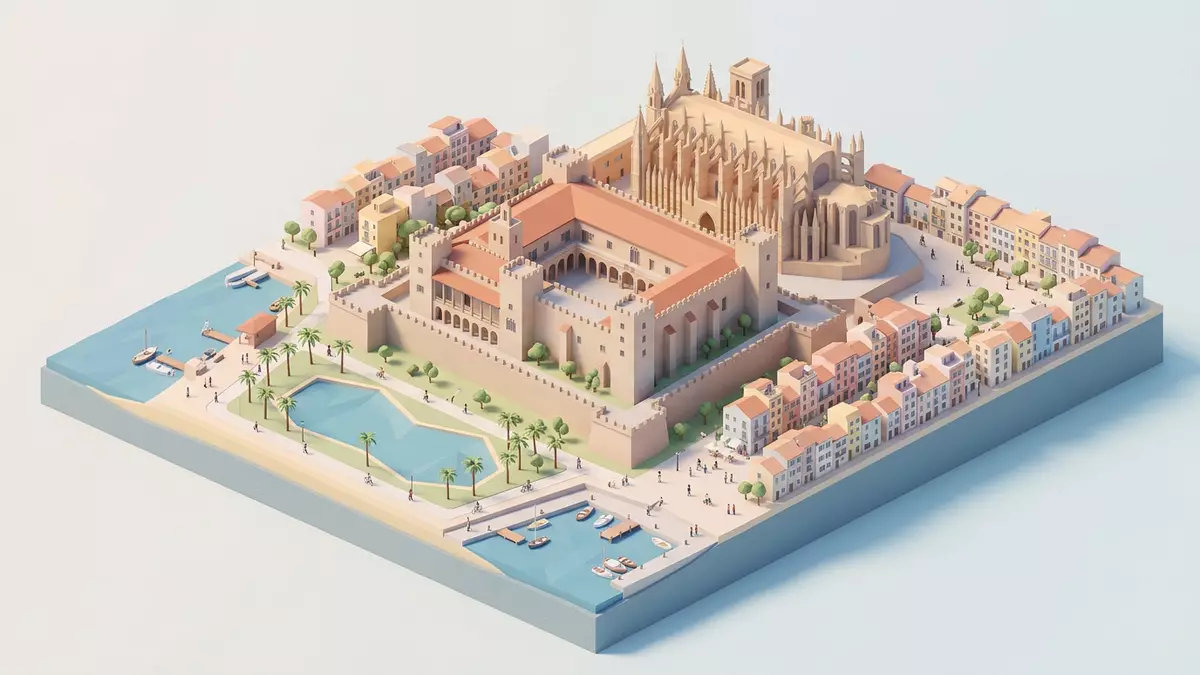
Palau de l'Almudaina in Palma is a fortified royal palace where Roman foundations, an Islamic alcázar and a Gothic residence for the kings of Mallorca share the same waterfront terrace. Built as a stronghold and reshaped between the thirteenth and fourteenth centuries, it remains an official residence of the Spanish royal family and a stone record of shifting Mediterranean power.
A waterfront palace shaped by successive kingdoms
Palau de l'Almudaina stands beside the cathedral of Palma, overlooking the city’s harbour and tracing a line back to the Roman settlement on this site. The complex incorporates remains from a Roman fortification, which were later absorbed into an Islamic stronghold at Madina Mayurqa, forming a palatial quarter where government and defence were concentrated.Roman Palma and Islamic rule The Arabic name “Almudaina” itself derives from a word for a fortified citadel, reflecting its role long before it became a Christian royal palace.the Arabic term for fortress
Christian rule arrived with King James I of Aragon in 1229, when his forces took Mallorca and the former Muslim citadel entered a new phase as a seat of Christian power.James I of Aragon in 1229 From 1281, the complex was progressively reshaped as a residence for the monarchs of the Kingdom of Majorca, with major alterations beginning in 1305 under King James II of Majorca.major alterations began in 1305 Construction continued into the fourteenth century during the reigns of James II, Sancho of Majorca and James III, giving the palace much of the outline recognised today.construction from 1281 to 1343
Gothic walls with Islamic echoes
The current palace presents a mainly Levantine Gothic profile, with a rectangular plan flanked by towers and seaward-facing façades defined by arcades and battlements.dominant Gothic Levantine style The layout preserves the central enclosure of the medieval fortress with prominent corner towers and the Ángel tower, whose Gothic weather vane was placed there during the reign of King Sancho of Majorca.central enclosure and Ángel tower Along the seafront side, Gothic balustrades and pointed arches reflect the language of the fourteenth-century royal builders.
Inside, the ground floor rooms retain a medieval character, with displays ranging from fifteenth-century pieces to later decorative arts.medieval ground-floor decoration The interior also carries a strong Mudéjar imprint, visible in timber ceilings and ornament that fuse Islamic and Christian artistic traditions.pronounced Mudéjar interiors The result is a palace where Gothic halls, Islamic details and later royal refurbishments coexist rather than replace one another.
From medieval court to royal residence
During the fourteenth century, Palau de l'Almudaina served as the main residence and ceremonial centre of the Kingdom of Majorca under its local dynasty.seat of the Kingdom of Majorca In 1349 it passed into the hands of Peter IV of Aragon, binding the building into the wider territories of the Crown of Aragon and, later, the Spanish monarchy.passed to Peter IV in 1349 Monarchs of Aragon and Spain held court here over subsequent centuries, and in the first half of the sixteenth century an upper floor was constructed on the orders of Charles V, Holy Roman Emperor.upper floor built under Charles V
La Almudaina forms part of Spain’s network of royal sites and is managed as a royal palace by Patrimonio Nacional.Royal Palace of La Almudaina It is recognised as the historic royal palace of Mallorca and remains an official residence of the Spanish royal family, used for ceremonial functions when the monarch is on the island.historic royal palace and official residence The palace therefore links the medieval kingdom to the present Spanish state through continuous royal use.
Visiting Palau de l'Almudaina: what travellers from Western Europe should know
- Palau de l'Almudaina stands in central Palma on Mallorca, directly beside the cathedral and above the city’s waterfront promenade, within walking distance of the historic old town streets.
- Inside the palace, staircases, uneven historic floors and stone corridors form part of the route, so visits involve walking and climbing steps within an enclosed fortress layout.
- Palma is on the island of Mallorca in Spain; the official language is Spanish and the currency is the euro.
Searching for Palau de l'Almudaina on social platforms
These links open searches for Palau de l'Almudaina on each platform.
Frequently asked questions about Palau de l'Almudaina
Where is Palau de l'Almudaina located?
Palau de l'Almudaina stands in Palma on the island of Mallorca in Spain, directly beside the city’s cathedral and overlooking the harbourfront.
What can visitors expect inside the palace?
Visitors encounter Gothic halls, Mudéjar-influenced interiors and medieval rooms arranged around a fortified layout, with displays of historic furnishings and decoration across several periods.
What makes Palau de l'Almudaina distinctive among Mediterranean palaces?
Palau de l'Almudaina brings together Roman foundations, an Islamic alcázar and a Gothic royal residence, while continuing to function as an official Spanish royal palace.


