
Palazzo Ducale and the Gothic architecture of Venice
Published on 09/22/2026 at 11:12 | Editorial responsibility: Rafael Müller, Editor-in-Chief AD HOC NEWS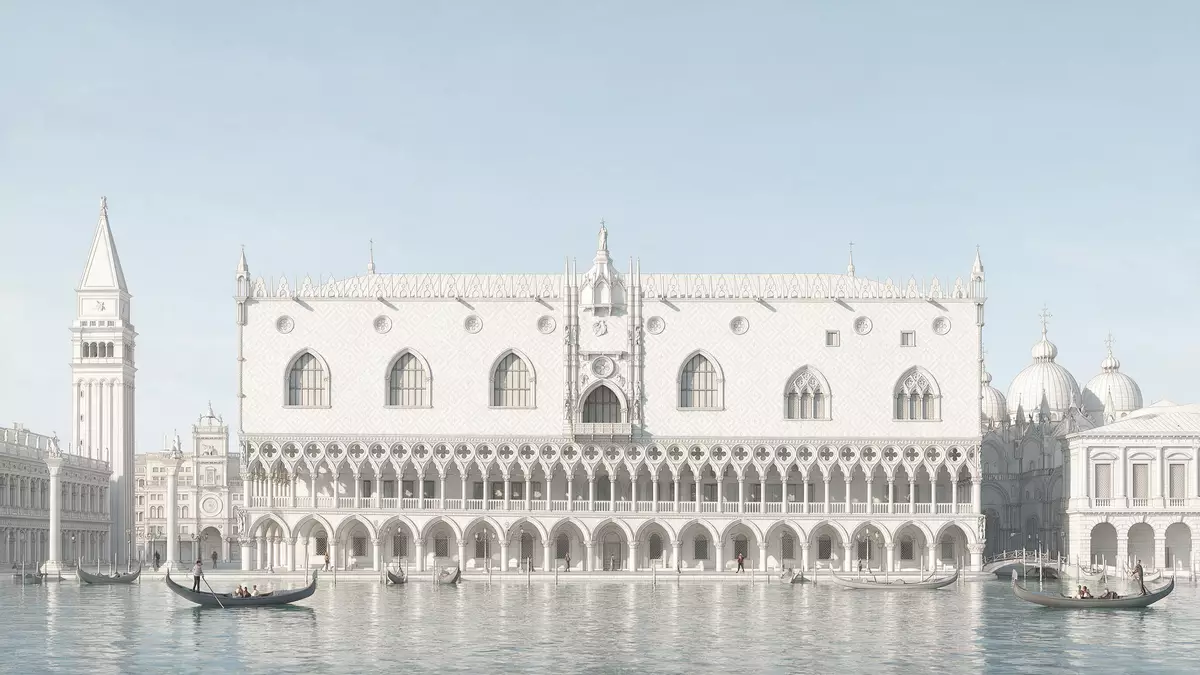
Palazzo Ducale rises beside the Venetian lagoon as a palace, civic seat and architectural composition of pale stone, carved detail and open loggias. Its present form brings together medieval building traditions, Gothic decoration and the political history of the Republic of Venice.
Palazzo Ducale beside the Venetian lagoon
Palazzo Ducale stands at the eastern end of Piazza San Marco, adjoining the Basilica of San Marco and facing the waterfront of the Riva degli Schiavoni. Its outer walls combine patterned stone surfaces with arcaded openings, creating a building that appears both solid and permeable.
The palace belongs to Venice’s San Marco district and forms part of the city’s most concentrated group of historic buildings. The lagoon, the piazza, the basilica and the palace meet within a small urban setting shaped by water, stone and ceremonial routes. The building’s lower arcades open towards the square and waterfront, while its upper levels contain richly decorated rooms.
Gothic stonework and open arcades
White Istrian stone and coloured marble give Palazzo Ducale its distinctive exterior palette. The lower storeys are marked by arcades and columns, while the upper wall presents a broad surface above the open loggias. Carved capitals and geometric patterns appear throughout the façade.
The palace is associated with Venetian Gothic architecture, a style that combines pointed arches and tracery with the ornament and spatial language of the eastern Mediterranean. Its decoration includes sculptural details, repeating motifs and carefully arranged contrasts between masonry and voids. The exterior is not a simple block, but a layered composition of arcades, balconies, windows and wall surfaces.
The famous Porta della Carta forms the ceremonial entrance beside the basilica. Its sculpted frame connects the palace to the public spaces around Piazza San Marco. Inside, grand stairways lead towards halls decorated with paintings, gilded details and carved woodwork.
From ducal government to museum interiors
Palazzo Ducale served as the residence of the doge and the centre of government for the Republic of Venice. Councils, courts and administrative offices occupied different parts of the complex. The building therefore joined residential, political and judicial functions within one palace.
The Republic of Venice developed its institutions across centuries, and Palazzo Ducale changed through rebuilding, enlargement and decoration. Fire damage affected parts of the complex, followed by reconstruction and renewed artistic work. The palace’s fabric consequently contains several historical phases rather than one uninterrupted design.
Among the best-known interiors are the Sala del Maggior Consiglio, the institutional chambers and the rooms associated with the doge’s household. Monumental paintings cover large sections of the interior, with works connected to artists including Tintoretto and Veronese. The Bridge of Sighs links the palace with the former prison buildings across the canal.
Venice’s political system ended in 1797, when Napoleon’s forces occupied the city and the Republic fell. Palazzo Ducale then passed through different administrative uses before becoming part of Venice’s museum landscape. The rooms preserve the relationship between artistic display and state ceremony that shaped the palace.
Visiting Palazzo Ducale: what travellers from Western Europe should know
- Palazzo Ducale is beside Piazza San Marco in central Venice. It is reached through the pedestrian streets and squares of the historic centre, with waterbus stops along the nearby waterfront.
- The approach crosses bridges and paved pedestrian routes. Venice’s historic centre contains steps, narrow passages and uneven stone surfaces, while the palace itself includes staircases between its principal rooms.
- The palace stands beside the Basilica of San Marco and faces the Riva degli Schiavoni. The Bridge of Sighs connects its historic court and prison complex across the canal.
- The official language is Italian and the currency is the euro.
Searching for Palazzo Ducale on social platforms
These links open searches for Palazzo Ducale on each platform.
Frequently asked questions about Palazzo Ducale
Where is Palazzo Ducale?
Palazzo Ducale stands beside Piazza San Marco in Venice, next to the Basilica of San Marco and the waterfront promenade.
What can visitors expect inside?
The interior contains ceremonial halls, government rooms, courts, stairways and painted decorations associated with Venetian civic power.
What makes the palace distinctive?
Its combination of Gothic arcades, pale stone, patterned façades and political history gives Palazzo Ducale a character closely connected with Venice.


