
Palia Poli Rodou and the layers inside its medieval walls
Published on 09/24/2026 at 04:06 | Editorial responsibility: Rafael Müller, Editor-in-Chief AD HOC NEWS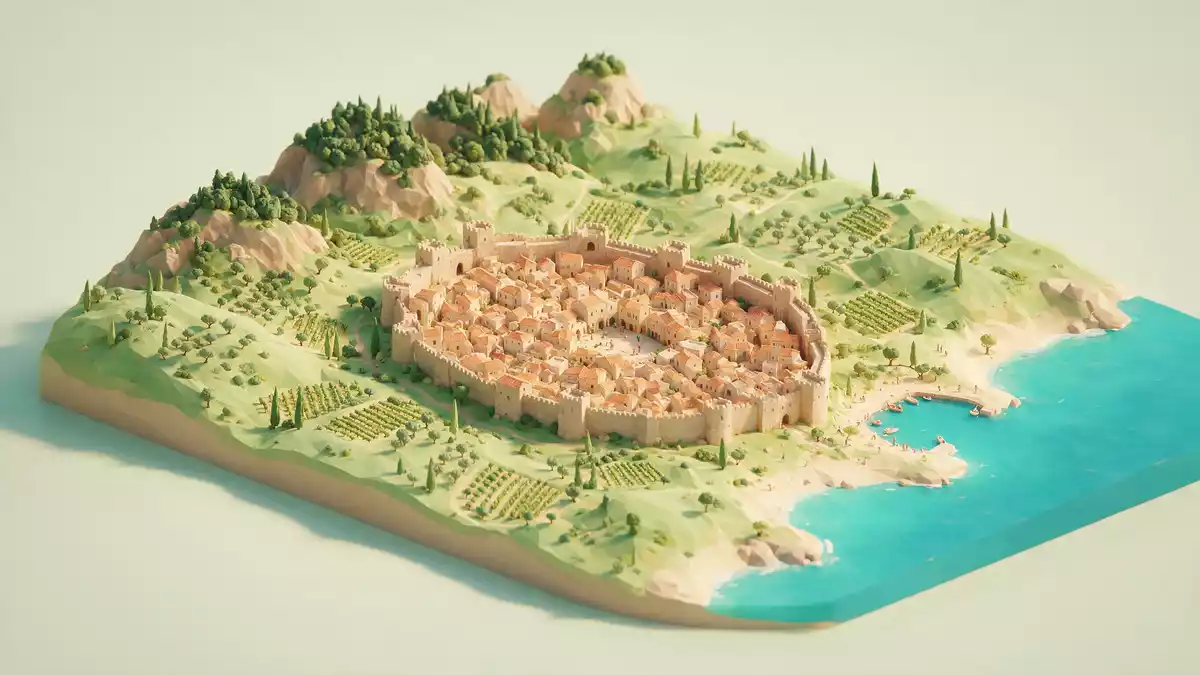
Palia Poli Rodou is the medieval city within the walls of Rhodos, where Gothic buildings, Ottoman monuments and inhabited streets occupy one fortified urban landscape. The stone enclosure gives the district its visible form, while the Street of the Knights, the Palace of the Grand Master and the lower town reveal different chapters of its history.
Palia Poli Rodou inside its stone walls
The medieval city lies within a wall about 4 km (2.5 miles) long. Its high town occupies the northern part of the enclosure, while the lower town extends towards the south and south-west. Gates, ramparts, towers and bastions define the edges of a neighbourhood that remains part of Rhodos.
The fortifications were maintained and remodelled between the fourteenth and sixteenth centuries. Artillery positions formed part of the later defensive arrangement, and the walls retain the heavy masonry associated with a city shaped by sieges. The 4 km-long city wall remains the clearest physical boundary between the medieval quarter and the newer city.
The Knights of Saint John and the Gothic high town
The Order of Saint John of Jerusalem occupied Rhodos from 1309 to 1523. During those centuries, the order transformed the city into a fortified headquarters, with the high town containing its principal religious, administrative and military buildings.
The Street of the Knights forms the best-known axis through this upper district. Its stone façades and former inns reflect the order’s organisation into “tongues”, or regional groups. The Palace of the Grand Master stands at the northern end, while the Great Hospital occupies another major position within the Gothic ensemble. The Street of the Knights connects these buildings through a narrow, cobbled urban corridor.
The Palace of the Grand Master, also called the Kastello, served as the residence of the order’s senior official and as an administrative centre. Its fortress-like exterior, large halls and stone details give the upper town a powerful architectural focus. The Great Hospital, built between 1440 and 1489, houses the Archaeological Museum of Rhodes.
Gothic, Ottoman and Jewish quarters
Palia Poli Rodou is not a single-style monument. The lower town contains Gothic structures beside mosques, public baths and houses associated with Ottoman rule. Islamic monuments include the Mosque of Suleiman and other mosques that occupied former churches after 1523.
The Jewish quarter adds another historic layer. Kahal Shalom Synagogue dates from the sixteenth century and remains connected with the Jewish history of Rhodos. Our Lady of the Castle also records changing uses, with Byzantine origins, a Gothic phase under the Knights and a later Islamic history.
Hippokratous Square lies near the Marine Gate, with streets leading towards shops, cafés and tavernas. Sokratous Street crosses the commercial part of the district, while smaller lanes lead towards churches, courtyards and residential buildings. The UNESCO World Heritage inscription dates from 1988 and covers the Medieval City of Rhodes as a layered historic settlement.
The city’s historical sequence continued under Ottoman and Italian rule. Italian reconstruction forms part of the urban history, while Ottoman additions remain visible in religious and domestic buildings. The result is a dense quarter where architecture from different periods appears within the same fortified frame.
Visiting Palia Poli Rodou: what travellers from Western Europe should know
- Palia Poli Rodou occupies the historic centre of Rhodos Town on the island of Rhodes, Greece. Local buses and taxis connect the town with Rhodes International Airport, while the harbour lies beside the old city.
- The streets include cobbles, uneven paving, narrow passages and staircases. Comfortable footwear and attention on the stone surfaces are practical necessities.
- The fortification walls, Palace of the Grand Master, Great Hospital, Street of the Knights and Ottoman monuments are distributed across the high and lower towns.
- The official language is Greek and the currency is the euro.
Searching for Palia Poli Rodou on social platforms
These links open searches for Palia Poli Rodou on each platform.
Frequently asked questions about Palia Poli Rodou
Where is Palia Poli Rodou?
Palia Poli Rodou is the medieval old town of Rhodos Town, on the island of Rhodes in Greece. It occupies the historic quarter enclosed by the city’s stone fortifications.
What can travellers see there?
The principal sights include the Palace of the Grand Master, Street of the Knights, Great Hospital, city walls, mosques, public baths, churches and Kahal Shalom Synagogue.
What makes the district distinctive?
Its defining character comes from Gothic, Byzantine, Ottoman and Italian layers preserved within one fortified urban settlement. The quarter combines monuments, commercial streets and residential buildings.


