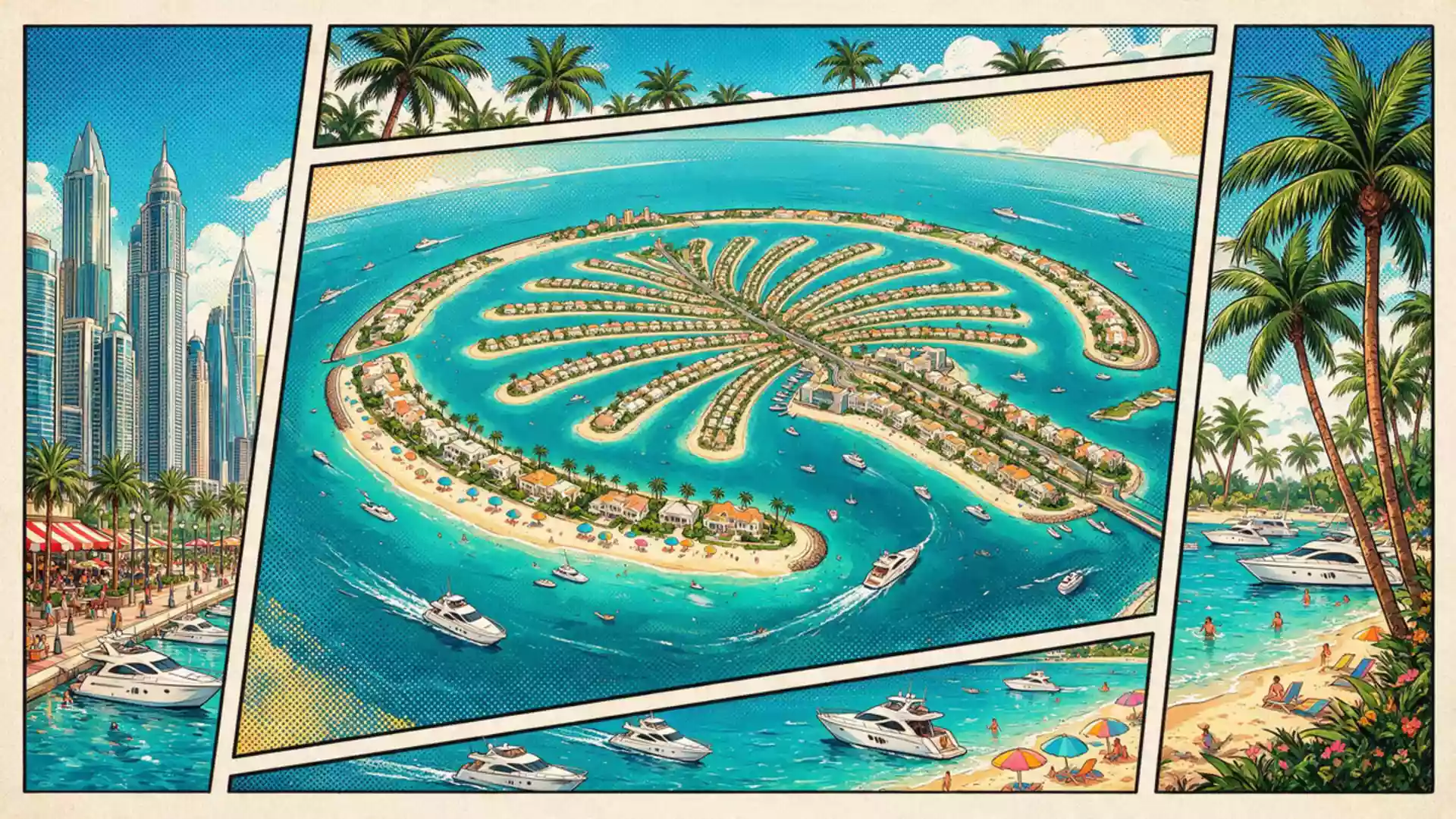
Palm Jumeirah’s palm?shaped shoreline in Dubai
Published on 08/20/2026 at 13:15 | Editorial responsibility: Rafael Müller, Editor-in-Chief AD HOC NEWS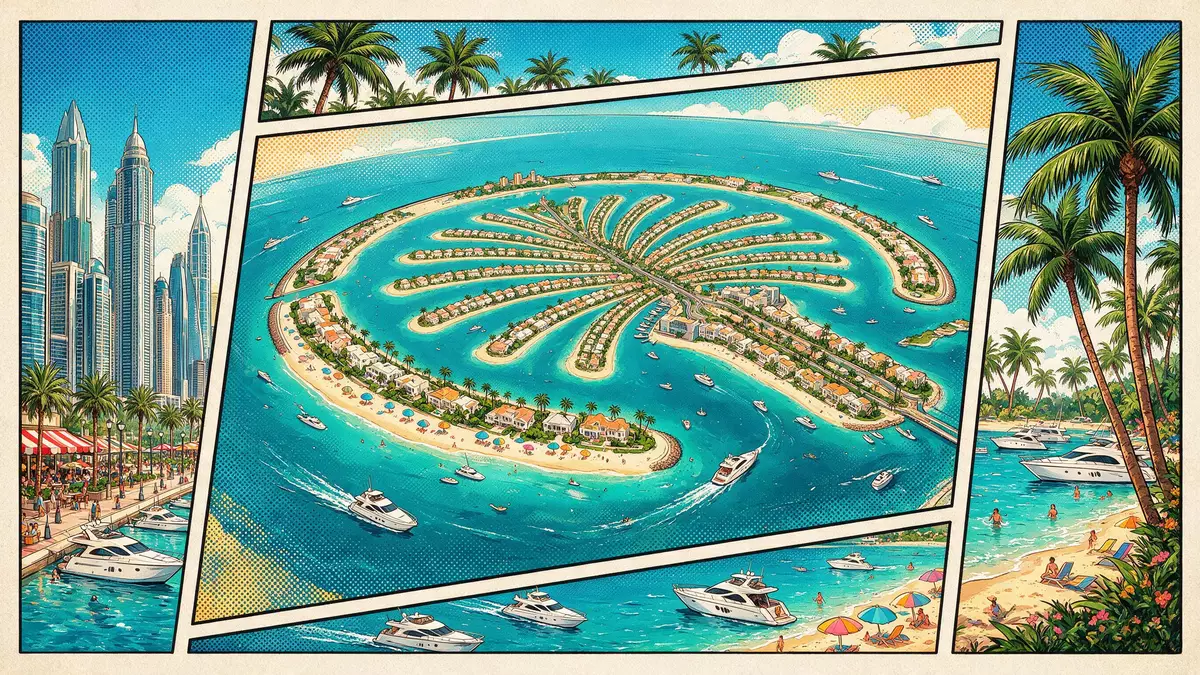
Palm Jumeirah in Dubai is an artificial archipelago shaped like a stylised palm tree, reclaimed from the waters of the Persian Gulf in the early twenty?first century. Its palm?tree plan, developed by Nakheel and master planned with input from the US firm Helman Hurley Charvat Peacock (HHCP), set out a new maritime district of villas, apartments and resort hotels built on sand and rock placed offshore.
A palm tree drawn at the scale of a district
The basic plan of Palm Jumeirah is immediately legible from any elevated viewpoint: a central trunk, radiating fronds and an outer crescent forming a protective breakwater. The overall footprint stretches several kilometres into the Gulf and adds many kilometres of waterfront to Dubai’s coastline, turning the outline of a date palm into a lived?in neighbourhood with streets, beaches and gardens laid out on reclaimed land.The trunk with 17 fronds is surrounded by the crescent, which curves around the outer edge as a sea wall.
The island is built from vast quantities of material dredged from the seabed and quarried on land, rather than resting on concrete platforms. Marine works for the Palm drew on large volumes of sand and rock, shaped into the palm outline with the help of satellite positioning and GPS?guided dredgers.The project used more than 110 million tonnes of sand and millions of tonnes of rock, creating a new landmass with long curving shorelines and sheltered inner waters.
From first construction in 2001 to a lived?in neighbourhood
Construction of Palm Jumeirah began in 2001, when marine reclamation works started pushing the palm outline out into the Gulf off the Jumeirah coastal strip of Dubai.By the middle of that decade the main landform was in place, and building plots along the fronds and trunk were prepared for villas, apartment towers and hotels. As the first residents moved in, the artificial island increasingly functioned as a residential district rather than a pure engineering showcase.
Palm Jumeirah is one of three palm?themed archipelagos planned off the coast of Dubai, alongside Palm Jebel Ali and the Dubai Islands. Of these, Palm Jumeirah is the completed and fully developed palm, and it has grown into a community with permanent residents as well as guest accommodation.Population figures published for 2022 place more than 25,000 people on the island, living in villas on the fronds and apartments along the trunk.
Hotels, monorail and the crescent at the edge of the Gulf
The crescent that wraps around Palm Jumeirah is more than a sea wall: it carries a continuous line of resort hotels facing both the open Gulf and the sheltered waters of the inner lagoon.Atlantis The Palm stands on the outer edge alongside the Aquaventure water park, marking the seaward tip of the development as a destination in its own right. Along the trunk, mid?rise apartment blocks and hotels line the main spine, while the fronds themselves carry rows of waterfront villas with private access to the sand.
A dedicated rail link runs along the trunk, carrying passengers between the gateway on the mainland and the hotel district near Atlantis. The Palm Monorail operates on the island, with stations serving points on the trunk and a terminus close to the Aquaventure complex at the outer end. A subsea road tunnel links the trunk to the crescent, taking vehicles beneath the inner waters to reach the outer ring of hotels without using a bridge along the surface.
Visiting Palm Jumeirah: what travellers from Western Europe should know
- Palm Jumeirah lies off the Jumeirah coastal area of Dubai, projecting into the Persian Gulf and linked to the mainland by a road bridge and the Palm Monorail.
- The development stands at sea level on reclaimed ground, with broad paved promenades, roadways and beaches rather than steep climbs or long staircases.
- The official language of the United Arab Emirates is Arabic and the currency is the UAE dirham (AED).
- Entry requirements depend on your nationality; UK travellers can check the FCDO travel advice at gov.uk/foreign-travel-advice, Irish travellers the Department of Foreign Affairs at ireland.ie.
Searching for Palm Jumeirah on social platforms
These links open searches for Palm Jumeirah on each platform.
Frequently asked questions about Palm Jumeirah
Where is Palm Jumeirah located?
Palm Jumeirah stands off the Jumeirah coastal area of Dubai in the United Arab Emirates, projecting into the Persian Gulf and connected to the mainland by bridge and tunnel.
What can visitors expect on a visit to Palm Jumeirah?
Visitors encounter a large artificial island laid out as a palm tree, with resort hotels on the crescent, apartments along the trunk and villa districts lining the residential fronds.
What makes Palm Jumeirah distinctive among coastal developments?
The island combines a clear palm?tree geometry, large?scale land reclamation using sand and rock, and a ring of waterfront hotels and homes built on a man?made shoreline.