
Pamukkale’s white terraces and ancient hillside city
Published on 08/14/2026 at 14:24 | Editorial responsibility: Rafael Müller, Editor-in-Chief AD HOC NEWS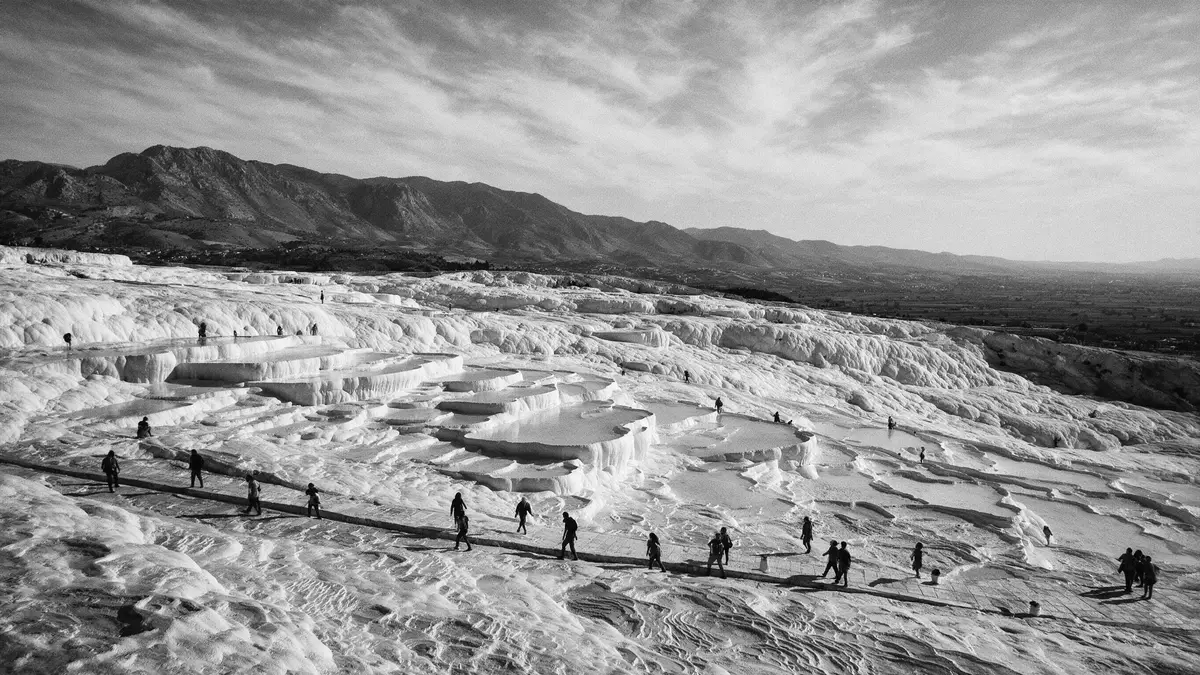
Pamukkale in Denizli Province in south-west Turkey is a hillside where luminous white terraces of mineral-rich water meet the ruins of the ancient city of Hierapolis. The combined landscape, recognised as Hierapolis-Pamukkale on the UNESCO World Heritage List since 1988, brings geology and history together on the same slope.
Water, limestone and a hillside of travertine
The defining feature of Pamukkale is a steep limestone cliff covered in bright terraces formed by mineral-rich thermal springs. As hot water emerges from underground and flows over the slope, it deposits calcium carbonate that hardens into travertine, a form of limestone known for building layered platforms and overhanging ledges.Pamukkale’s travertine terraces sit above the Menderes River plain, creating a contrast between the white cliff and the cultivated land below.The UNESCO description of a cliff almost 200 m high anchors the sense of scale.
The thermal springs that feed Pamukkale carry high levels of dissolved calcium carbonate, picked up as groundwater moves through buried limestones before rising along faults in Turkey’s inner Aegean region.The hot springs of Pamukkale contain calcium carbonate-rich water which precipitates as travertine where it meets the air. Over many thousands of years, this steady deposition has built mineral forests, overhanging flows that resemble frozen waterfalls and a dense stack of terrace rims stepping down the hillside.Geological accounts describe travertines forming for hundreds of thousands of years, so the landscape is still shaped by ongoing mineral build-up.
Hierapolis above the terraces
Above the travertine slope, the plateau holds the remains of Hierapolis, an ancient city built beside the springs that now feed the terraces below. Hierapolis formed part of the Greco-Roman world in western Anatolia and later passed through Byzantine and other periods, leaving a dense archaeological field of streets, gates, temples and bath complexes laid out on a high shelf of stone.The World Heritage inscription recognises Hierapolis-Pamukkale as a combined cultural and natural property, reflecting this pairing of ruins and travertine.
On the plateau, the remains of the city show a structured plan with long streets intersecting at right angles and lined with buildings, forming a grid that follows the line of the travertine cascades.Descriptions of Hierapolis refer to a Hippodamos grid system, giving the ruined city a clear urban order even in its broken state. Stone-built theatres, tombs and public buildings sit within view of the white slope; the fabric of the ancient town and the mineral landscape are therefore understood as parts of one setting, rather than as separate sites.
Stone, colour and the experience of the slope
From a distance, Pamukkale appears as a white band across the side of the hill, its travertine surfaces reflecting sunlight in a way that has given rise to the Turkish name meaning “cotton castle”.Explainers on the travertines highlight the meaning of Pamukkale as “Cotton Castle”, pointing to the light colour and textured forms that resemble piled fabric. The terraces themselves take the form of broad steps edged by mineral rims, with shallow basins behind them that catch flowing water where it is present.
Seen close up, the travertine surfaces show fine textures and ripples where mineral-rich water has overflowed and hardened, with some sections forming rounded protrusions and others smoothing into gently curving slopes. In places the travertine has built vertical faces that echo the idea of petrified waterfalls described in the World Heritage listing.The UNESCO entry mentions mineral forests and petrified waterfalls, capturing how the deposits mimic familiar shapes in solidified form. The overall impression is of a landscape made not only of rock and water but of time, with each terrace rim marking a long period of slow mineral accumulation.
Visiting Pamukkale: what travellers from Western Europe should know
- Pamukkale lies in Denizli Province in south-west Turkey, inland from the Aegean coast; the terraces and the ruins of Hierapolis stand above the plain north of the city of Denizli.
- The travertine slope is steep and covered in hardened mineral deposits; walking the site involves uneven surfaces, terrace edges and changes in gradient between the plateau and the lower hillside.
- Hierapolis occupies a plateau above the terraces; moving through the ruins means covering open ground between stone structures, with sections of ancient paving and occasional low steps or thresholds.
- The official language is Turkish and the currency is the Turkish lira.
- Entry requirements depend on your nationality; UK travellers can check the FCDO travel advice at gov.uk/foreign-travel-advice, Irish travellers the Department of Foreign Affairs at ireland.ie.
Searching for Pamukkale on social platforms
These links open searches for Pamukkale on each platform.
Frequently asked questions about Pamukkale
Where is Pamukkale and what kind of place is it?
Pamukkale is a landscape of travertine terraces and thermal springs on a limestone hill in Denizli Province in south-western Turkey, with the ruins of Hierapolis above the slope.
What should visitors expect when exploring Pamukkale?
A visit combines views of white terraces shaped by mineral-rich water with time among ancient streets and stone buildings on the plateau, with walking over uneven, inclined ground.
What makes Pamukkale distinctive compared with other ancient sites?
Pamukkale stands out for the close pairing of an extensive travertine terrace system and a planned ancient city, both recognised together as a mixed cultural and natural World Heritage property.


