
Panmunjom and the blue huts on Korea’s dividing line
Published on 09/12/2026 at 13:54 | Editorial responsibility: Rafael Müller, Editor-in-Chief AD HOC NEWS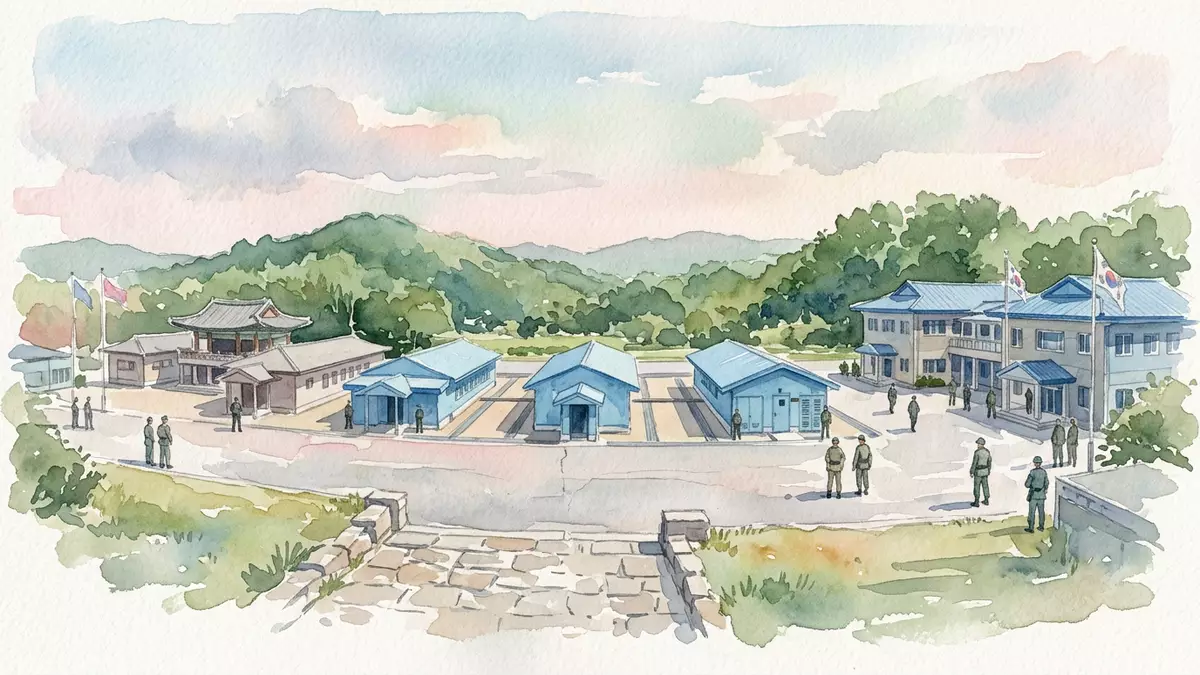
Panmunjom is a small settlement on the Korean Demilitarised Zone (DMZ) where the armistice ending active fighting in the Korean War was signed in 1953, and where military delegations from North Korea and the United Nations Command still face each other across a low concrete line. The former village site lies near Paju in South Korea and Gaeseong in North Korea, and the heart of the area is the Joint Security Area with its blue-painted conference huts straddling the Military Demarcation Line.
A truce village framed by war and ceasefire
Panmunjom began as a modest farming village on the road between Seoul and Gaeseong, close to the 38th parallel that became the rough dividing line between North and South Korea after the Second World War. During the Korean War in the early 1950s, the settlement became the venue for prolonged armistice talks between representatives of the United Nations forces on one side and North Korean and Chinese commanders on the other, with formal negotiations running between 1951 and 1953.
The armistice agreement that paused the Korean War was signed at Panmunjom on 27 July 1953, in a building that still stands on the northern side and is now known as the North Korea Peace Museum. The agreement established the DMZ as a buffer zone roughly 4 km (2.5 mi) wide, stretching across the peninsula, with Panmunjom situated within it as a designated meeting point for armistice commissions and later inter-Korean contacts.Armistice history at Panmunjom The area is sometimes described as a truce village because civilian settlement was removed and military oversight took its place.
The Joint Security Area and the blue conference huts
South of the original village site, the Joint Security Area (JSA) was laid out as a square compound where North Korean soldiers and personnel of the United Nations Command stand almost within arm’s reach of each other. The JSA is about 800 m wide and 400 m long, with a central row of single-storey conference buildings aligned along the Military Demarcation Line so that one half of each room is in North Korea and the other in South Korea.
The best-known structures are the blue-painted conference huts used for meetings between the two sides, with doorways facing the border markers and guards posted nearby, while larger halls such as Freedom House and the Peace House stand further back on the southern side.Panmunjeom Joint Security Area description A concrete slab running just a few centimetres high marks the Military Demarcation Line through the compound, and crossing it inside an authorised meeting counts as a symbolic step between the two states. The JSA lies a short distance south of the site of the original village, but the name Panmunjom is widely used for both the historic settlement and the compound.
Panmunjom as a continuing meeting place
After 1953, Panmunjom became the formal address for the Military Armistice Commission and the Neutral Nations Supervisory Commission, with liaison officers and guards from several countries stationed there under the armistice framework. Over the decades, the same small group of buildings has hosted inter-Korean talks, military negotiations and occasional summits, making the frontier both visibly tense and administratively functional at the same time.Panmunjom as a venue for inter-Korean talks
Panmunjom also forms part of guided itineraries into the DMZ arranged through designated tour operators, with visitors brought to viewing points around the Joint Security Area and briefed on its history under strict rules and military supervision. The surrounding landscape is unexpectedly rural, with the Sa’cheon stream and low hills nearby, yet the presence of watchtowers, fences and armed guards underlines that this is one of the most closely monitored border zones in the world.Geographical setting of Panmunjom
Visiting Panmunjom: what travellers from Western Europe should know
- Panmunjom lies within the Korean Demilitarised Zone, north of Seoul in South Korea, with tour coaches approaching through Paju towards the Joint Security Area.
- The area around the Joint Security Area has hardened surfaces and some uneven ground, with steps inside and around the conference halls and observation platforms.
- The official language is Korean and the currency is the South Korean won.
- Entry requirements depend on your nationality; UK travellers can check the FCDO travel advice at gov.uk/foreign-travel-advice, Irish travellers the Department of Foreign Affairs at ireland.ie.
Searching for Panmunjom on social platforms
These links open searches for Panmunjom on each platform.
Frequently asked questions about Panmunjom
Where is Panmunjom?
Panmunjom is in the Korean Demilitarised Zone near Paju in South Korea and Gaeseong in North Korea, north of Seoul along the corridor towards the 38th parallel.
What can visitors expect on a trip to Panmunjom?
Visitors on organised tours are taken to observation points around the Joint Security Area, seeing the blue conference huts, the Military Demarcation Line and guarded frontier installations under close supervision.
What makes Panmunjom distinctive compared with other border areas?
Panmunjom combines its role as the 1953 armistice signing site with the Joint Security Area where representatives of North Korea and the United Nations Command still meet within one compact compound.


