
Parque Nacional Talampaya and its Triassic sandstone walls
Published on 08/14/2026 at 14:09 | Editorial responsibility: Rafael Müller, Editor-in-Chief AD HOC NEWS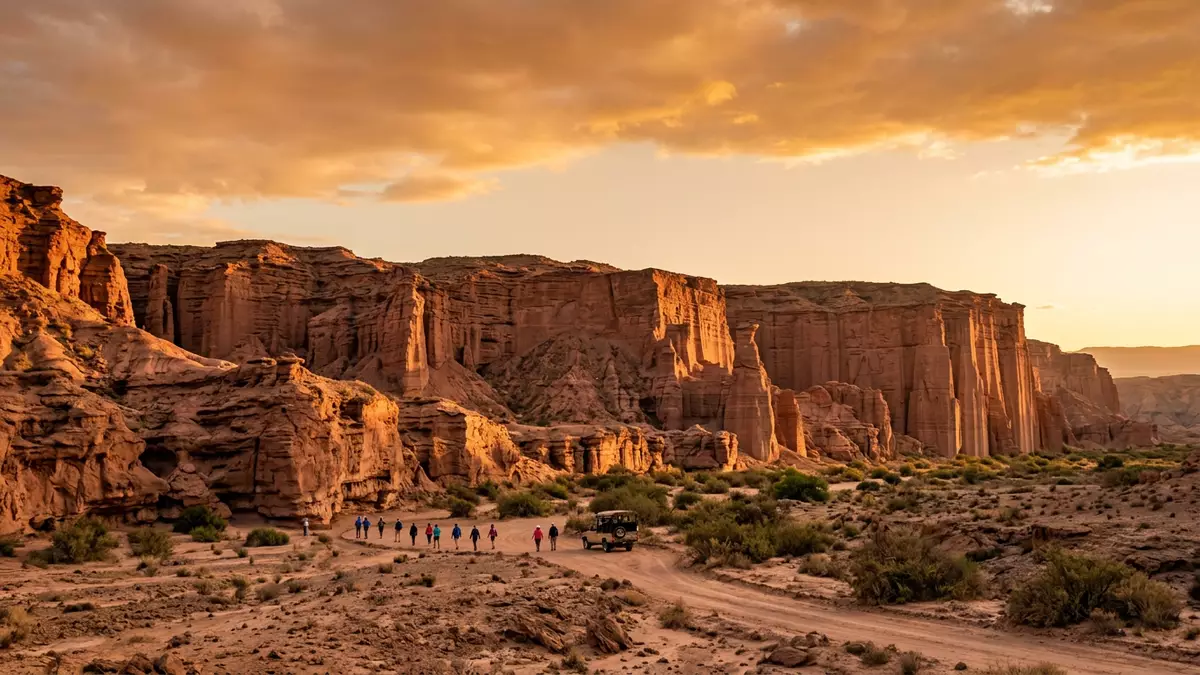
Parque Nacional Talampaya in La Rioja, Argentina is a protected desert landscape where vertical red sandstone cliffs frame a broad canyon floor and Triassic fossils lie in the surrounding strata. The park forms part of the Ischigualasto–Talampaya Natural Parks, recognised as a UNESCO World Heritage Site for preserving a complete sequence of continental sediments from the Triassic Period.Ischigualasto–Talampaya Natural Parks
Red sandstone canyon in the Monte desert
Talampaya lies in the centre–west of La Rioja Province, in the Monte de Sierras y Bolsones ecoregion, a band of arid basins and mountain ranges on the inland side of the Andes.Monte de Sierras y Bolsones ecoregion Within this dry environment the park’s main canyon cuts through reddish sedimentary rocks, exposing cliffs that rise high above a wide sandy floor. Sparse desert vegetation clings to terraces and slopes, leaving the geology largely visible.
The protected area covers more than 213,000 hectares, giving space for long stretches of canyon, open plains and mesas shaped by wind and occasional water flows.Talampaya National Park area Many of the cliffs show vertical faces where the sandstone appears layered, highlighting the gradual accumulation of sediments over millions of years. In places, freestanding rock formations stand out against the sky, separated from the main walls by erosion.
Triassic fossils and World Heritage status
Talampaya is part of a larger geological unit extending across La Rioja and neighbouring San Juan, where fossil-bearing rocks record the entire Triassic Period of Earth’s history.Triassic fossil sequence Within the park, palaeontological sites have yielded remains of early vertebrates, including ancestors of mammals and other groups that help trace the evolution of life on land.
The park’s importance for geology and palaeontology contributed to its inscription on the UNESCO World Heritage List in 2000, alongside Ischigualasto Provincial Park in San Juan.World Heritage inscription in 2000 Talampaya itself became a provincial park in 1975 and was later reclassified as a national park in 1997 under Argentine law.National park since 1997 The protected status supports conservation of both fossil sites and archaeological remains linked to human use of the region.
Access, routes and desert conditions
The main access to Parque Nacional Talampaya runs from the west of La Rioja Province along National Route 76, which links the park with towns such as Villa Unión and the junction at Patquía.Access via National Route 76 From the entrance area, internal routes follow the canyon and neighbouring valleys, with guided excursions using authorised vehicles and walking sections on the canyon floor where conditions permit.
The terrain inside Talampaya is that of a high desert, with strong sun exposure, loose sand underfoot and occasional rocky surfaces shaped by erosion. Some viewpoints lie above the canyon floor and are reached by short climbs, while other sections involve walking on relatively level ground between the cliff bases and scattered shrubs. Seasonal changes affect temperature and weather, and rain can lead to temporary water flow through the canyon and across the plains.
Visiting Parque Nacional Talampaya: what travellers from Western Europe should know
- Parque Nacional Talampaya lies in the west of La Rioja Province in northern Argentina and is reached mainly by road along Ruta Nacional 76 from towns such as Villa Unión.
- The terrain is arid and elevated, with stretches of deep sand, exposed rock and limited shade, so walking routes across the canyon floor and viewpoints involve uneven surfaces and temperature extremes.
- The official language is Spanish and the currency is the Argentine peso.
- Entry requirements depend on your nationality; UK travellers can check the FCDO travel advice at gov.uk/foreign-travel-advice, Irish travellers the Department of Foreign Affairs at ireland.ie.
Searching for Parque Nacional Talampaya on social platforms
These links open searches for Parque Nacional Talampaya on each platform.
Frequently asked questions about Parque Nacional Talampaya
Where is Parque Nacional Talampaya located?
Parque Nacional Talampaya is in the centre–west of La Rioja Province in northern Argentina, reached by road along National Route 76 from the west of the province.
What can visitors expect on a visit to Talampaya?
Visitors encounter a broad desert canyon with high red sandstone cliffs, sparse vegetation, sandy ground and guided routes that follow the canyon floor and nearby valleys.
What makes Parque Nacional Talampaya distinctive?
Talampaya stands out for its combination of towering sandstone walls and fossil-rich Triassic rocks, recognised through its inclusion in the Ischigualasto–Talampaya World Heritage listing.


