
Philae Temple on Agilkia Island: Isis between Nile and rock
Published on 08/18/2026 at 14:59 | Editorial responsibility: Rafael Müller, Editor-in-Chief AD HOC NEWS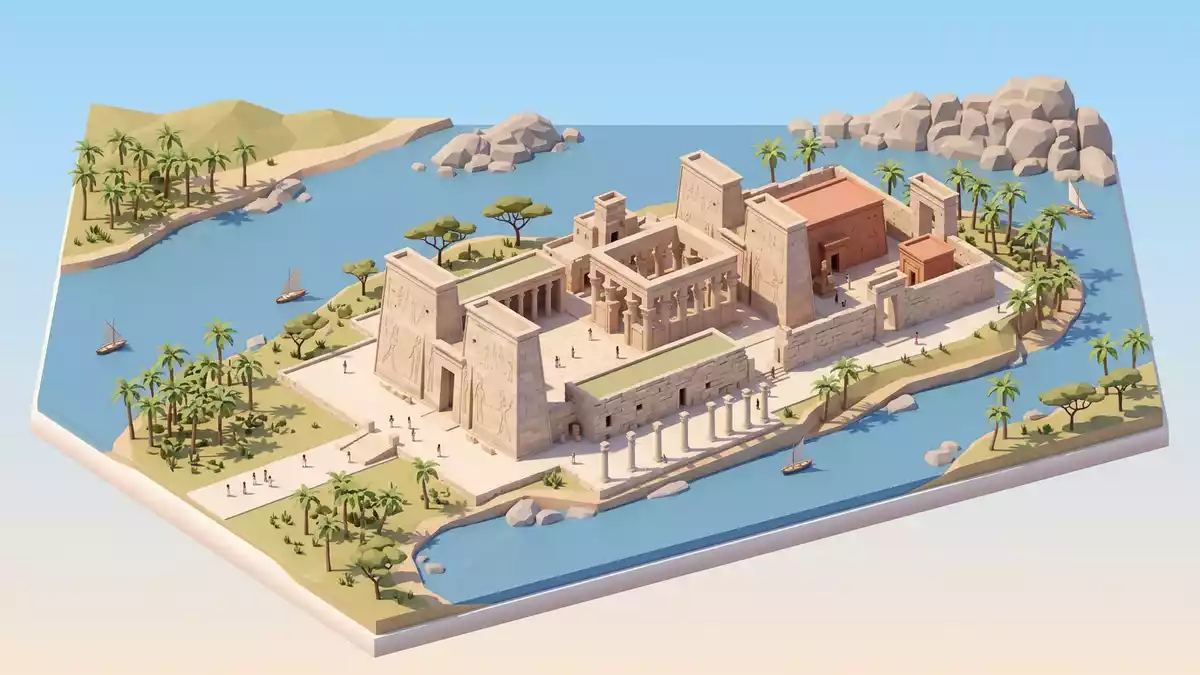
Philae Temple near Assuan in southern Egypt is an ancient sanctuary dedicated to Isis that now rises from Agilkia Island in the Nile, rebuilt stone by stone after the Aswan dams threatened to drown its original home. The complex brings together late pharaonic, Ptolemaic, Roman and Christian layers in one compact ensemble of pylons, courts and colonnades.
Isis on the Nile: an island sanctuary reassembled
The story of Philae Temple begins on a small rocky island once sacred to Isis near the First Cataract of the Nile, a stretch of shallow rapids that long marked the traditional frontier between Egypt and Nubia. From early Egyptian times the site was associated with the goddess of magic, healing and motherhood, and shrines to her stood on Philae Island long before the imposing stone temple that visitors know today.early Egyptian times Over centuries Philae became a place of pilgrimage and a key stopping point on river journeys through Upper Egypt.place of pilgrimage
The main stone temple that defines the site today belongs to the Ptolemaic period, when Greek rulers governed Egypt but continued to honour its gods. Construction of the principal Temple of Isis was begun under Ptolemy II Philadelphus in the third century BC, building on earlier sanctuaries to create a grand axial complex aligned with the river.Ptolemy II Philadelphus Reliefs and inscriptions show Isis with her consort Osiris and their son Horus, linking the temple to ideas of royal legitimacy and rebirth that mattered deeply in ancient Egyptian religion.Isis, Osiris and Horus
Layers of history: from pharaohs to Christian carvings
Philae Temple is remarkable for the way successive periods of Egyptian history are inscribed on its stone. The sanctuary belongs to the late pharaonic and Ptolemaic eras in its core layout, yet Roman emperors added their own gateways and decorated walls, weaving imperial titulature into older religious scenes.four major epochs The complex remained in use as a centre of Isis worship into the Roman period, long after the traditional temples of the Nile Valley began to fade.
The longevity of Philae is striking: the temple complex is traditionally dated to the seventh or sixth century BC in its earliest form and continued to function as a pagan sanctuary until the sixth century AD, when the Byzantine emperor Justinian I ordered the closure of such cult centres.seventh or sixth century BC After that decree the main temple was converted into a church, with crosses carved over older hieroglyphic scenes and some images of deities deliberately defaced.converted into a Christian church A visit brings these overlapping layers into view: pharaonic reliefs share walls with later inscriptions, and the architecture bears marks of religious change that unfolded over more than a millennium.
Rescue and relocation to Agilkia Island
The position of Philae Temple on a low island close to the cataract gave it drama but left it exposed when modern dams reshaped the Nile. The construction of the Aswan Low Dam in the early twentieth century and the later Aswan High Dam in the 1960s led to water levels that repeatedly inundated Philae Island, leaving its monuments partially submerged for much of the year.submerged by floodwater For preservation this situation was untenable, and an international rescue effort was launched under the auspices of UNESCO.
Between the 1960s and 1980 Philae Temple was dismantled and moved in an operation often described as one of the most significant archaeological rescue campaigns undertaken. The complex was taken apart stone by stone and reassembled on nearby Agilkia Island, an outcrop in the Nile reservoir downstream from the Old Aswan Dam that had been reshaped to mirror the contours of the original site.relocated to Agilkia Island Accounts of the project describe tens of thousands of blocks being carefully numbered, transported and re-erected so that the rebuilt sanctuary on Agilkia preserves the spatial relationships of courtyards, colonnades and pylons familiar from its former island setting.stone by stone
Visiting Philae Temple: what travellers from Western Europe should know
- Philae Temple stands on Agilkia Island in the Nile near Assuan in southern Egypt; access is by boat from the riverbank, with small craft crossing to the island.
- Within the complex there are stone-paved courts and interior spaces linked by steps; the approach and exploration involve walking on uneven surfaces and climbing stairways.
- The wider setting is defined by the Nile reservoir and desert hills; from the temple terraces there are wide views over the water to rocky shores and dam structures in the distance.
- The official language is Arabic and the currency is the Egyptian pound.
- Entry requirements depend on your nationality; UK travellers can check the FCDO travel advice at gov.uk/foreign-travel-advice, Irish travellers the Department of Foreign Affairs at ireland.ie.
Searching for Philae Temple on social platforms
These links open searches for Philae Temple on each platform.
Frequently asked questions about Philae Temple
Where is Philae Temple located?
Philae Temple stands on Agilkia Island in the Nile close to Assuan in southern Egypt, having been relocated there from its original island.
What can visitors expect when exploring Philae Temple?
Visitors encounter Ptolemaic and Roman temple architecture dedicated to Isis, with decorated pylons, open courts, colonnades and interior chambers showing traces of later Christian use.
What makes Philae Temple distinctive among Nile temples?
Philae Temple is distinctive for its long continuity of cult into the sixth century AD and for the modern rescue that reassembled the whole complex on Agilkia Island after flooding threats.


