
Philae Temple on the Nile between granite and gods
Published on 09/09/2026 at 11:08 | Editorial responsibility: Rafael Müller, Editor-in-Chief AD HOC NEWS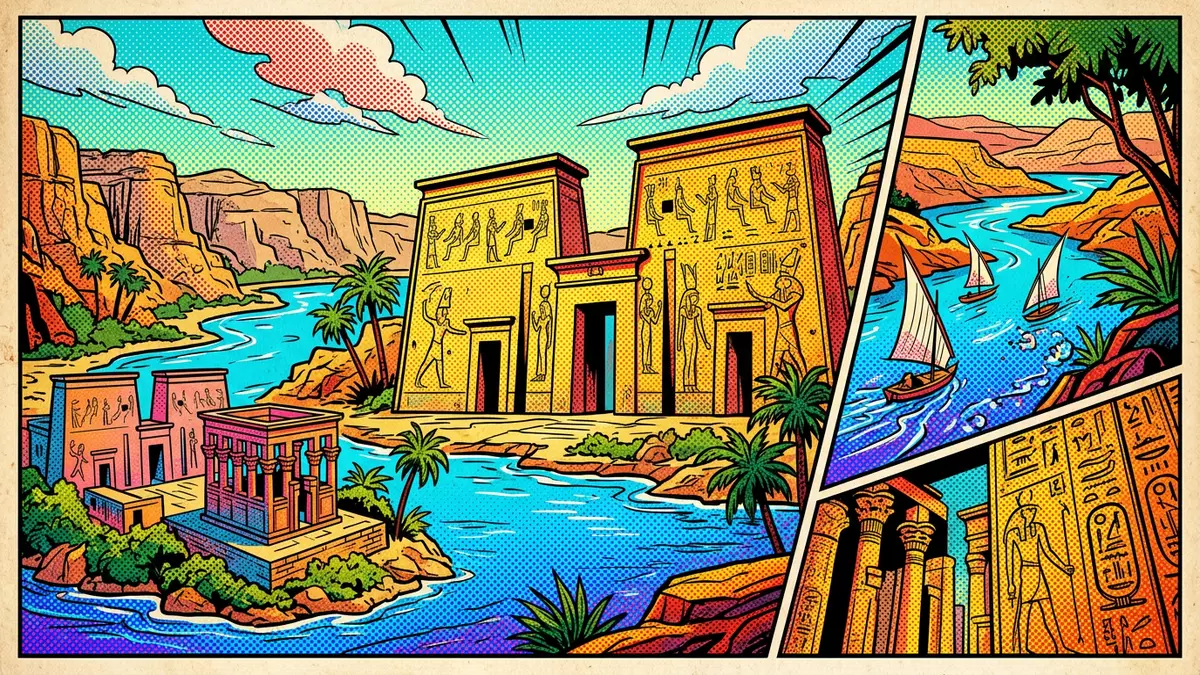
Philae Temple near Assuan in southern Egypt is a riverside sanctuary of Isis set on Agilkia Island, lifted stone by stone from its submerged original home in the Nile. The complex belongs to the ancient landscape of Nubia and preserves a sequence of monuments from the pharaonic, Ptolemaic, Roman and Christian periods in one concentrated island setting.
Granite island, water and stone
The temple complex occupies Agilkia Island in the reservoir between the Old Aswan Dam and the Aswan High Dam, with dark granite rocks forming a natural backdrop to its sandstone colonnades.island in the Nile From the water, the first impression is of pylons and columns rising directly from the river, framed by the low, rugged hills of Upper Egypt. Boats approach the landing at the edge of the island, where stone steps climb from the quay to the level of the monuments.
Once on the upper terrace, the arrangement of buildings becomes clear: a main axial temple of Isis aligned roughly south to north, flanked by smaller shrines, kiosks and gateways that step down towards the water.Ptolemaic-era temple complex The granite setting and the surrounding reservoir turn the island into a contained world of stone and water, with views out to the dams and desert beyond whenever the colonnades open towards the river.
Isis and the Ptolemaic builders
The dominant monument at Philae Temple is the great Temple of Isis, a sandstone sanctuary whose main body was begun under Ptolemy II Philadelphus in the third century BC.temple begun by Ptolemy II Philadelphus Isis, her husband Osiris and her son Horus were all honoured here, and the reliefs on the pylons and inner walls follow familiar scenes of offering, processions and divine encounters seen across Ptolemaic Egypt.Temple of Isis at Philae
The complex also preserves a longer building history. An earlier shrine to Isis from the fourth century BC under Nectanebo I once stood on the island, and later rulers from the Ptolemaic dynasty and Roman emperors extended and completed the sanctuary and neighbouring chapels.earliest building on Philae Around the main axis, visitors encounter the Kiosk of Trajan with its free-standing columns, a small Temple of Hathor and arches associated with Hadrian, all reinforcing Philae’s role as a religious centre during the Greco-Roman period.
From submerged isle to Agilkia Island
For most of antiquity the temples stood on Philae Island near the First Cataract of the Nile, but the construction of the Aswan dams brought the complex repeatedly under water and threatened its long-term survival.report on Philae rescue plan In the twentieth century an international campaign led by Egypt and UNESCO dismantled the monuments and reassembled them on the nearby, higher Agilkia Island, preserving the overall layout while protecting the stone from permanent submersion.dismantled and reassembled on Agilkia
The relocation work took place in the 1960s and 1970s as part of the wider Nubia Campaign, and it allowed Philae Temple, Abu Simbel and several other Nubian sites to continue as accessible monuments rather than archaeological remains under the reservoir.relocated during UNESCO Nubia Campaign Philae, Abu Simbel and neighbouring ruins later received recognition as a combined UNESCO World Heritage site, placing the island complex among the internationally protected monuments of the Nile.UNESCO World Heritage designation
Visiting Philae Temple: what travellers from Western Europe should know
- Philae Temple stands on Agilkia Island in the Nile reservoir south of Assuan, reached by road to the Shellal boat dock and then by motorboat across the water.
The approach combines a drive past the dams with a short crossing between granite headlands. - The landing on Agilkia Island connects to the monuments by stone steps, and routes through the complex involve walking over uneven sandstone paving and low gradients.
- The surrounding landscape includes views towards the Old Aswan Dam, the Aswan High Dam and the desert hills of Upper Egypt, with the river forming a broad sheet of water around the island.
- The official language is Arabic and the currency is the Egyptian pound.
- Entry requirements depend on your nationality; UK travellers can check the FCDO travel advice at gov.uk/foreign-travel-advice, Irish travellers the Department of Foreign Affairs at ireland.ie.
Searching for Philae Temple on social platforms
These links open searches for Philae Temple on each platform.
Frequently asked questions about Philae Temple
Where is Philae Temple located?
Philae Temple is located on Agilkia Island in the Nile near Assuan in southern Egypt, between the Old Aswan Dam and the Aswan High Dam.
What should visitors expect during a visit?
Visitors cross by motorboat to an island complex of sandstone temples and colonnades, then walk on stone paths and steps among relief-covered pylons and river views.
What makes Philae Temple distinctive among Egyptian sites?
The combination of a Ptolemaic Isis sanctuary, its rescue and relocation from a submerged island, and its setting within a dam reservoir together give Philae Temple a distinctive island character.


