
Piazza dei Miracoli, a walled lawn of stone and sky
Published on 08/20/2026 at 14:58 | Editorial responsibility: Rafael Müller, Editor-in-Chief AD HOC NEWS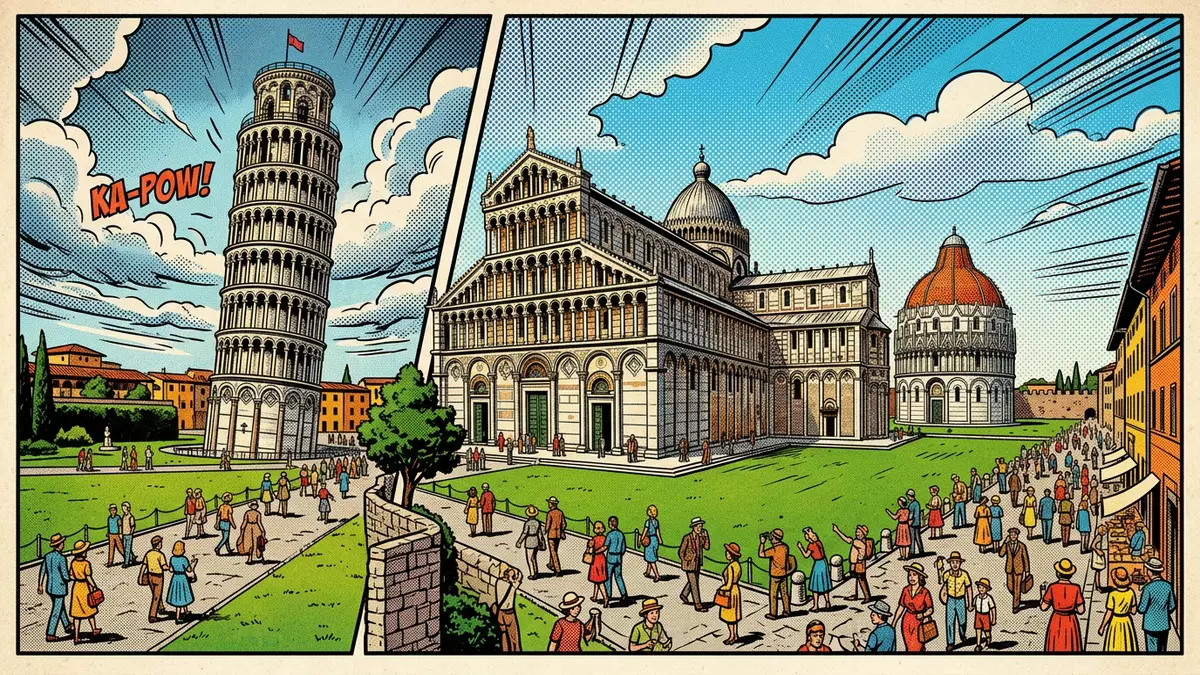
Piazza dei Miracoli in Pisa sets four great marble monuments on a single expanse of grass, enclosed by walls and open to the Tuscan sky. The square, formally known as Piazza del Duomo, crystallises the ambition of the Maritime Republic of Pisa between the eleventh and fourteenth centuries in one clearly bounded space.
A medieval ensemble on a walled green
Piazza dei Miracoli is a walled compound in the north-western part of Pisa, separated from the denser streets of the city by its enclosure and by the sweep of lawn within it.The square forms a distinct precinct where stone and grass meet in simple bands. Within this area stand the Cathedral of Santa Maria Assunta, the Baptistery of San Giovanni, the campanile known worldwide as the Leaning Tower of Pisa and the arcaded rectangle of the Camposanto Monumentale, grouped close together on the turf.The cathedral, baptistery, bell tower and cemetery all rise from the same green surface
The ensemble is recognised as a UNESCO World Heritage Site, one of the earliest Italian listings, and is formally inscribed under the name Piazza del Duomo, Pisa.UNESCO protection connects the four monuments as a single complex The square’s nickname, Piazza dei Miracoli, gained currency in the early twentieth century and underlines how the grassy field and the pale stone structures together form a single visual scene.
The cathedral and its leaning campanile
The Cathedral of Santa Maria Assunta anchors the composition of Piazza dei Miracoli. Construction of this medieval cathedral began in 1063 under the architect Buscheto, at a time when Pisa asserted itself as a maritime power in the Mediterranean.The building was consecrated in 1118 and presents a long nave with aisles and a façade layered with colonnaded arcades, combining elements of Romanesque architecture with local Pisan detailing in stone and marble. Inside, the cathedral’s plan and elevation give a sense of longitudinal depth, aligning the main axis with the green expanse outside.
Behind the cathedral stands its campanile, the Leaning Tower of Pisa, begun in 1173 with a circular plan and a shell of superposed arcades.The tower rises in stacked loggias around a core The tilt that made the tower a global reference point in architectural history developed during construction due to the ground below, and the visual relationship between the leaning campanile and the straight body of the cathedral becomes one of the square’s defining contrasts. The bell tower and church are linked visually by material and ornament, sharing the same light stone and repeated arches, yet they react differently to gravity in the visitor’s eye.
The Baptistery of San Giovanni and the Camposanto Monumentale
Opposite the west front of the cathedral stands the Baptistery of San Giovanni, a free?standing baptistery whose construction began in 1153 under the architect Diotisalvi.The structure combines a lower Romanesque zone with later Gothic decoration Its exterior presents a ring of columns and arches around a robust lower storey, with a crown of more intricate stonework added under Nicola Pisano and Giovanni Pisano in the thirteenth century. The baptistery’s mass occupies the grass directly before the cathedral, creating a balanced pair of volumes that visitors can circle entirely on the lawn.
Along one edge of Piazza dei Miracoli runs the Camposanto Monumentale, a walled cemetery laid out as an elongated cloister with an internal courtyard.Work on this monumental burial ground began in the late thirteenth century Inside its walls lie sarcophagi and tombs from different periods, set against a sequence of arcades that frame the sky and the grass beyond. The Camposanto closes the composition of the square on one side, mirroring the external walls that define the precinct and completing the allegory of life’s stages that later writers have read in the arrangement of baptistery, cathedral and cemetery.
Stone, grass and the geometry of space
The lead impression of Piazza dei Miracoli is the dialogue between built mass and open lawn. The monuments stand on a continuous field of grass that runs between and around them, so that every approach to the cathedral, baptistery, tower or Camposanto involves crossing the same soft surface. The marble and stone of the structures rise directly from this green base, creating a legible ground line that contrasts with the intricate arches, columns and cornices above.
The walls around the square frame this relationship in a simple rectangle, cutting the monuments off from the fabric of Pisa and giving them their own horizon. Viewed from one corner of the lawn, the visitor sees the baptistery catching the light on its layered roof, the cathedral stretching along the field, the leaning campanile stepping up behind it and the Camposanto drawing a long, pale boundary. In this arrangement, the square becomes a kind of stage on which the architecture presents itself as a sequence of volumes on a single plane of grass.
Visiting Piazza dei Miracoli: what travellers from Western Europe should know
- Piazza dei Miracoli lies on the north-western edge of central Pisa, within walking distance of the Arno and reached by city streets that lead towards the cathedral precinct.
- The monuments rise from a large, level lawn, and moving between the cathedral, baptistery, campanile and Camposanto involves walking on grass as well as paved paths.
- Pisa is connected to other Italian cities by rail, and travellers arrive at Pisa Centrale station or Pisa’s airport before continuing by local transport or on foot towards Piazza dei Miracoli.
- The official language is Italian and the currency is the euro.
Searching for Piazza dei Miracoli on social platforms
These links open searches for Piazza dei Miracoli on each platform.
Frequently asked questions about Piazza dei Miracoli
Where is Piazza dei Miracoli located?
Piazza dei Miracoli is in Pisa, in the Italian region of Tuscany, on the north-western side of the city close to the historical centre.
What can visitors expect to see on the square?
Visitors encounter the Cathedral of Santa Maria Assunta, the Baptistery of San Giovanni, the Leaning Tower of Pisa and the walled Camposanto Monumentale set on a shared expanse of grass.
What makes Piazza dei Miracoli distinctive among Italian squares?
The square gathers a cathedral, a baptistery, a leaning campanile and a monumental cemetery on one walled lawn, giving medieval religious architecture a clear geometric frame in stone and turf.


