
Piazza Navona’s baroque stage over ancient Rom
Published on 08/23/2026 at 11:37 | Editorial responsibility: Rafael Müller, Editor-in-Chief AD HOC NEWS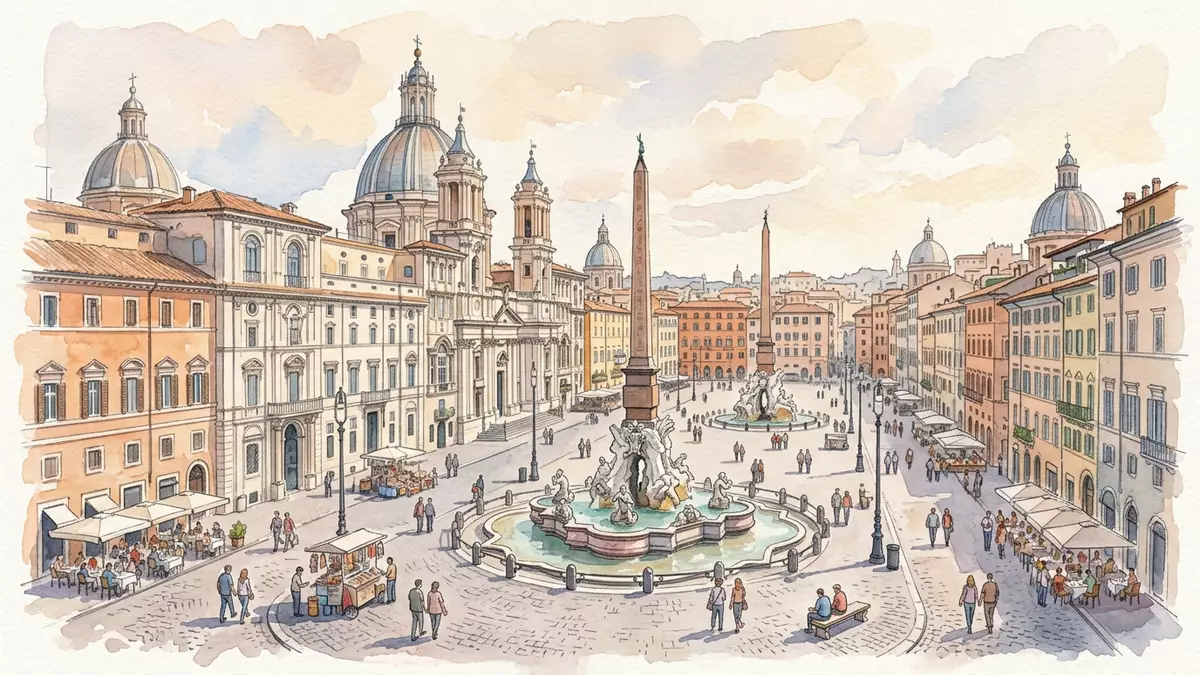
Piazza Navona in Rom is an elongated city square that follows the outline of the ancient Stadium of Domitian, turning a Roman arena into a baroque urban stage. Its present appearance dates to seventeenth-century interventions under Pope Innocent X, when fountains, palaces and the church of Sant’Agnese in Agone reshaped the former stadium interior into a theatrical open space.
From Domitian’s stadium to a Roman piazza
The distinctive long, gently curved plan of Piazza Navona preserves the footprint of the Stadium of Domitian, a masonry arena for athletic contests built in the first century AD under Emperor Domitian.the Stadium of Domitian Spectators once sat on stepped tiers around a central track; the square occupies the former arena where competitions took place.
After the imperial period, domestic buildings and churches gradually occupied the stadium’s structure, while the open interior evolved into a marketplace and gathering ground by the late fifteenth century.a marketplace in the fifteenth century The long space remained intact, so the later square still reads as a sporting arena in plan, with rounded ends and a broad central floor flanked by continuous building fronts.
Baroque façades and the Pamphilj court
The present baroque character of Piazza Navona emerged in the seventeenth century under Pope Innocent X Pamphilj, whose reign from 1644 to 1655 turned the square into a showpiece of his family’s influence.Pope Innocent X Pamphilj On the west side, the long façade of Palazzo Pamphilj stretches along the piazza, giving it the depth and rhythm of an aristocratic gallery facing the open space.
Opposite the palace rises the church of Sant’Agnese in Agone, associated with architects including Francesco Borromini, Girolamo Rainaldi and Carlo Rainaldi, whose work gives the piazza its highly recognisable baroque skyline of towers and domes.Sant’Agnese in Agone Between palace and church, the narrow streets of central Rom open into the bright paved rectangle of the square, where façades, cornices and balconies form a continuous architectural backdrop.
Three fountains along a former arena
The surface of Piazza Navona is punctuated by three fountains aligned along the stadium’s central axis, turning the former track into a sequence of sculptural water basins. At the centre stands the Fontana dei Quattro Fiumi, created between 1648 and 1651 by Gian Lorenzo Bernini for Innocent X and crowned by an ancient obelisk.Fontana dei Quattro Fiumi Travertine rock forms rise from the basin, carrying personifications of major rivers such as the Nile, Danube, Ganges and Rio de la Plata.
At the southern end of the square, the Fontana del Moro combines a basin by Giacomo della Porta from the 1570s with a later central figure of a Moor and marine creatures designed by Bernini, while the northern end is marked by the Fontana del Nettuno, whose sculptural group was completed in the nineteenth century with Neptune surrounded by sea figures.the three fountains The three fountains divide the long paved floor into zones, their basins reflecting the surrounding houses and churches where the stadium’s track once lay.
Visiting Piazza Navona: what travellers from Western Europe should know
- Piazza Navona lies within the historic centre of Rom, west of the Pantheon and not far from the bend of the River Tiber.
- The square is paved and level, with a broad open interior and narrow streets leading in, so walking surfaces are mostly stone with occasional kerbs.
- Public buses serve streets close to Piazza Navona, and central city bridges over the Tiber make it reachable on foot from other monuments in the historic core.
- The official language is Italian and the currency is the euro.
Searching for Piazza Navona on social platforms
These links open searches for Piazza Navona on each platform.
Frequently asked questions about Piazza Navona
Where is Piazza Navona in Rom?
Piazza Navona is in the historic centre of Rom, in Italy, west of the Pantheon and close to the River Tiber.
What can visitors expect when they arrive?
Visitors find a long stone-paved square lined with historic buildings, dominated by three sculptural fountains and the baroque façades of Palazzo Pamphilj and Sant’Agnese in Agone.
What makes Piazza Navona distinctive among Rom’s squares?
Piazza Navona stands out for its stadium-like shape traced from Domitian’s arena and for Bernini’s Fontana dei Quattro Fiumi with its obelisk at the centre of the space.


