
Piazza San Marco and its stone stage of power in Venedig
Published on 08/23/2026 at 10:11 | Editorial responsibility: Rafael Müller, Editor-in-Chief AD HOC NEWS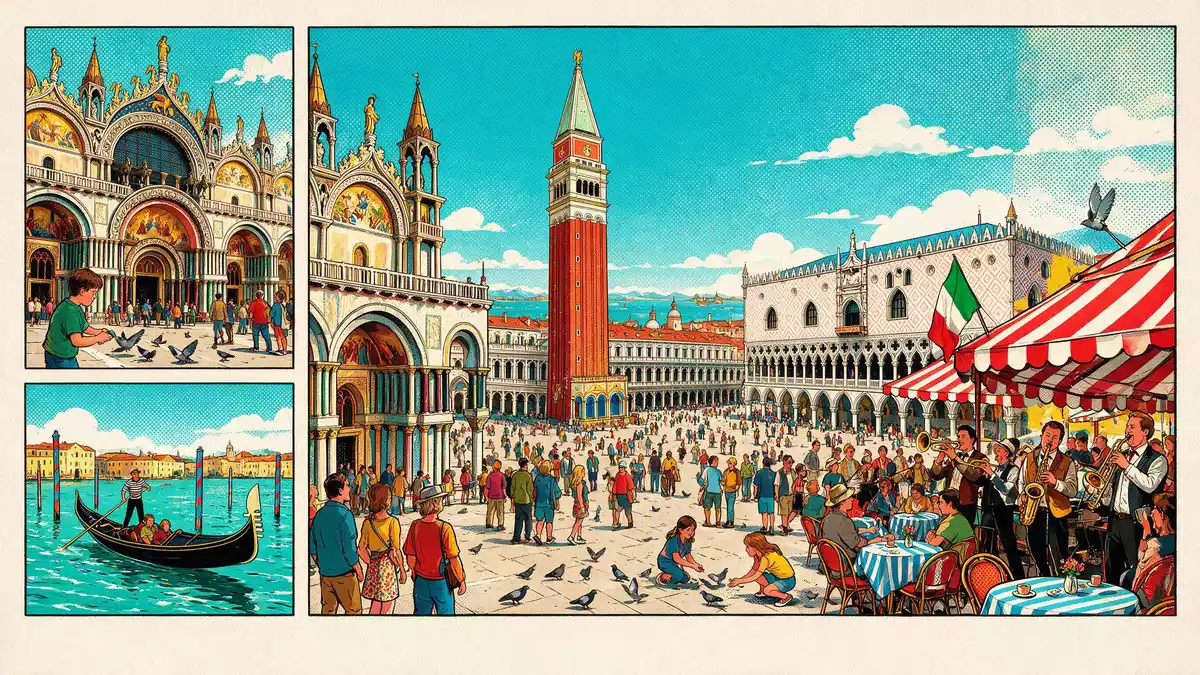
Piazza San Marco in Venedig is a long, gently widening stone square framed by arcades, a basilica, a bell tower and the Doge’s Palace, forming the historic civic stage of Venice, Italy. Its present outline grew from a smaller forecourt in front of St Mark’s Basilica and was reshaped in the twelfth century, when Doge Sebastiano Ziani enlarged the area to match the city’s growing power.
A single piazza at the heart of Venice
Piazza San Marco is the principal public square of Venice and the only open space in the city officially designated as a “piazza”; all other squares are known as “campi”, underlining its special role in the urban fabric.principal public square of Venice Together with the adjoining Piazzetta that runs towards the water, it forms a stone forecourt to the Venetian Lagoon, where ceremonial arrivals by boat once met the city’s formal architecture.
The square takes a trapezoidal plan, narrowing towards the Basilica di San Marco at the eastern end, so the façade of the church closes the perspective framed by the long arcades of the Procuratie. In front of the basilica stands the free-standing Campanile di San Marco, a tall brick bell tower that became a maritime landmark for ships entering the lagoon.St. Mark’s Bell Tower The square’s stone surface is laid out in a geometrical pattern of trachyte paving slabs, a design attributed to the Venetian architect Andrea Tirali in the eighteenth century.
From early forecourt to grand stone stage
The origins of Piazza San Marco lie in the ninth century, when it was a modest open area in front of an earlier church of St Mark that stood beside the doge’s residence.small area in front of the original St Mark's Basilica At that time, a canal known as Rio Batario crossed the space and separated the church precinct from the area that is now the main field of the piazza, while a dock lay between the Doge’s Palace and the water.
In the twelfth century the layout was transformed: the canal and dock were filled in and the square was enlarged to a shape recognisable today, aligned with the ceremonial and political importance of Venice under the doges.twelfth-century redesign under Doge Sebastiano Ziani The surface was paved with bricks laid in a herringbone pattern, then, in 1723, replaced by the present trachyte slabs and pale stone bands that elongate the perspective across the square.geometrical pavement design by Andrea Tirali Over centuries the piazza hosted religious ceremonies, state proclamations and civic gatherings, with its changing form mirroring Venice’s shifts in wealth and power.
An architectural ensemble of basilica, campanile and Procuratie
The eastern side of Piazza San Marco is dominated by the Basilica di San Marco, a multi-domed church whose present form took shape in the eleventh century and displays a blend of Byzantine, Gothic and later elements in its mosaics and sculptural decoration.St. Mark’s Basilica as an 11th-century masterpiece Beside it rises the Campanile di San Marco, rebuilt in the early twentieth century after a collapse in 1902, yet keeping the tall, simple profile that had long marked the skyline.Campanile collapse and rebuild
The long northern edge of the piazza is lined with the Procuratie Vecchie, arcaded buildings begun in the early sixteenth century to house the offices and apartments of the Procurators of St Mark, among the highest officials of the Venetian Republic.Procuratie Vecchie along the north side Opposite them, the Procuratie Nuove along the south side date from the late sixteenth and early seventeenth centuries, with architects such as Jacopo Sansovino and Vincenzo Scamozzi contributing to their Renaissance language of arches and paired columns.works of Sansovino, Longhena, Scamozzi and others At the western end, the Ala Napoleonica closes the perspective with another arcaded façade, creating a continuous architectural frame that turns the square into a room open to the sky.
Visiting Piazza San Marco: what travellers from Western Europe should know
- Piazza San Marco lies at the eastern end of Venice’s historic core, beside the Venetian Lagoon, and is reached on foot from central districts or by vaporetto waterbus stopping near the Riva degli Schiavoni.
- The square itself is level and paved with large stone slabs, but access to viewpoints such as the Campanile di San Marco involves stairways or lifts within tall structures.
- In wet weather the paving can be slippery and areas may be affected by high water from the lagoon, so raised walkways can appear across parts of the square.
- Several major landmarks stand immediately around the piazza, including the Basilica di San Marco, the Doge’s Palace, the Torre dell’Orologio clock tower and the Procuratie arcades.
- The official language is Italian and the currency is the euro.
Searching for Piazza San Marco on social platforms
These links open searches for Piazza San Marco on each platform.
Frequently asked questions about Piazza San Marco
Where is Piazza San Marco in Venice?
Piazza San Marco stands at the eastern edge of Venice’s historic centre beside the Venetian Lagoon, forming a stone terrace between the city and the water.
What should a visitor expect on a first visit?
A visitor encounters a broad paved square framed by arcades, with St Mark’s Basilica and the Campanile di San Marco rising at one end and the Doge’s Palace close by.
What makes Piazza San Marco distinctive among Venetian squares?
Piazza San Marco is distinctive as the only square in Venice formally called a “piazza”, and as a single architectural ensemble of basilica, campanile, Procuratie and lagoon-facing Piazzetta.


