
Piazza San Marco and its stone stage of Venetian power
Published on 08/14/2026 at 14:48 | Editorial responsibility: Rafael Müller, Editor-in-Chief AD HOC NEWS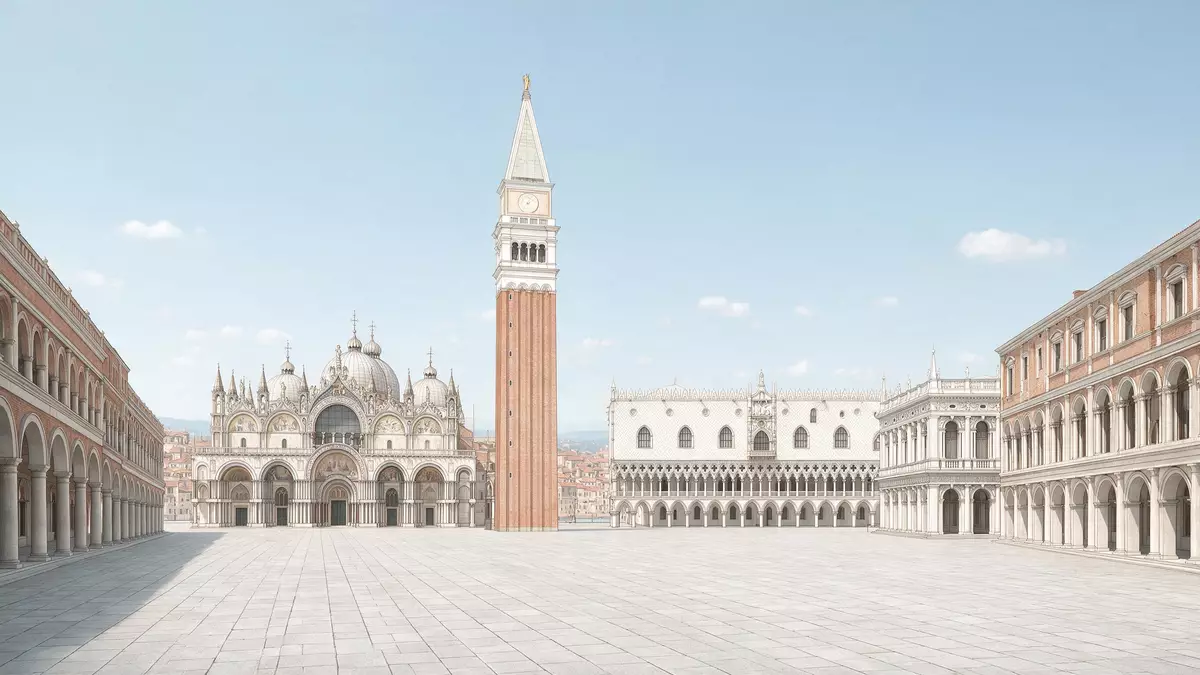
Piazza San Marco is the great ceremonial square of Venedig, framed by stone arcades and dominated by St Mark’s Basilica and its campanile at the eastern end. The space took on its present elongated form in the twelfth century, when waterways crossing the area were filled to create a single paved expanse for high diplomatic gatherings.
A long stone room open to the sky
Piazza San Marco reads almost like an open-air hall, defined by straight lines and repeated arches on three sides and closed by the ornate front of the basilica to the east. From the basilica’s entrance a visitor can look along a paved rectangle extending towards the Ala Napoleonica, the neoclassical wing that seals the western end of the square and completes its sense of enclosure.Enclosed on three sides by the Procuratie and Ala Napoleonica The proportions are generous enough to hold processions, gatherings and formal receptions, yet still tight enough that the arcades and façades feel close and legible.
The stone paving underfoot is part of the square’s character as much as its architecture. Brick paving was laid in the late twelfth century and later replaced in 1723 by a geometrical stone design attributed to the Venetian architect Andrea Tirali, whose work still shapes the patterns seen in the slabs.Geometrical pavement design by Andrea Tirali from 1723 The regular bands and panels in the paving echo the rhythm of the façades, reinforcing the sense of a carefully ordered urban room.
Basilica, campanile and the Doge’s Palace
At the eastern end of Piazza San Marco rises St Mark’s Basilica, with a façade built over centuries and completed in its main form in the eleventh century as Venice’s cathedral. Behind its arcades and domes lies the relic shrine of St Mark, the evangelist whose body was brought to Venice in the early medieval period and whose cult shaped the city’s identity.The basilica built in the eleventh century to house St Mark’s body Its mosaics, marble columns and sculpted portals give the square a richly ornamented focus.
Beside the basilica stands the free-standing campanile of San Marco, rebuilt in 1912 after a collapse in 1902, and reaching close to 99 m (325 ft) in height.The campanile rebuilt in 1912 after its 1902 collapse Its tall brick shaft and belfry act as a vertical counterpoint to the long horizontal square. From the basilica and campanile the eye is drawn southwards towards the Piazzetta and the waterfront, where the pale stone of the Doge’s Palace meets the lagoon. The palace, seat of the Doge of the former Republic of Venice, forms one corner of the ensemble, linking the square with the quayside and continuing the line of arcades.
Procuratie arcades and the shaping of the square
The long northern and southern sides of Piazza San Marco are formed by the Procuratie, arcaded buildings that housed offices and residences for high state officials. The Procuratie Vecchie on the north and the Procuratie Nuove on the south were reshaped between the sixteenth and seventeenth centuries, creating the continuous lines of arches and windows that visitors see today.The second great phase of construction in the 1500s and 1600s With the Ala Napoleonica added in the early nineteenth century on the western side, the square became a coherent architectural composition.
The present size and shape of Piazza San Marco were established in 1177 when the canal known as Rio Batario, which had bounded the area, and a dock separating the Doge’s Palace from the square were filled in to prepare for a meeting between Pope Alexander III and Emperor Frederick I Barbarossa.Enlargement of the square and filling of Rio Batario in 1177 Since then the Piazza has been regarded as the centre of Venice, concentrating religious authority in the basilica, political power in the Doge’s Palace and Procuratie, and civic life in the open space between them.
Visiting Piazza San Marco: what travellers from Western Europe should know
- Piazza San Marco lies in the eastern part of Venedig’s historic centre, close to the Grand Canal’s mouth and facing the Bacino di San Marco. It is reached on foot along narrow calli and over bridges or by vaporetto services that stop at nearby quays.
- The square itself is level and paved, but the surrounding area includes bridges, short flights of steps and arcaded walkways that can be exposed to water from the lagoon.
- English is widely understood, but the official language is Italian and the currency is the euro.
- The Doge’s Palace and the Museo Correr occupy adjoining buildings around the square, so several major historic interiors lie within a short walk.
Searching for Piazza San Marco on social platforms
These links open searches for Piazza San Marco on each platform.
Frequently asked questions about Piazza San Marco
Where is Piazza San Marco in Venedig?
Piazza San Marco lies in the eastern part of Venedig’s historic centre, close to the opening of the Grand Canal and the waterfront of the Bacino di San Marco.
What can visitors expect when they arrive at Piazza San Marco?
Visitors encounter a large paved square framed by historic arcades, with St Mark’s Basilica and its campanile at one end and the Doge’s Palace and Piazzetta opening towards the lagoon.
What makes Piazza San Marco distinctive among Italian squares?
Piazza San Marco brings together Venice’s cathedral, its former ducal palace, long arcaded state buildings and an early instance of planned paving into a single coherent urban composition.


