
Pingyao Gucheng and the living Ming–Qing city wall
Published on 08/18/2026 at 14:18 | Editorial responsibility: Rafael Müller, Editor-in-Chief AD HOC NEWS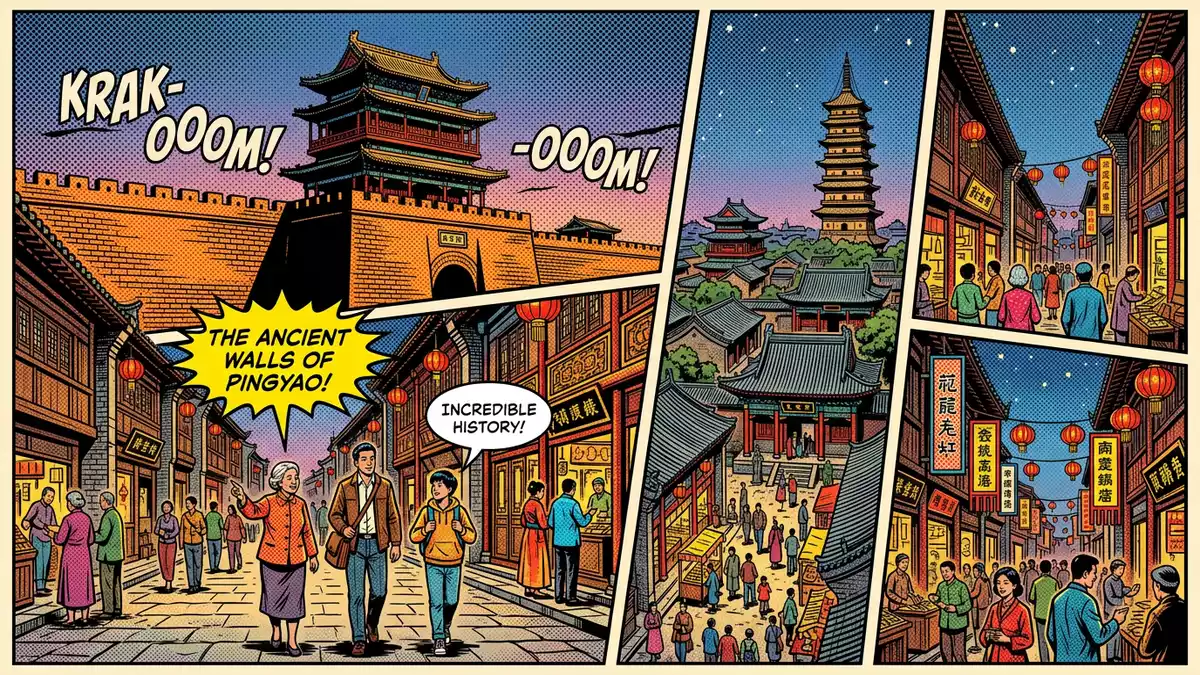
Pingyao Gucheng is the historic walled core of Pingyao in Shanxi Province, a Han Chinese county town whose urban fabric still reflects Ming and Qing dynasty life. Within its fortifications, courtyard houses, temples and market streets form a continuous ensemble that has earned the Ancient City of Ping Yao inscription on the UNESCO World Heritage List since 1997.Ancient City of Ping Yao
A complete Ming–Qing town preserved within walls
Pingyao Gucheng occupies the old city of Pingyao, a county-level town in central Shanxi whose plan and streets are laid out in a grid that dates back to the Ming period.traditional Han Chinese city The enclosed area extends over roughly 2 square kilometres (0.8 sq mi), with stone-paved lanes lined by low courtyard dwellings, ancestral halls and small temples that carry carved timber fronts and tiled roofs.ancient city area
The town is traditionally dated to the fourteenth century in its present form as a fortified settlement, while its history as a settlement stretches back more than 2,000 years.founded in the 14th century Within the walls, more than 4,000 traditional buildings survive, from courtyard houses to official residences and religious sites, giving Pingyao Gucheng a density of preserved architecture that is unusual for a Chinese county town.traditional buildings
The turtle-shell city wall and its gates
The defining feature of Pingyao Gucheng is its rectilinear city wall, completed in 1370 during the early Ming dynasty and still encircling the old town.city wall built in 1370 The fortifications run for more than 6 km (about 3.7 mi) around the city, reaching about 12 m (39 ft) in height and several metres in thickness, with a rammed-earth core faced with brick.wall length and height Watchtowers stand at intervals along the parapet and battlements line the outer edge, forming a continuous defensive route above the streets.
The overall outline of the fortifications is often described as resembling a turtle, with a head, tail and four projections forming legs around the rectangle, a configuration that has given the ancient city a local nickname.turtle-shell design Six main gates pierce the wall, aligned broadly with the cardinal directions, and lead into axial streets that run straight through Pingyao Gucheng. South Gate forms one of the principal entrances, and within the walls, elevated views open across tiles, courtyards and alleyways that follow the historic grid.
Courtyard houses and banking streets
Beyond the fortifications, Pingyao Gucheng is known for its dense network of courtyard houses, shopfronts and guild halls that record Pingyao’s role as a centre of finance in the nineteenth and early twentieth centuries.buildings associated with banking Among them is Rishengchang, recognised as one of China’s earliest draft banks, housed in a traditional compound where counters and offices are arranged around paved yards.Rishengchang Draft Bank
Official compounds and temples stand close to the main streets, including the ancient government office and religious complexes such as Shuanglin Temple and Zhenguo Temple, which form part of the wider World Heritage property beyond the core town.property components Together, these structures document the evolution of town planning and architecture in imperial China over roughly five centuries, from the early Ming dynasty into the late Qing period.five centuries of urban fabric
Visiting Pingyao Gucheng: what travellers from Western Europe should know
- Pingyao Gucheng lies in Pingyao County in central Shanxi Province, north China, and is reached by rail services to Pingyao followed by local transport to the ancient city area.
- The historic core is enclosed by a high city wall, with approaches involving walking on uneven stone-paved streets and climbing stairways to reach parts of the fortifications.
- Shuanglin Temple stands to the south-west of Pingyao Gucheng and Zhenguo Temple to the north-east, forming additional historic sites within a short journey of the old town.
- The official language is Chinese and the currency is the renminbi (yuan).
- Entry requirements depend on your nationality; UK travellers can check the FCDO travel advice at gov.uk/foreign-travel-advice, Irish travellers the Department of Foreign Affairs at ireland.ie.
Searching for Pingyao Gucheng on social platforms
These links open searches for Pingyao Gucheng on each platform.
Frequently asked questions about Pingyao Gucheng
Where is Pingyao Gucheng located?
Pingyao Gucheng forms the ancient walled city of Pingyao in central Shanxi Province in northern China, enclosed by Ming dynasty fortifications.
What should visitors expect inside the old city?
Inside the walls, visitors encounter stone-paved lanes, courtyard houses, temples, official compounds and former banking buildings set within a largely intact Ming–Qing street grid.
What makes Pingyao Gucheng distinctive among historic towns?
Pingyao Gucheng is distinctive for its continuous Ming-period city wall, dense stock of traditional buildings and its role as a nineteenth-century banking centre preserved in situ.


