
Plain of Jars and the stone vessels of Laos
Published on 09/22/2026 at 14:16 | Editorial responsibility: Rafael Müller, Editor-in-Chief AD HOC NEWS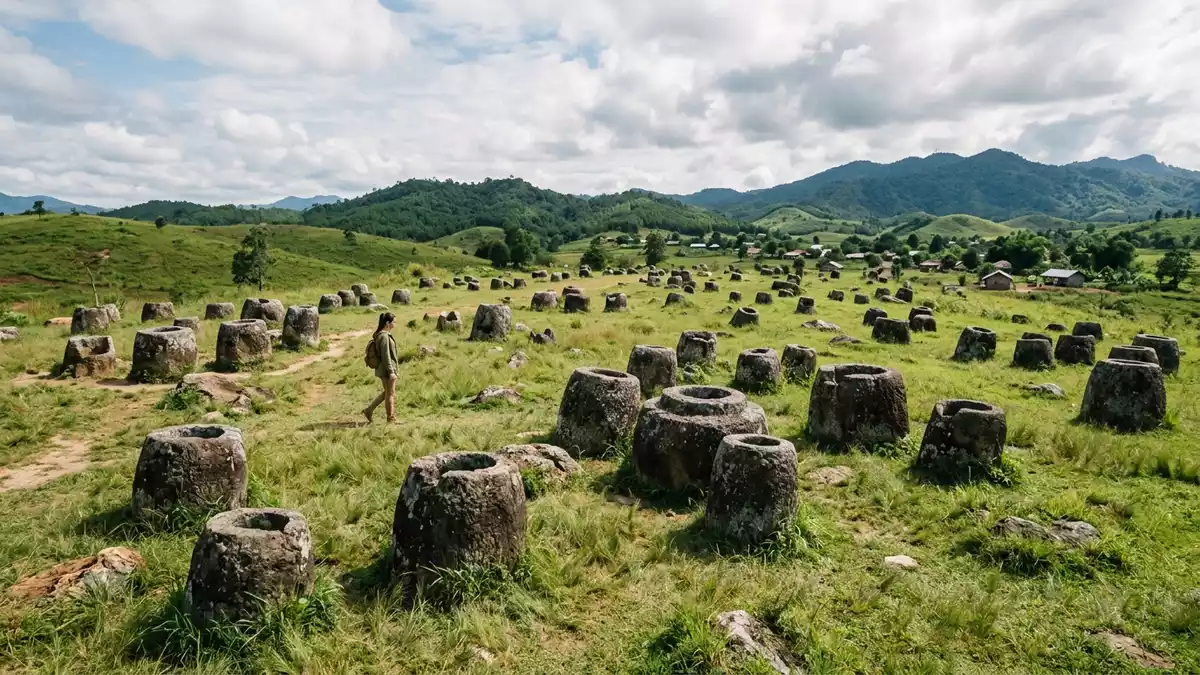
Plain of Jars spreads across the Xiangkhoang Plateau near Phonsavan in central Laos. Carved stone vessels stand on hill slopes, ridges and open grassland, forming an archaeological landscape rather than a single monument. The jars give the region its name, while their scale and distribution connect separate places across the plateau.
Plain of Jars: a landscape of carved stone vessels
The jars are megalithic containers shaped from local stone, with surfaces ranging from carefully worked faces to weathered, irregular edges. Some stand alone, while others appear in clusters across elevated ground. Their interiors are open to the sky, and stone discs, grave markers and secondary burials occur among them.
The UNESCO World Heritage property contains 15 component areas and 1,325 large carved jars. Its wider archaeological landscape includes more than 2,100 tubular-shaped stone jars, distributed across Xiengkhuang and neighbouring Luang Prabang province. UNESCO’s Plain of Jars listing records the jars, quarries, tombstones, grave goods and related features together.
Iron Age funerary sites around Phonsavan
Plain of Jars is associated with funerary practices dating from about 500 BCE to 500 CE, with some archaeological evidence extending towards 800 CE. Human remains, ceramics and burial goods show that the jars formed part of a wider mortuary landscape.
The people who made the jars left no surviving written account that explains their society in detail. The archaeological remains provide the principal evidence: stone containers, burial areas, manufacturing places, quarries and objects placed near the dead. Archaeological evidence from Laos connects the sites with the Early Iron Age and with cultural links across mainland Southeast Asia.
Quarries, ridges and the wider archaeological area
The jars are not confined to one plain. They occur on slopes and spurs around the central plateau, where settlements, routes and burial places formed part of a broader regional setting. Quarries and unfinished stone features add evidence of production.
Research has also identified sites beyond the best-known groups near Phonsavan. The archaeological landscape includes clusters containing several hundred vessels, together with smaller groups and isolated jars. The archaeological project archive records surveys, excavations and inventories from several megalithic sites.
Visiting Plain of Jars: what travellers from Western Europe should know
- Plain of Jars lies around Phonsavan in Xiengkhuang Province, on the Xiangkhoang Plateau. Road travel from Phonsavan connects the town with the principal accessible jar groups.
- The sites occupy open hillsides and ridges. Visits involve walking over uneven ground between stone jars, burial features and archaeological remains.
- The official language is Lao and the currency is the Lao kip.
- Entry requirements depend on your nationality; UK travellers can check the FCDO travel advice at gov.uk/foreign-travel-advice, Irish travellers the Department of Foreign Affairs at ireland.ie.
Searching for Plain of Jars on social platforms
These links open searches for Plain of Jars on each platform.
Frequently asked questions about Plain of Jars
Where is Plain of Jars?
Plain of Jars is located on the Xiangkhoang Plateau around Phonsavan in central Laos. The archaeological landscape extends across Xiengkhuang and parts of Luang Prabang province.
What can visitors expect at the sites?
Visitors encounter carved stone jars, open hillsides, burial features, stone discs and archaeological remains. Walking takes place across uneven terrain between separate groups of monuments.
What makes Plain of Jars distinctive?
Its distinctive character comes from the combination of large stone vessels, funerary remains, quarries and a wide plateau setting. The sites belong to an Iron Age archaeological landscape rather than a single building.


