
Plaza de Espana in Sevilla and its sweeping brick arc
Published on 08/14/2026 at 14:06 | Editorial responsibility: Rafael Müller, Editor-in-Chief AD HOC NEWS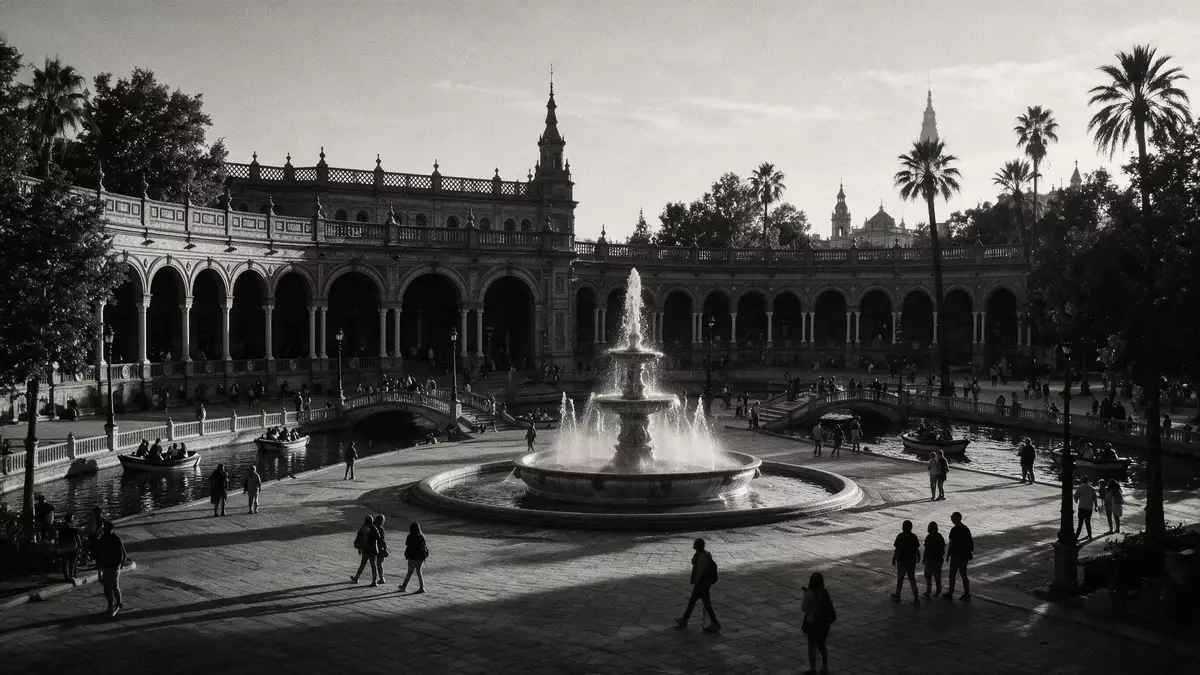
Plaza de Espana in Sevilla is a sweeping brick arc wrapped around water and paving in Maria Luisa Park, created as a monumental centrepiece for the Ibero-American Exposition of 1929. Conceived in the early twentieth century and completed in the late 1920s, it anchors the southern edge of Sevilla’s historic core with a blend of Andalusian materials and revived historic styles.
A semi-circular palace of brick, water and stone
The defining gesture of Plaza de Espana is its semi-circular plan, a broad embrace of brick and stone that frames an open plaza and a canal. The curved façade carries long galleries with arches facing the square, and within the arc rises a central block that reads as a palace, flanked by matching towers at each end.Its floor plan is semicircular and the ensemble sits within the greenery of Maria Luisa Park, so the geometry appears against trees rather than dense streets.
The canal follows the same curve as the building, separating the inner plaza from the terraces at the base of the façade. Small bridges span the water, their balustrades lined with coloured tiles that pick up patterns from around Spain.A canal runs for several hundred metres with rowboats, and from its surface the arc of the building and its towers appear like a continuous stage set. In the centre of the plaza a fountain marks the axis, reinforcing the radial organisation of paving, water and brick.
Regionalist architecture and the hand of Anibal Gonzalez
Plaza de Espana arose during a period when architects in southern Spain were exploring “regionalist” ways of building that revived Renaissance, Baroque and Mudéjar motifs. The architect Anibal Gonzalez, born in Sevilla in the late nineteenth century, developed the project from 1914 and became chief architect of the exposition.Plaza de España was built for the Ibero-American Exhibition of 1929, and Gonzalez’s design mixes Spanish Renaissance Revival elements with neo-Moorish forms.
The building relies heavily on warm-coloured brick, which forms walls, piers and the tall twin towers. Against this backdrop, ceramic tiles add colour at balustrades, panels and staircases, and carved wood and wrought iron appear at doors, balconies and lamps.Exposed brick, ceramics and wrought iron are key materials, worked by local craftspeople into patterns that echo historic palaces and churches across Andalusia. The composition sits between revival and invention: recognisable motifs are combined in a new, expansive urban set piece.
Tiles, provinces and the legacy of the exposition
Along the inner curve of Plaza de Espana, tiled alcoves line the base of the building, each with a bench and a map panel. These represent the provinces of Spain, using coloured ceramics to depict historical scenes, coats of arms and place names, so a walk along the arc becomes a tour through the country’s administrative geography.Forty-eight benches are dedicated to Spanish provinces, arranged in alphabetical order. Above them, further medallions and shields celebrate figures from Spanish history, embedding a narrative of state and culture in the decoration.
The square was one of the main national pavilions of the Ibero-American Exposition, a world’s fair held in Sevilla between 1929 and 1930 that brought together Spain, Portugal, several American republics and other participants.The exposition opened on 9 May 1929, and Plaza de Espana’s scale—described in some sources as covering tens of thousands of square metres—reflects its role as a national showcase. In the decades since the fair, the building has housed administrative offices and other functions, while the plaza and canal have remained a public space, integrating the exposition’s legacy into everyday Sevilla.
Visiting Plaza de Espana: what travellers from Western Europe should know
- Plaza de Espana stands within Maria Luisa Park, south of the historic centre of Sevilla, and is reached on foot from nearby avenues and from tram and bus stops serving the park.
- The square consists of broad paved areas, steps up to the building’s terraces and staircases leading to upper galleries, with the canal crossed by gently sloping bridges.
- The towers at each end of the ensemble rise to considerable height, and climbing internal stairs to higher levels involves a sustained ascent on narrow flights.
- The setting in Maria Luisa Park means that shaded paths and tree-lined lawns extend around the plaza, so a visit can combine architectural exploration with a walk through landscaped grounds.
- The official language is Spanish and the currency is the euro.
Searching for Plaza de Espana on social platforms
These links open searches for Plaza de Espana on each platform.Frequently asked questions about Plaza de Espana
Where is Plaza de Espana located in Sevilla?
Plaza de Espana stands inside Maria Luisa Park, on the south side of central Sevilla, near avenues such as Avenida de Isabel la Catolica.
What should visitors expect when they arrive?
Visitors encounter a broad paved plaza, a curved canal with bridges, large brick galleries with arches, tiled provincial benches and tall corner towers rising above the park trees.
What makes Plaza de Espana distinctive among Spanish squares?
Its semi-circular plan, combination of brick, ceramics and water, and the sequence of tile panels dedicated to Spain’s provinces together give Plaza de Espana a monumental, theatrical character.


