
Plitvicka jezera, Croatia’s terraced lakes and waterfalls
Published on 09/10/2026 at 12:50 | Editorial responsibility: Rafael Müller, Editor-in-Chief AD HOC NEWS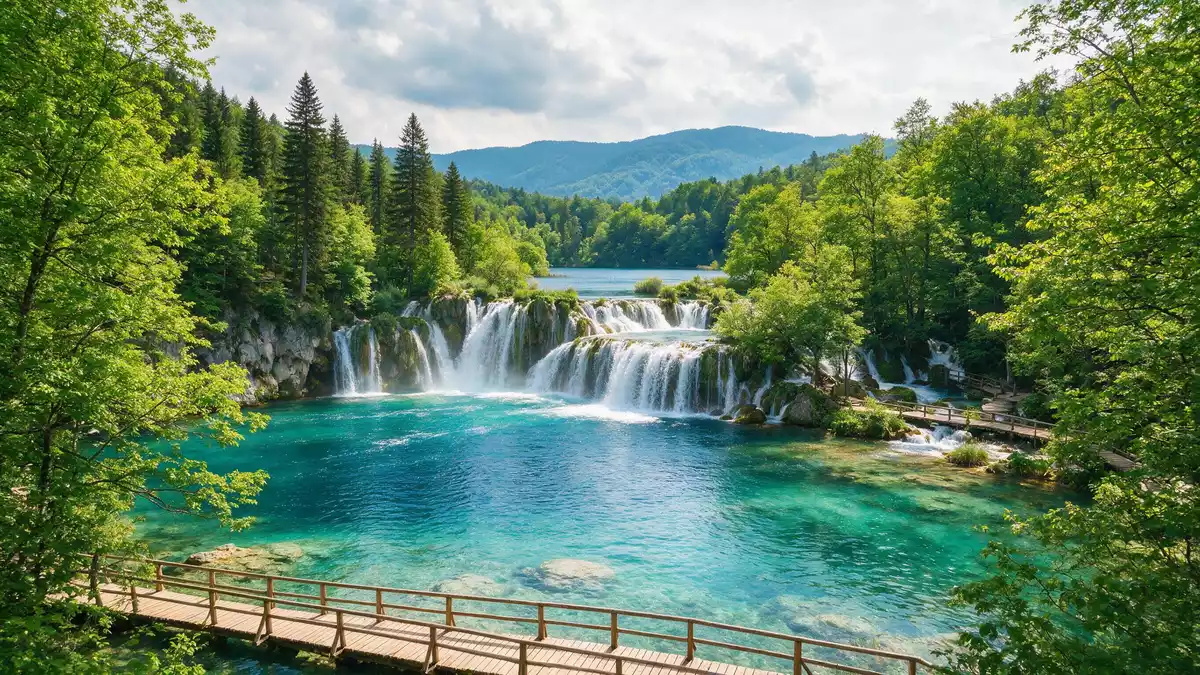
Plitvicka jezera, known internationally as Plitvice Lakes National Park, is a highland valley in central Croatia where water, limestone and forest form a long chain of lakes and waterfalls. Recognised as a national park since 1949 and inscribed on the UNESCO World Heritage List in 1979, it lies between the mountain massifs of Mala Kapela and Plješivica in the interior of the Dinaric Alps.
A stairway of water in a karst valley
The defining experience at Plitvicka jezera is following water as it descends through a sequence of lakes set in a karst landscape. The protected area extends across almost 30,000 ha of central Croatia, in Lika-Senj and Karlovac counties, where limestone and dolomite form cliffs, basins and ledges that hold the lakes.Croatia's largest national park The lakes occupy a canyon-like hollow at lower elevations, framed by the surrounding Dinarides.
Visitors move along wooden walkways and paths that run beside turquoise basins, cross narrow straits and pass footbridges close to cascades. The surface of the water ranges in colour from pale green to deep blue depending on depth and mineral content, while tufa barriers, formed by calcium carbonate deposits, step the water down in countless small drops between larger falls.a picturesque series of tufa lakes Forested slopes above the water complete the sense of a valley enclosed by vegetation and rock.
From upper lakes to canyon and Veliki Slap
Plitvicka jezera is structured as a chain of lakes arranged in two main groups, upper and lower, which descend in terraces along the course of the river Korana.a complex of terraced lakes The upper lakes occupy a broader basin with gentler slopes and an almost continuous succession of basins and smaller waterfalls, while the lower lakes lie in a narrower gorge where the water gathers before leaving the valley.
In the lower section, the most striking single feature is Veliki Slap, the high waterfall where water plunges into the canyon at the end of the chain.Veliki Slap at the lower lakes Wooden paths descend towards its base, giving views both along the gorge and across the spray towards the higher rim. Elsewhere, small side streams feed the main sequence, adding their own cascades and pools at different levels. The contrast between the enclosed gorge of the lower lakes and the more open setting of the upper section is one of the park’s clearest spatial experiences.
Protection, forests and the wider landscape
Plitvicka jezera was designated as a national park in 1949, becoming the oldest national park in Croatia and one of the earliest protected areas of its type in south-eastern Europe.founded as a national park in 1949 Its recognition as a World Heritage site in 1979 underscores the importance of both its landscape and its ongoing tufa-forming processes, which continue to reshape the barriers between lakes. The inscription covers criteria related to scenic value and geological and ecological significance.inscription in 1979 under natural criteria
Beyond the water itself, the protected area includes extensive mixed forests, meadows and karst ridges. The lakes lie between Mala Kapela on the west and Li?ka Plješivica on the east, in a part of the Dinaric mountain chain characterised by sinkholes, underground drainage and cliffs punctuated by vegetation.between Mala Kapela and Plješivica Away from the main paths, the terrain rises to forested slopes, with viewpoints over sections of the lakes and glimpses of the surrounding highlands.
Visiting Plitvicka jezera: what travellers from Western Europe should know
- Plitvicka jezera lies in central Croatia, in Lika-Senj and Karlovac counties, south of Karlovac and north of Zadar, along a major north–south road towards the Adriatic coast.
- The terrain combines lakeside walkways with paths on forested slopes; many routes include wooden decks close to the water and stairways linking different levels.
- The park sits in a karst mountain area of the Dinaric Alps, with noticeable elevation changes; footwear suitable for uneven ground is important on the longer circuits.
- The official language is Croatian and the currency is the euro.
Searching for Plitvicka jezera on social platforms
These links open searches for Plitvicka jezera on each platform.
Frequently asked questions about Plitvicka jezera
Where is Plitvicka jezera located?
Plitvicka jezera lies in central Croatia, in Lika-Senj and Karlovac counties, between the Mala Kapela and Li?ka Plješivica mountain ranges, near the border with Bosnia and Herzegovina.
What can visitors expect on a visit to Plitvicka jezera?
A visit centres on walking beside and across a chain of turquoise lakes and waterfalls on wooden walkways and paths, with forested slopes rising around a karst valley.
What makes Plitvicka jezera distinctive among European landscapes?
The park combines an extensive terraced lake system formed by tufa barriers with protection as both Croatia’s oldest national park and a UNESCO World Heritage site.


