
Plitvicka jezera, the terraced lakes of Plitvice
Published on 08/24/2026 at 21:24 | Editorial responsibility: Rafael Müller, Editor-in-Chief AD HOC NEWS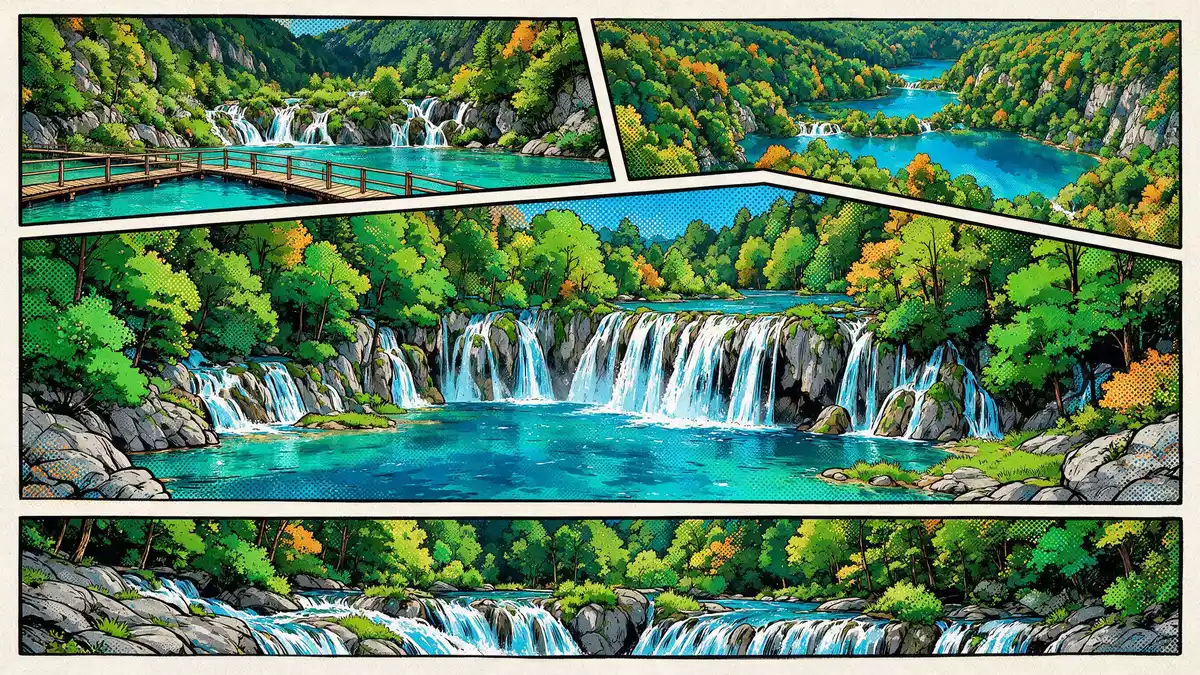
Plitvicka jezera, known in English as Plitvice Lakes, is a terraced lake system in central Croatia where water, limestone and forest shape a continuous chain of lakes and waterfalls. Set in the hills between the Mala Kapela and Li?ka Plješivica mountain ranges, it forms the heart of Plitvice Lakes National Park, declared a protected area in 1949 and later recognised as a UNESCO World Heritage site for its extraordinary tufa-forming processes.
The lake chain: water stepping through limestone
The defining feature of Plitvicka jezera is a sequence of lakes arranged like steps, each spilling into the next over natural dams built from limestone deposits. The national park administration describes a system of sixteen named lakes with additional smaller ones, cascading one into another and divided into Upper and Lower groups across the valley.The lake system is comprised of 16 named and several smaller unnamed lakes The Upper Lakes include Kozjak, the largest basin, alongside Proš?ansko jezero and a string of others that fill a broad upland hollow.
The Lower Lakes lie downstream, enclosed by steep cliffs where clearer height differences between basins and waterfalls can be seen. At the end of this lower sequence, the river drops in a single bold fall known as Veliki Slap or Great Waterfall, recognised in Croatian documentation as the tallest waterfall in the country at about 78 m (256 ft).Veliki slap with its 78 metres is the largest in Croatia Seen from the wooden walkways and viewing platforms, the lakes form an almost continuous band of water surfaces and falling streams, framed by forest rising on either side.
A national park shaped by karst and forest
Plitvicka jezera sits in a karst landscape of sinkholes, cliffs and ridges, part of the Dinaric range that runs through this part of Croatia. The official park information places it between Mala Kapela to the west and northwest and Li?ka Plješivica to the southeast, with the lake basins lying in the lower elevations of the Dinarides.The park is situated between the Mala Kapela and Li?ka Plješivica ranges Limestone bedrock and dissolved minerals provide the basis for tufa, the porous stone that builds up as water deposits carbonate, slowly raising natural barriers across the valley.
These geological processes and the landscape they have produced were central to the decision to declare the area a national park on 8 April 1949, making Plitvicka jezera Croatia’s oldest and largest national park.Plitvice Lakes National Park was declared in 1949 The protected area extends over almost 30,000 ha of hills, forests and water, according to UNESCO’s listing, and includes extensive beech and fir woodland as well as the lakes themselves.Croatia's largest national park covers almost 30,000 hectares Away from the main visitor circuits, forest tracks and quieter bays underline that the lakes are part of a much wider ecological system.
UNESCO recognition and ways of exploring
Plitvicka jezera gained international recognition on 26 October 1979, when Plitvice Lakes National Park was inscribed on the UNESCO World Heritage List for the outstanding universal value of its tufa-forming lake system.The park was inscribed on the UNESCO World Heritage List on 26 October 1979 The nomination highlighted the long-term process through which tufa barriers and lakes develop, and the visible sequence of basins and waterfalls as a rare example of such a system on a landscape scale.Plitvicka jezera was listed on the UNESCO World Heritage List in 1979
Visitors experience this terrain through a structured network of paths and transport. The park authority describes seven different routes alongside four marked hiking trails that thread across bridges, boardwalks and forest tracks around the lakes.The park offers seven routes and four hiking trails Electric boats cross the larger central lake, while shuttle vehicles follow a panoramic line along the slopes, linking different sectors of the protected area.Electric boats and panoramic shuttle trains connect sectors of the park Boardwalks bring travellers close to the water where channels run beneath the planks, while more conventional paths take in higher viewpoints above the basins.
Visiting Plitvicka jezera: what travellers from Western Europe should know
- Plitvicka jezera lies in central Croatia’s Lika region, south of the town of Karlovac and near the village of Plitvicki Ljeskovac. It is reached by road from Zagreb and the Adriatic coast, with bus services stopping near the park entrances.
- The terrain combines lakeside boardwalks with forest paths and sections of ground that climb between basins. Some routes include stairways and short, steep ascents that require steady footing.
- The protected area sits on upland karst, and weather conditions can change quickly on exposed paths and viewpoints. Footwear with good grip is helpful on wooden walkways and natural surfaces.
- The official language is Croatian and the currency is the kuna.
- Entry requirements depend on your nationality; UK travellers can check the FCDO travel advice at gov.uk/foreign-travel-advice, Irish travellers the Department of Foreign Affairs at ireland.ie.
Searching for Plitvicka jezera on social platforms
These links open searches for Plitvicka jezera on each platform.
Frequently asked questions about Plitvicka jezera
Where is Plitvicka jezera?
Plitvicka jezera is in central Croatia, in the Lika region between the Mala Kapela and Li?ka Plješivica mountain ranges, within Plitvice Lakes National Park.
What can travellers expect on a visit?
Travellers walk beside and above a chain of lakes and waterfalls on boardwalks and paths, with electric boats and shuttle vehicles linking different sectors of the protected area.
What makes Plitvicka jezera distinctive?
The combination of tufa-forming limestone barriers, a stepped series of sixteen lakes and the surrounding forested karst landscape, recognised as a UNESCO World Heritage site, gives Plitvicka jezera its character.


