
Pont Alexandre III and the sculpture of a Parisian crossing
Published on 09/23/2026 at 16:41 | Editorial responsibility: Rafael Müller, Editor-in-Chief AD HOC NEWS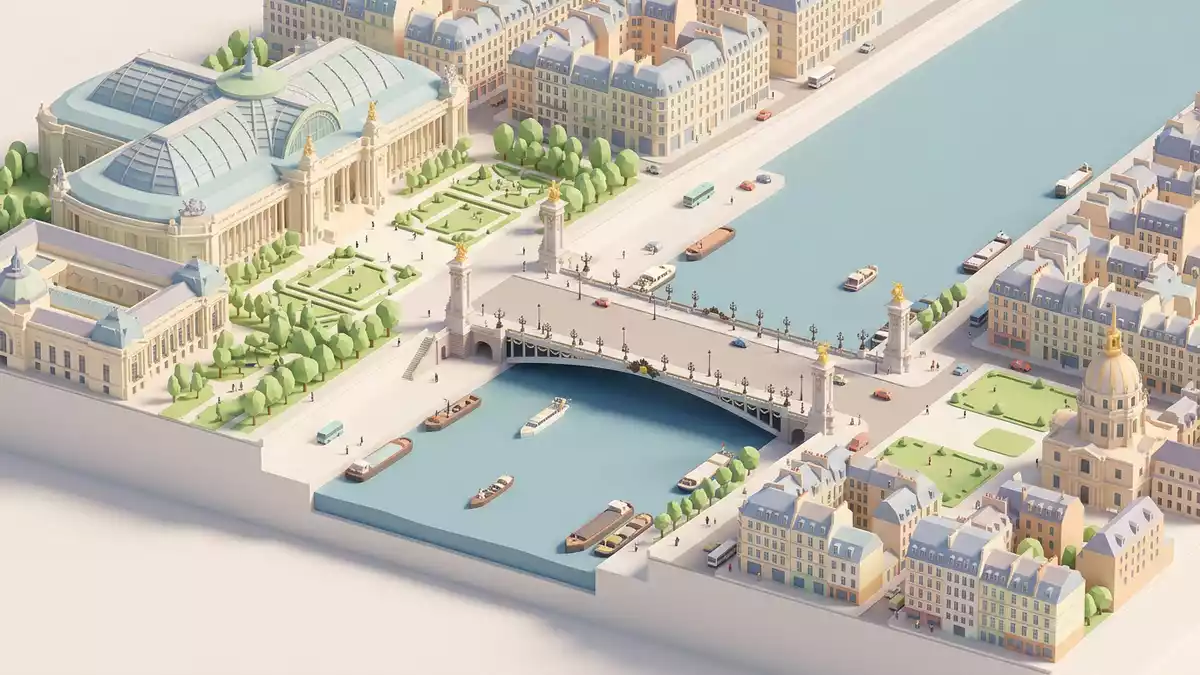
Pont Alexandre III crosses the Seine between Les Invalides and the Grand Palais in Paris. Its low steel arch carries a broad deck beneath elaborate lamps, bronze sculpture and gilded winged horses.
Opened in 1900 for the Exposition Universelle, the bridge combines engineering with the decorative language of the Belle Époque.
Pont Alexandre III: a low arch beneath Parisian sculpture
The bridge is a single-span steel structure with masonry supports at either end. Its deck runs between the Esplanade des Invalides on the left bank and Avenue Winston Churchill on the right bank, beside the Grand Palais and Petit Palais.
Its arch remains visually low above the Seine. Stone pylons mark the approaches, and gilded Pegasus figures stand above them. Along the parapets, lamps, copper details and bronze ornaments turn the crossing into a continuous sequence of architectural decoration. The bridge’s span measures about 154 m (505 ft), while its width is about 45 m (148 ft). The bridge’s dimensions are closely tied to its broad roadway and pedestrian pavements.
Built for the Exposition Universelle of 1900
Pont Alexandre III was constructed between 1896 and 1900, during the preparations for the Paris Exposition Universelle. The first stone was laid on 7 October 1896 by Tsar Nicholas II, Empress Alexandra Feodorovna and French president Félix Faure.
The bridge takes its name from Alexander III, Nicholas II’s father and emperor of Russia. Its inauguration formed part of the 1900 exhibition, the same event associated with the Grand Palais and Petit Palais. The bridge’s 1900 setting links the river crossing with the exhibition architecture on both banks.
Jean Résal and Amédée Alby handled the engineering, while Joseph Cassien-Bernard and Gaston Cousin were the architects. Their work brought together a three-hinged metal arch, classical composition and an abundant decorative programme. The design team represents the bridge’s division between structural engineering and architectural ornament.
From the Invalides axis to the Seine
The bridge occupies a carefully defined urban axis. On the south side, the Esplanade des Invalides leads towards the Hôtel des Invalides. On the north side, the roadway reaches Avenue Winston Churchill, with the Grand Palais and Petit Palais nearby.
Views from the bridge include the Seine, the Invalides dome and the Eiffel Tower. The crossing also forms part of the architectural sequence created for the 1900 exhibition, where monumental buildings, avenues and the river were brought into a single Parisian setting.
The decorative figures have distinct roles within that composition. Gilded winged horses crown the approach pylons, while sculptural groups and lamps line the bridge itself. The ornament includes references to the arts, sciences, industry and commerce, alongside figures associated with the Seine and the Neva. The bridge’s sculptural programme presents the crossing as an outdoor gallery.
Pont Alexandre III is also protected as a historic monument. Its painted and gilded surfaces, stonework, metal arch and sculptural details belong to the architectural character of the bridge rather than to separate museum displays.
Visiting Pont Alexandre III: what travellers from Western Europe should know
- Pont Alexandre III crosses the Seine between Les Invalides and Avenue Winston Churchill. It is reached on foot, by road transport and through nearby Paris public-transport routes serving the Invalides, Champs-Élysées and Grand Palais area.
- The bridge has broad pavements beside the roadway, with stone approaches and sculptural pylons at the corners. Its surface is an urban crossing rather than a level park path.
- The Seine, the dome of Les Invalides, the Grand Palais and the Petit Palais are all close to the bridge. The Eiffel Tower is visible from the crossing.
- The official language is French and the currency is the euro.
Searching for Pont Alexandre III on social platforms
These links open searches for Pont Alexandre III on each platform.
Frequently asked questions about Pont Alexandre III
Where is Pont Alexandre III?
Pont Alexandre III crosses the Seine in central Paris between Les Invalides and Avenue Winston Churchill. The Grand Palais and Petit Palais stand beside its northern approach.
What can visitors expect on the bridge?
The crossing combines a steel arch, broad pavements, stone pylons, gilded winged horses, ornate lamps and bronze decoration. Views extend along the Seine towards major Paris landmarks.
What makes Pont Alexandre III distinctive?
Its low 1900 steel arch carries an unusually elaborate Beaux-Arts and Belle Époque decorative scheme. The bridge joins an engineering structure with an open-air display of sculpture and metalwork.


