
Pont du Gard and the Roman bridge of three levels
Published on 09/23/2026 at 15:57 | Editorial responsibility: Rafael Müller, Editor-in-Chief AD HOC NEWS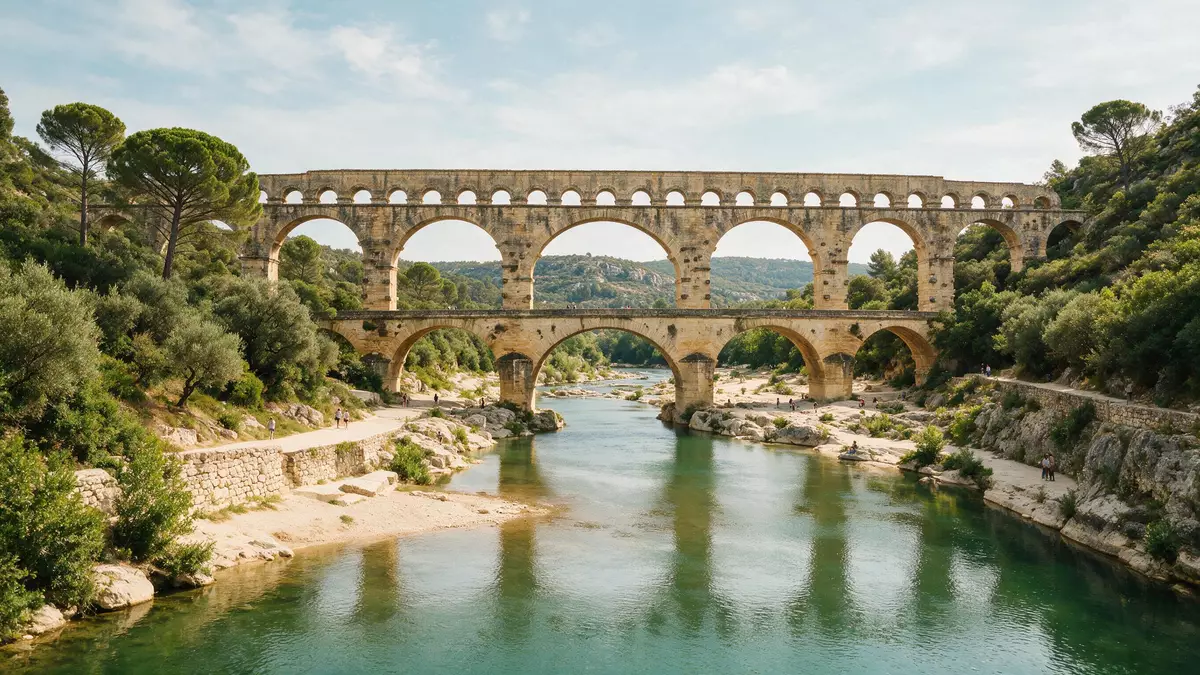
Pont du Gard is a Roman aqueduct bridge rising above the Gardon near Vers-Pont-du-Gard in southern France. Three stacked levels of arches carry the monument to nearly 49 metres, giving the bridge a distinctly architectural presence across the river valley.
Pont du Gard: three levels of Roman masonry
The bridge is built from carefully laid limestone blocks, with the lower and middle tiers formed by large arches and the upper tier carrying the water channel. The masonry remains largely unadorned, leaving the rhythm of the arches, the weight of the stone and the changing scale of the openings to define the structure.
The lowest tier contains six arches, the middle tier eleven, and the upper tier thirty-five smaller arches. The top arcade reaches roughly 275 metres across the valley, while the entire bridge rises to about 49 metres above the Gardon. These dimensions give Pont du Gard its visible character: a horizontal bridge extended through the landscape, held above the water by a vertical sequence of masonry.
The Nîmes aqueduct and its first-century setting
Roman engineers built Pont du Gard in the first century AD as the principal crossing of the aqueduct that carried water towards Nemausus, the Roman city known today as Nîmes. The aqueduct extended for about 50 kilometres from its source near Uzès to the city.
The channel at the summit is narrow compared with the monumental arcades below it. Water travelled through this elevated conduit, while the bridge itself crossed the Gardon and preserved the gentle fall required by the wider aqueduct. Pont du Gard therefore combines a civic water system with a bridge whose scale remains legible from the riverbanks.
The monument belongs to the Roman architectural tradition of using repeated arches to span uneven terrain. Its three superimposed arcades form a rare surviving arrangement, with each level expressing a different structural scale. Roman engineering context places the bridge within the larger history of ancient hydraulic construction.
Stone, water and a protected landscape
Pont du Gard is not an isolated fragment of masonry. It is the most recognisable surviving element of the Nîmes aqueduct, whose route included underground channels, other bridges and passages across the limestone country of the Gard.
The Gardon flows beneath the lowest arcade, while the upper structure follows a straight line across the valley. From below, the bridge can be read in layers: broad arches at river level, a second row above them and a fine upper arcade beneath the water channel. The changing proportions prevent the elevation from becoming a single solid wall.
The bridge entered the UNESCO World Heritage list in 1985. Its protected status reflects both its survival from antiquity and the relationship between Roman engineering, monumental architecture and the surrounding river landscape. UNESCO World Heritage status records Pont du Gard as part of the wider aqueduct associated with Nîmes.
The monument’s proportions are easiest to understand when the full elevation is visible. The lower arches meet the river valley, the middle arcade continues the vertical sequence, and the upper row marks the route of the ancient channel. three superimposed arcades remain the defining feature of the site.
Visiting Pont du Gard: what travellers from Western Europe should know
- Pont du Gard stands near Vers-Pont-du-Gard in the Gard department, between Nîmes and Avignon. Road access leads towards the monument from the surrounding towns.
- The Gardon valley combines riverbanks, exposed limestone and changing levels beneath the bridge. The monument is viewed from paths and open ground around the river.
- The upper water channel is part of the ancient aqueduct, while the visible lower levels form the bridge across the Gardon. The route of the wider aqueduct reaches towards Nîmes.
- The official language is French and the currency is the euro.
Searching for Pont du Gard on social platforms
These links open searches for Pont du Gard on each platform.
Frequently asked questions about Pont du Gard
Where is Pont du Gard?
Pont du Gard is near Vers-Pont-du-Gard in southern France. The bridge crosses the Gardon as part of the ancient aqueduct leading towards Nîmes.
What can visitors expect at the monument?
The site presents a Roman bridge of limestone, river scenery and paths beneath the three levels of arches. Views from below show the changing scale of the masonry and the elevated water channel.
What makes Pont du Gard distinctive?
Its three superimposed arcades combine a 49-metre height with a long crossing over the Gardon. The bridge also preserves the visible relationship between a Roman water conduit and monumental civic architecture.


