
Pont du Gard and the Roman bridge of three tiers
Published on 09/22/2026 at 11:28 | Editorial responsibility: Rafael Müller, Editor-in-Chief AD HOC NEWS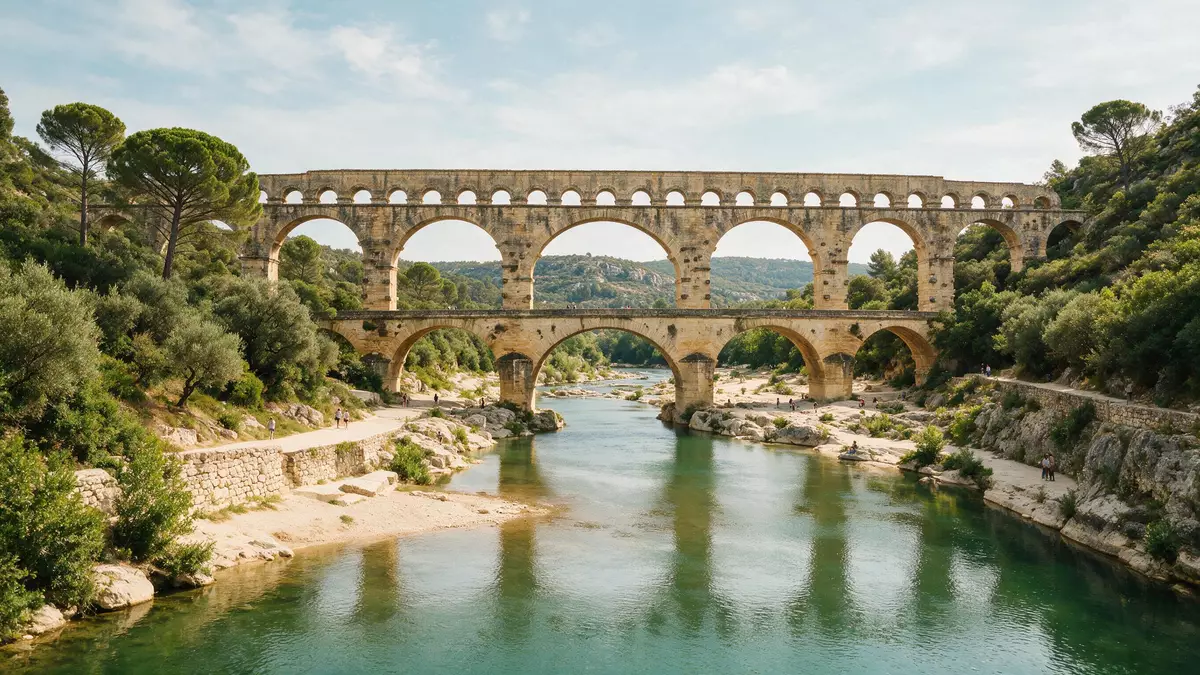
Pont du Gard rises above the Gardon near Vers-Pont-du-Gard as a stone bridge with three superimposed tiers of arches. Built in the first century AD, it formed the most recognisable crossing of the Roman aqueduct that supplied Nemausus, the ancient city of Nîmes.
The bridge reaches nearly 49 metres and extends roughly 275 metres across the river valley. Its three levels remain legible from below, turning a water conduit into an architectural landmark whose scale belongs to both engineering and landscape.
Three tiers above the Gardon
The lower arcade carries the greatest visual weight. Its broad arches stand on substantial piers, while the middle arcade repeats the rhythm at a higher level. Above them, the upper arcade carries the narrow channel that once conveyed water towards Nîmes.
The tiers are not identical in size or function. The lower and middle levels form the visible bridge structure, while the top level contains the aqueduct channel. This arrangement gives Pont du Gard its characteristic stacked profile, with the masonry narrowing towards the summit.
The longest surviving span runs across the Gardon, and the bridge’s warm limestone surface records the texture of Roman construction. Blocks are arranged in regular courses, with the arches creating open intervals between the solid piers.
From Uzès to Roman Nîmes
Pont du Gard was a major element of an aqueduct extending about 50 kilometres from the Eure springs near Uzès to Nemausus. The Roman aqueduct to Nîmes crossed the Gardon on the upper level.
The aqueduct belongs to the Roman period of southern Gaul. Its destination, Nemausus, was a Roman colony whose urban water system depended on a long, carefully graded route through the countryside.
Water engineering explains the bridge’s practical identity without reducing its appearance to utility. The channel occupies the highest tier, while the two lower arcades raise it above the river. The visible monument therefore combines a transport route, a bridge and a monumental stone composition.
The building date is expressed differently in historical accounts. The structure is securely associated with the first century AD, while some descriptions place construction around the middle of that century. The Roman setting and its connection with Nîmes remain central to the site’s identity.
A Roman structure with a long afterlife
Pont du Gard has survived as a bridge-aqueduct, although the water system no longer defines its daily role. The lower level preserves the form of a crossing above the Gardon, while the upper channel remains visible as part of the ancient structure.
Its stonework connects the river landscape with the Roman history of the region. The Gardon passes beneath the arcades, and the bridge’s horizontal line contrasts with the wooded banks and exposed limestone around the valley.
Pont du Gard entered the UNESCO World Heritage list in 1985. Its World Heritage status recognises the aqueduct bridge as part of the cultural history of Roman water engineering.
The monument’s physical identity remains unusually clear: a three-storey Roman aqueduct bridge, built in limestone, crossing the Gardon near Vers-Pont-du-Gard. Its Roman construction and height place the bridge among the defining ancient structures of southern France.
Visiting Pont du Gard: what travellers from Western Europe should know
- Pont du Gard lies near Vers-Pont-du-Gard in southern France, between Uzès and Nîmes. Road access serves the monument from the surrounding Gard and Occitanie region.
- The Gardon valley contains riverbanks, exposed rock and uneven outdoor ground. The bridge itself is viewed from paths and spaces at different levels around the river.
- The Roman aqueduct route extends far beyond the bridge. The surviving monument is the crossing above the Gardon, not the complete 50-kilometre water system.
- The official language is French and the currency is the euro.
Searching for Pont du Gard on social platforms
These links open searches for Pont du Gard on each platform.Frequently asked questions about Pont du Gard
Where is Pont du Gard?
Pont du Gard stands above the Gardon near Vers-Pont-du-Gard in southern France. It lies on the Roman aqueduct route connecting the Eure springs near Uzès with Nîmes.
What can visitors expect at the monument?
The site presents a large limestone bridge-aqueduct, river scenery and outdoor paths around the Gardon. Views reveal the lower, middle and upper arcades as separate levels within one structure.
What makes Pont du Gard distinctive?
Its three superimposed tiers combine a bridge, a water channel and Roman architectural design. The structure reaches nearly 49 metres above the Gardon and belongs to a 50-kilometre aqueduct.


