
Positano: a vertical village above the Tyrrhenian Sea
Published on 08/23/2026 at 13:14 | Editorial responsibility: Rafael Müller, Editor-in-Chief AD HOC NEWS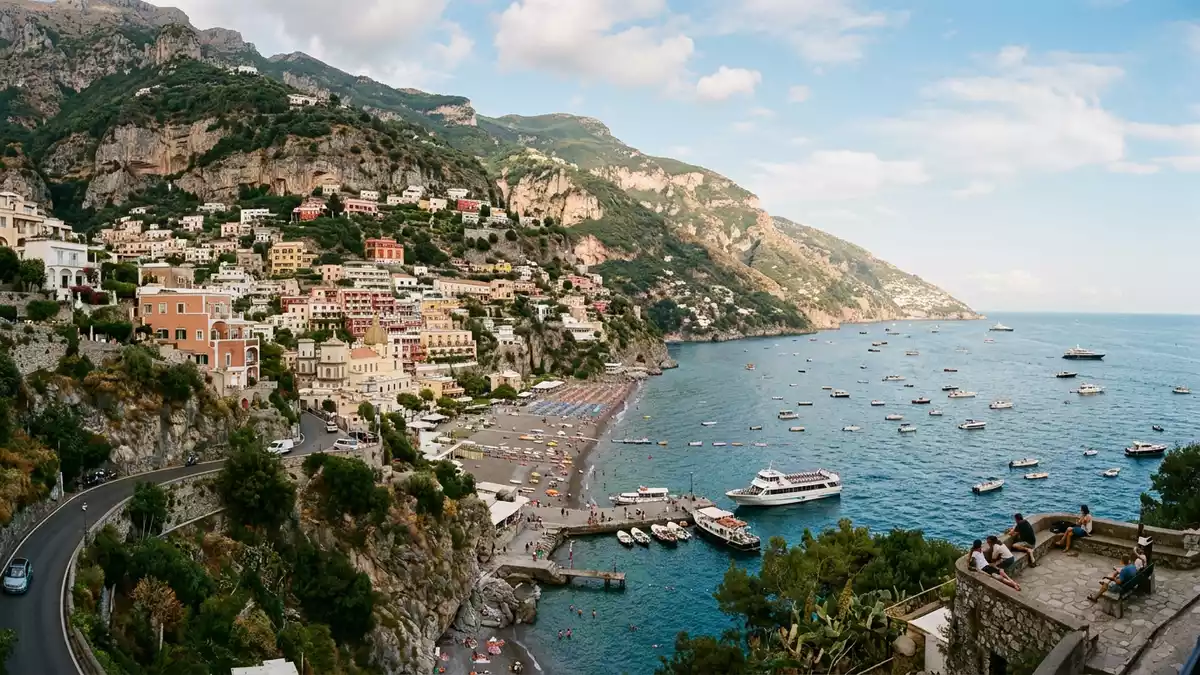
Positano clings to the limestone slopes of the Amalfi Coast in southern Italy, its houses and lanes cascading in tiers towards the Tyrrhenian Sea. The town lies in the region of Campania, within the Province of Salerno, forming part of the stretch of coastline recognised as a UNESCO World Heritage Sitealong the Amalfi Coast.
A town built on terraces of rock and houses
Seen from the water, Positano appears as a steep amphitheatre where pastel façades, narrow stairways and small gardens climb the mountainside in overlapping layers. The settlement occupies an enclave in the hills that descend sharply to the sea, with buildings arranged on man-made ledges cut into the rugged flank of the Lattari Mountainsabove the Tyrrhenian shore.
The slopes behind Positano are dominated by limestone, and the town’s streets and staircases wind between retaining walls, rock faces and clusters of houses. From higher points in the settlement there are clear views along the Amalfi Coast, where other villages sit on similar terraces carved into the same coastal rangeof limestone cliffs. At sea level, the built-up slopes gather around Marina Grande, the main beach at the foot of the town.
Santa Maria Assunta and the Black Madonna
At the centre of Positano’s seafront quarter stands the Church of Santa Maria Assunta, the town’s principal church and a landmark visible from the beach. Its most recognisable feature is the majolica-tiled dome, patterned in yellow, green and blue tiles that catch the light above the surrounding housesover Marina Grande. Inside the church, a Byzantine icon of the Madonna and Child is venerated on the high altar, and plays a central role in Positano’s religious identity.
The origins of Santa Maria Assunta are linked to a Benedictine monastery dedicated to Saint Mary that existed in Positano by the late eleventh centuryin the medieval period. A document dated 14 June 1159 records the dedication of the church to the Blessed Virgin Mary, marking the site as an established place of worship in the twelfth centuryunder Archbishop Giovanni II of Amalfi. The church acquired its present appearance through extensive work in the eighteenth century, when baroque stucco and gilded decoration were added and the interior took on the form visitors see nowafter eighteenth-century restoration.
From fishing village to cliffside resort town
Positano developed as a coastal settlement facing the Tyrrhenian Sea, with fishing and seafaring shaping daily life for many inhabitants. In the nineteenth and early twentieth centuries it was a relatively remote village along the Campanian coast, reached by paths and coastal routes that followed the contours of the cliffson the Amalfi Coast.
During the twentieth century Positano attracted writers, artists and travellers drawn to its steep lanes, sea views and stacked houses, and tourism became central to its economy. The town is a municipality in its own right with several thousand inhabitants, forming part of the chain of settlements that make up the Amalfi Coast road between Sorrento and Amalfiin the Province of Salerno. While hotels, restaurants and shops occupy many of the buildings near the waterfront, the upper parts of the town retain clusters of dwellings, small piazzas and stepped lanes that mirror the older structure of the settlement.
Visiting Positano: what travellers from Western Europe should know
- Positano stands on the Amalfi Coast in Campania, south of Naples, and is reached by coastal road links and ferries that connect it with Sorrento and Amalfi.
- The town is built on steep hillsides, and movement between the upper streets and Marina Grande involves long staircases and sloping lanes with significant changes in elevation.
- The surroundings include limestone cliffs, small coves and other Amalfi Coast villages, with road and sea routes continuing east towards Amalfi and west towards Sorrento.
- The official language is Italian and the currency is the euro.
Searching for Positano on social platforms
These links open searches for Positano on each platform.
Frequently asked questions about Positano
Where is Positano?
Positano is a town and municipality on the Amalfi Coast in the Province of Salerno, in the Campania region of southern Italy, facing the Tyrrhenian Sea.
What should visitors expect in Positano?
Visitors encounter steep stairways, stepped streets and terraced houses descending to Marina Grande beach, with the dome of Santa Maria Assunta rising above the seafront quarter.
What makes Positano distinctive?
Positano is distinctive for its vertical layout on limestone slopes, pastel façades layered above the sea, and the majolica dome and Byzantine icon of Santa Maria Assunta at its centre.


