
Potala and the red hill above Lhasa
Published on 08/23/2026 at 13:54 | Editorial responsibility: Rafael Müller, Editor-in-Chief AD HOC NEWS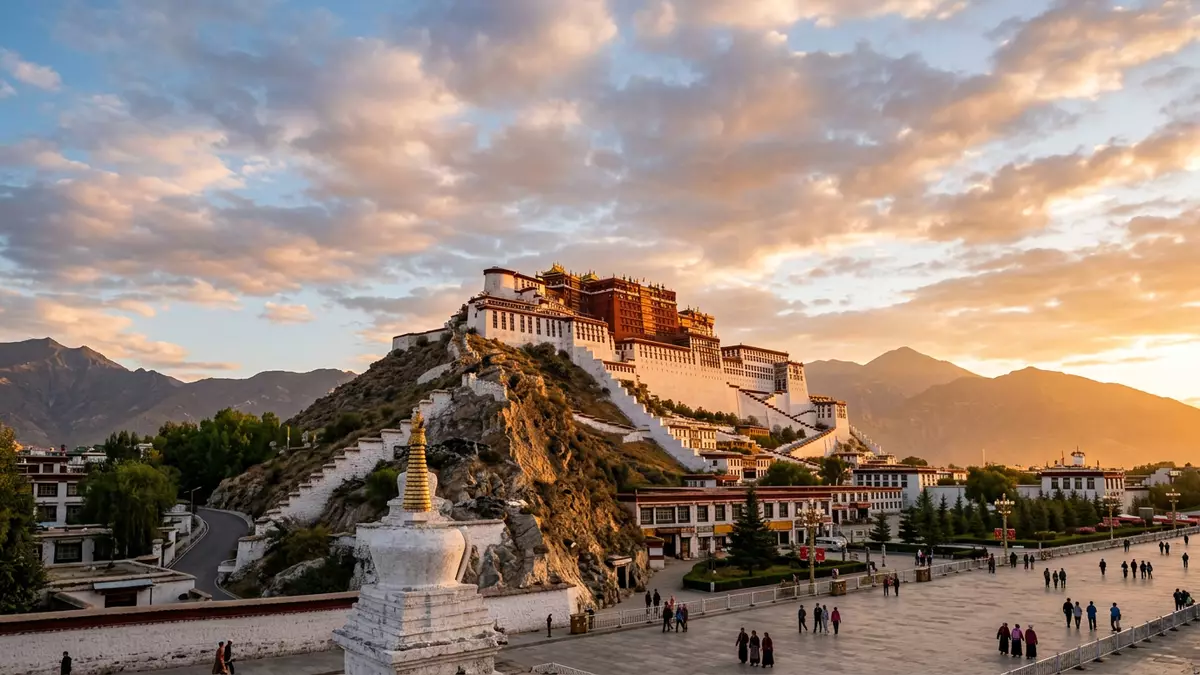
Potala in Lhasa is the palace complex on Marpo Ri, the Red Hill, and its white and red masses remain the strongest visual argument for Tibetan state power and religious authority. The Historic Ensemble of the Potala Palace is a UNESCO World Heritage site, and the complex is linked with the fifth Dalai Lama, Lozang Gyatso, and the seventeenth century.
White walls, red core
The palace presents a steep sequence of stone walls, white exterior surfaces and a red central mass, with flat roofs and a strong hilltop profile. Its present fabric belongs chiefly to the Ganden Phodrang project that began in 1645 and continued into the late seventeenth century.
The White Palace and Red Palace remain the two names most closely associated with the building. The palace also preserves the memory of Songtsen Gampo, the Tibetan king linked to the earliest palace on the site in the seventh century.
Patronage, period and historical weight
The standing monument is inseparable from the fifth Dalai Lama, who ordered the major rebuilding in 1645. The result became the winter palace of the Dalai Lamas and a centre of government in Lhasa.
Its inscription as part of the Historic Ensemble of the Potala Palace, Lhasa places it within a wider group that includes the Jokhang Temple and Norbulingka. That wider setting frames Potala as both a palace and a religious monument in the Tibetan plateau city.
Stone, timber and the hill in Lhasa
Potala rises from Marpo Ri rather than spreading across level ground, and the hill itself is part of the reading of the place. The structure combines rammed earth, stone and timber, a material palette that gives the palace its dense and layered appearance.
Its long façade and stacked volumes create a mass that reads more like a fortified mountain than a conventional residence. That effect belongs to the building’s form, not to any separate commentary on it.
Visiting Potala: what travellers from Western Europe should know
- Potala stands in Lhasa, in the Tibet Autonomous Region of China, on Marpo Ri above the city centre.
- The approach involves the hillside setting and extensive stairways within the complex, so the monument is not a level, single-floor visit.
- The official language is Mandarin Chinese and the currency is the Chinese yuan.
- Entry requirements depend on your nationality; UK travellers can check the FCDO travel advice at gov.uk/foreign-travel-advice, Irish travellers the Department of Foreign Affairs at ireland.ie.
Searching for Potala on social platforms
These links open searches for Potala on each platform.
Frequently asked questions about Potala
Where is Potala?
Potala is in Lhasa, on Marpo Ri in the Tibet Autonomous Region of China. It rises above the city as a hilltop palace complex.
What does a visit involve?
The place is shaped by slopes, stairways and a multi-part complex rather than a flat plan. Its white, red and stone surfaces dominate the experience of the hill.
What makes Potala distinctive?
Its identity comes from the combination of the fifth Dalai Lama’s seventeenth-century rebuilding, the earlier association with Songtsen Gampo, and its World Heritage status.


