
Potala Palace in Lhasa: a mountain of stone and faith
Published on 08/14/2026 at 14:09 | Editorial responsibility: Rafael Müller, Editor-in-Chief AD HOC NEWS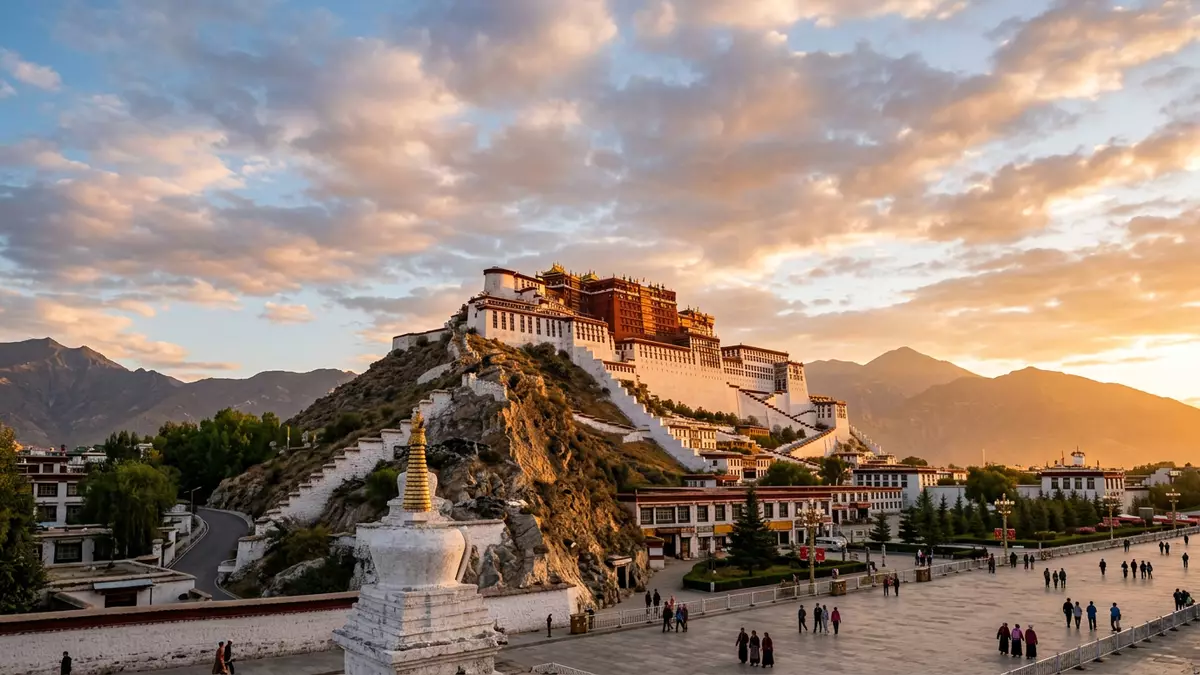
Potala in Lhasa is a vast palace and monastery built into Red Mountain, where Tibetan rulers and Dalai Lamas turned a bare ridge into a stepped mass of stone, timber and shrine-filled halls in the seventeenth century.
Potala on Red Mountain above the Lhasa valley
Potala stands on Marpo Ri, the “Red Mountain”, above the central Lhasa valley in the Tibet Autonomous Region of China, with its highest point around 3,700 m (12,140 ft) above sea level.Red Mountain in the centre of Lhasa Valley The palace complex crowns the ridge with a layered profile of sloping walls, flat roofs and projecting towers that appear to grow straight out of the rock.
The present Potala was begun in 1645 under the Fifth Dalai Lama Ngawang Lobsang Gyatso, who made it the seat of government and spiritual authority for the Ganden Phodrang administration.Begun 1645 Work on the White Palace was completed in 1648, while the Red Palace above followed in the 1690s, giving Potala its characteristic tiered form and enclosing a labyrinth of chapels, audience halls and stairways within thick masonry.
A layered palace of white and red
The vast building is divided into two principal parts: the lower White Palace, used for temporal affairs and daily residence, and the upper Red Palace, devoted to religious functions and chapel complexes.White Palace and Red Palace From the outside, bands of whitewashed walls, dark window frames and deep red upper structures mark the transition from administrative quarters to ritual spaces, with gilded roof elements catching the high-altitude light.
Inside, stone walls and timber beams support multiple levels of rooms that range from simple monk cells to grand halls lined with thangka paintings, carved altars and reliquary stupas of successive Dalai Lamas.Thirteen-storey seat of government Potala’s plan adapts to the ridge it sits on, stepping up in terraces that follow the mountain’s contours and give long views across the city and towards the surrounding Himalayan ranges.
Seat of the Dalai Lama and World Heritage ensemble
From the seventeenth century until 1959, Potala served as the winter residence of the Dalai Lamas and the headquarters of the Tibetan government, combining secular offices, living quarters and religious chambers within one fortified complex.winter residence of the Dalai Lama The palace formed part of a wider ensemble that included Norbulingka, the summer residence, and Jokhang Temple in the old town, together shaping the religious and political landscape of Lhasa.
In 1994 the Historic Ensemble of the Potala Palace, Lhasa, including Potala, Jokhang and Norbulingka, was inscribed as a UNESCO World Heritage Site, recognising its role as a symbol of Tibetan Buddhism and traditional administration.Historic Ensemble of the Potala Palace The listing emphasises the palace’s classical Tibetan architecture, with earth, stone and wood construction, battered walls and inward-looking courtyards sitting directly on the mountain slope.
Visiting Potala: what travellers from Western Europe should know
- Potala rises above central Lhasa in the Tibet Autonomous Region, reached from the city’s streets by approach paths and stairways that climb the lower slopes of Red Mountain.
- The palace complex stands at high altitude and access involves climbing stone stairways and ramps, with significant changes in level between the base and the upper terraces.
- The official language is Chinese and Tibetan and the currency is the Chinese yuan.
- Entry requirements depend on your nationality; UK travellers can check the FCDO travel advice at gov.uk/foreign-travel-advice, Irish travellers the Department of Foreign Affairs at ireland.ie.
Searching for Potala on social platforms
These links open searches for Potala on each platform.
Frequently asked questions about Potala
Where is Potala located?
Potala stands on Red Mountain above central Lhasa in the Tibet Autonomous Region of China, overlooking the urban valley at around 3,700 m (12,140 ft).
What can visitors expect at Potala?
Visitors encounter a vast palace and monastery complex with steep stone approaches, multi-level halls, chapels, monk quarters and views across Lhasa from the upper terraces.
What makes Potala distinctive among Himalayan sites?
Potala is distinctive for combining a mountain-top palace, monastery and former seat of the Dalai Lama in one stepped structure, inscribed as part of a UNESCO World Heritage ensemble.


