
Potala Palace in Lhasa: a mountain of stone, faith and power
Published on 09/12/2026 at 21:09 | Editorial responsibility: Rafael Müller, Editor-in-Chief AD HOC NEWS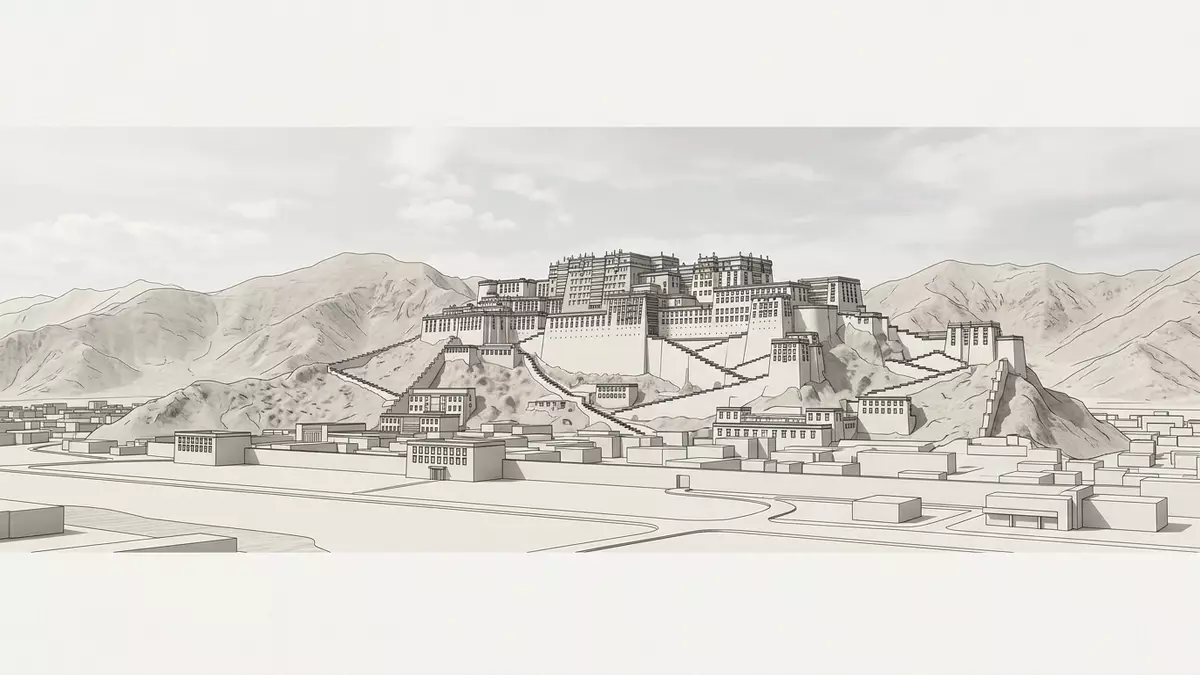
Potala Palace dominates the skyline of Lhasa, its white and red walls rising directly from a rocky hill to form one of the most recognisable silhouettes in Tibet. Built on Marpo Ri, the “Red Hill” in the centre of the Lhasa Valley, it combines fortress, monastery and palace in a single stepped mass of stone and timber that reads as much as a piece of mountain architecture as a building.Built on Marpo Ri
From Songtsen Gampo’s hilltop palace to the seat of the Dalai Lamas
The story of Potala Palace begins in the seventh century, when the Tibetan king Songtsen Gampo shifted his court to Lhasa and established a palace on the same hill.Songtsen Gampo moved his capital to Lhasa That first palace, traditionally dated to 637, stood above the growing town and reflected the rise of Lhasa as a political and religious centre.The earlier palace is traditionally dated to 637 The present Potala Palace is the result of a later rebuilding that turned the hill into the formal seat of the Dalai Lamas.
In 1645 the Fifth Dalai Lama, Lozang Gyatso, ordered the construction of a new palace complex on Marpo Ri, expanding the site into a multi-storey structure that could accommodate both religious authority and government.Construction began under the Fifth Dalai Lama in 1645 The first major phase produced the White Palace, completed in 1648 and adopted as the Dalai Lama’s residence and administrative centre.The White Palace was completed in 1648 Later in the seventeenth century the Red Palace followed, turning the hilltop into a layered complex that functioned as winter palace and government seat until the mid twentieth century.The Red Palace was added in the 1690s
Architecture on a cliff: white walls, red core and stepped roofs
Potala Palace is built in the Tibetan dzong style, combining massive outer walls with inwardly stacked rooms and chapels that climb the slope in terraces.Potala is built in the dzong style The complex rises to thirteen storeys, using stone and timber construction to anchor hundreds of rooms, galleries and shrines directly into the rock.The thirteen-storey palace combines fortress and monastery Seen from the city below, the broad white base and upper red section form a clear hierarchy: the White Palace houses the secular and residential functions, while the Red Palace is given over largely to religious halls and stupas.
The façades of Potala Palace carry bands of window openings framed by dark timber, with projecting galleries and rooflines that step back as they climb, echoing the broken form of the underlying hill. Within, the Red Palace contains richly painted assembly halls and chapels, including the tomb stupas of several Dalai Lamas, enclosed in gilded structures that rise through multiple levels.The Red Palace houses the stupas of Dalai Lamas The White Palace’s rooms form a warren of corridors, audience halls and private apartments, linked by staircases that climb between floors and up to roof terraces overlooking Lhasa and the plain beyond.The White Palace once served as the seat of the Tibetan government
Religion, politics and World Heritage on the Red Hill
For centuries Potala Palace served as the winter residence of the Dalai Lamas and the principal seat of the Tibetan government, binding religious leadership and political power into a single institution housed within its walls.The palace was the winter residence and government seat Its position above Lhasa placed it between the great monastic centres of Drepung and Sera and the old city, physically marking the link between temple, administration and urban life.Marpo Ri lies between Drepung, Sera and the old city After 1959 the palace complex took on a new role as a museum, even as its architecture and artefacts continued to express Tibetan Buddhist traditions.
In 1994 UNESCO inscribed the Historic Ensemble of the Potala Palace, Lhasa, on the World Heritage List, recognising the palace and its surroundings as an outstanding example of Tibetan architecture and a symbol of Tibetan Buddhism’s role in the region.The Historic Ensemble of the Potala Palace was inscribed in 1994 The designation was later extended to include Jokhang Temple and Norbulingka, forming a trio of sites that together represent the religious and governmental heart of historic Lhasa.The ensemble includes Jokhang and Norbulingka Within Potala Palace itself, the combination of fortified outer shell, monastic interiors and ceremonial spaces continues to convey the layered identity of the complex as both power centre and sacred site.
Visiting Potala: what travellers from Western Europe should know
- Potala Palace stands on Marpo Ri in central Lhasa, within the Tibet Autonomous Region of China, reached from the city’s streets by approaches that climb steadily up the hill.
- The complex is built on a high rocky slope, and a visit involves walking up long staircases and stepped paths, with significant altitude and many flights of steps inside the palace.
- The official language is Chinese and the currency is the renminbi (yuan), though Tibetan is also widely used in Lhasa.
- Entry requirements depend on your nationality; UK travellers can check the FCDO travel advice at gov.uk/foreign-travel-advice, Irish travellers the Department of Foreign Affairs at ireland.ie.
Searching for Potala on social platforms
These links open searches for Potala on each platform.Frequently asked questions about Potala
Where is Potala Palace and what is its setting?
Potala Palace stands on Marpo Ri, the Red Hill in central Lhasa, rising above the Lhasa Valley within the Tibet Autonomous Region of China.The palace stands on Marpo Ri in the Lhasa Valley
What should visitors expect on a visit to Potala Palace?
A visit involves climbing staircases and stepped paths up the hill and moving through multi-storey interiors with chapels, audience halls and roof terraces, all at high altitude.
What makes Potala Palace distinctive among Tibetan sites?
Its combination of fortress-like massing, the White and Red Palace sections, and its historic role as winter residence of the Dalai Lamas and seat of the Tibetan government give Potala Palace a character closely tied to Tibetan Buddhism and governance.The World Heritage listing recognises its religious and governmental role


