
Potala rises above Lhasa as a palace of white and red
Published on 09/23/2026 at 18:55 | Editorial responsibility: Rafael Müller, Editor-in-Chief AD HOC NEWS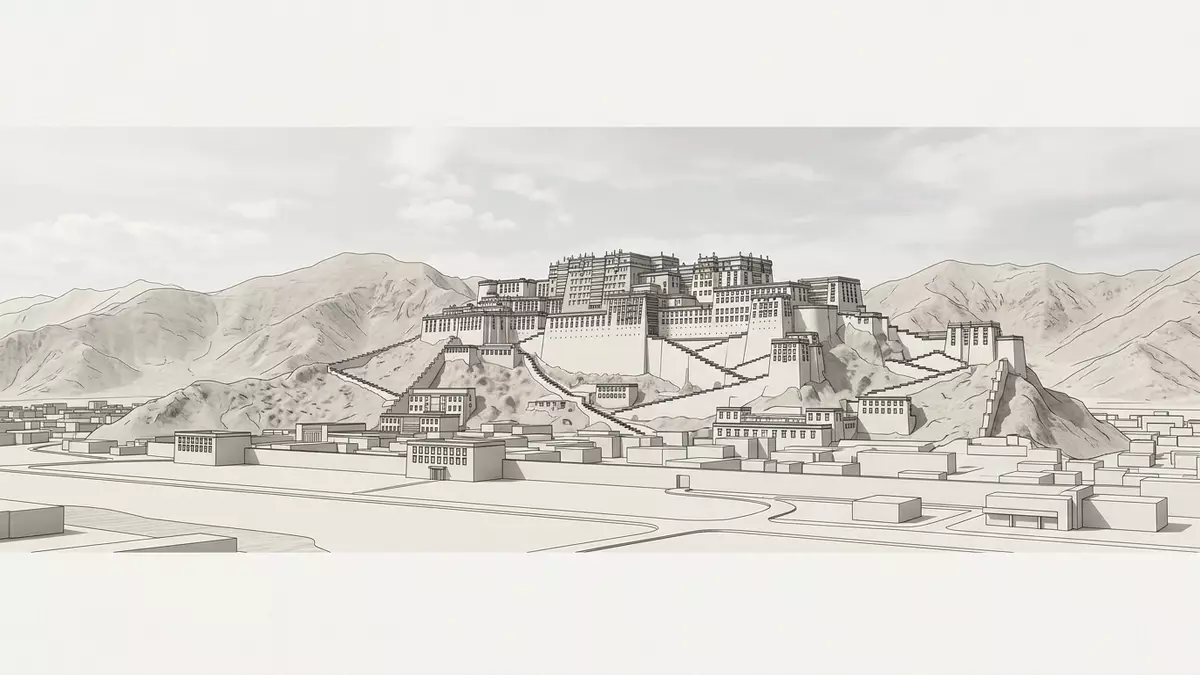
Potala rises above Lhasa as a broad composition of white walls, red halls and gilded roofs. The palace stands on Red Mountain, with the city and the Lhasa Valley below, and combines the forms of a fortress, monastery and royal residence.
White Palace and Red Palace on Red Mountain
The building visible today belongs chiefly to the seventeenth-century expansion of Potala. Construction began in 1645 under the Fifth Dalai Lama, Lozang Gyatso, with the White Palace forming the first major phase. The Red Palace followed between 1690 and 1694 under his regent Desi Sanggye Gyatso, creating the central religious section of the complex. the seventeenth-century phases are visible in the distinction between the two principal colours.
The White Palace contains halls and residential spaces associated with government and the Dalai Lama’s residence. The Red Palace contains chapels, shrines and sacred images, together with the tombs of several Dalai Lamas. Potala’s architecture uses thick walls, timber structures, painted decoration and gilded details in a dense arrangement on the mountain.
Potala and the history of Tibetan rule
Potala’s historical layers reach back to the seventh century, when King Songtsen Gampo established an earlier palace on the mountain. The complex is connected with the rise of Lhasa as a political and religious centre, and its name refers to Mount Potala, associated with Avalokiteshvara in Tibetan Buddhism.
The seventeenth-century palace became the winter residence of the Dalai Lamas and the seat of the Ganden Phodrang government. Its rooms joined religious practice with administration, while its summit chapels preserved paintings, statues, scriptures and ritual objects. The palace’s former political role and its continuing religious importance remain part of the meaning carried by its walls.
A monumental Tibetan architectural composition
Potala rises to roughly 117 m (384 ft) above Red Mountain and occupies a large complex of halls, courtyards, stairways and chapels. Its elevated position gives the building a strong vertical profile, while the horizontal sweep of the lower walls connects the palace with the rocky hill.
The complex forms part of the Historic Ensemble of the Potala Palace, Jokhang Temple and Norbulingka. Potala entered the UNESCO World Heritage List in 1994, with the Jokhang Temple and Norbulingka added to the ensemble in 2000 and 2001. the protected historic ensemble records the religious, symbolic and administrative character of Lhasa’s historic centre.
Visiting Potala: what travellers from Western Europe should know
- Potala stands on Red Mountain in central Lhasa, Tibet Autonomous Region, China. Roads and urban transport connect the palace with the surrounding city.
- The palace is at an altitude of about 3,700 m (12,139 ft). Its approach includes steep ground, stairways and elevated courtyards.
- Interior spaces include chapels, painted halls, tombs, religious objects and passageways within a large historic complex.
- The official language is Mandarin Chinese and the currency is the Chinese yuan.
- Entry requirements depend on your nationality; UK travellers can check the FCDO travel advice at gov.uk/foreign-travel-advice, Irish travellers the Department of Foreign Affairs at ireland.ie.
Searching for Potala on social platforms
These links open searches for Potala on each platform.
Frequently asked questions about Potala
Where is Potala?
Potala stands on Red Mountain in Lhasa, in China’s Tibet Autonomous Region. The palace overlooks the Lhasa Valley from an altitude of about 3,700 m.
What can visitors expect inside?
The interior contains chapels, painted halls, sacred images, scriptures, courtyards and the tombs of Dalai Lamas. Stairways and elevated passages connect the principal sections.
What makes Potala distinctive?
Its white and red palaces form a single monumental complex combining religious, administrative and residential spaces. The seventeenth-century building also carries the history of Tibetan Buddhist government in Lhasa.


