
Praza do Obradoiro and its four monumental faces in Santiago de Compostela
Published on 08/23/2026 at 12:08 | Editorial responsibility: Rafael Müller, Editor-in-Chief AD HOC NEWS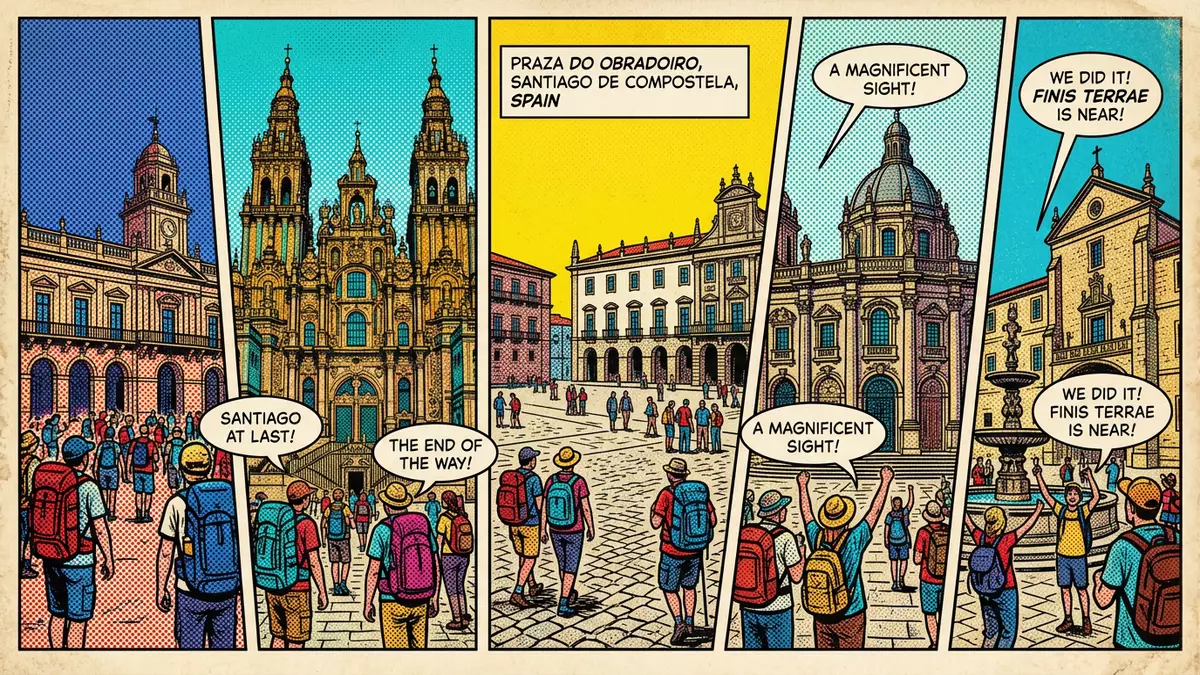
Praza do Obradoiro is the monumental square at the western front of Santiago de Compostela Cathedral, where four major buildings face one another across an open granite surface that marks the end of the Camino de Santiago. Its Galician name refers to the craftsmen’s workshop that stood here during the building of the cathedral, reflecting the square’s origins as a place of labour as well as arrival. Today it reads at a glance as an architectural cross-section of Galicia’s political, religious and academic life, concentrated into a single urban space.
A rectangle framed by four institutions
The square takes a rectangular form, enclosed on each side by a building that has shaped the identity of Santiago de Compostela. On the eastern side stands the Obradoiro façade of Santiago de Compostela Cathedral, the great Baroque front that conceals the older Romanesque structure within and presents towers, statuary and stonework towards the open space of the square.Obradoiro façade of the Cathedral Opposite it to the west runs the long elevation of the Pazo de Raxoi, an eighteenth-century building in a Neoclassical style that serves as seat of the municipal and regional authorities, its rhythmic colonnade and pediment framing the square.
The northern side is taken up by the Real Hostal dos Reis Católicos, founded by the Catholic Monarchs Ferdinand II of Aragon and Isabella I of Castile in the early sixteenth century as a hospital for pilgrims and now operating as a state-owned parador hotel.Hostal dos Reis Católicos To the south stands the Colegio de San Xerome, which houses the rectorate of the University of Santiago de Compostela and presents a portal with Romanesque and Gothic features brought from an earlier college site.Colegio de San Xerome rectorate Between them, the four buildings turn the space into a visible junction of faith, civic authority, hospitality and scholarship.
From stonemasons’ ground to pilgrimage end point
The name “Obradoiro” derives from the workshops that occupied this side of the cathedral during its construction, where stonemasons prepared columns, portals and sculptural pieces for the fabric of the building.name “obradoiro” meaning workshop The square that emerges from that work is paved largely in granite and free of road traffic, allowing uninterrupted views between the façades and making the expanse itself feel like an antechamber to the cathedral’s Pórtico da Gloria. The western front of the cathedral rises directly from the edge of the square, so that crossing the open ground and then the threshold into the nave follows the logic of a processional route.
Towards the centre of the square a stone marker in the paving records the Council of Europe’s 1987 recognition of the Camino de Santiago as the first European Cultural Route, a small but precise sign that this urban space is treated as the kilometre zero for the pilgrimage routes that converge on the city.granite marker for the Camino Pilgrims who arrive from Galicia’s countryside or from other regions of Spain and Europe step into a square that is deliberately kept open of commercial terraces and marquees, so that the line of sight from paving to towers remains clear. The large granite surface, broken only by surface patterns such as scallop shell motifs, gives the space a coherent character, tying the different architectural styles together under a single ground material.granite paving with scallop shell
Layers of style around a single urban void
Praza do Obradoiro is often described through the contrast between its empty centre and the rich architectural envelope around it. The cathedral façade presents exuberant Baroque forms raised on an older Romanesque structure, the Hostal dos Reis Católicos carries Renaissance decoration, the Pazo de Raxoi reads as Neoclassical, and the portal of the Colegio de San Xerome carries Gothic detail.Baroque, Renaissance, Neoclassical and Gothic This mix of styles developed over several centuries as each institution consolidated its presence facing the square, producing a kind of stone archive of changing tastes and political arrangements.
Despite this variety, the buildings share certain features that make the ensemble read as a coherent whole. All present long, largely horizontal elevations to the square, punctuated by towers or pediments but maintaining a similar overall height. Their façades are built in local stone, so their different carvings and window patterns still present closely related colours and textures. The absence of permanent structures in the centre of the square means that each side can be seen in full, and the experience of crossing the space involves a continuous shifting of focus between cathedral, palace, hostel and university building rather than a single dominant perspective.four representative buildings of the city
Visiting Praza do Obradoiro: what travellers from Western Europe should know
- Praza do Obradoiro lies in the historic centre of Santiago de Compostela, in Galicia in the north-west of Spain, directly in front of the western front of the cathedral and reached on foot along narrow streets from the surrounding old town.
- The square itself is level and paved with granite, but approaches from some directions pass along streets with gradients and stone surfaces, and entry into the cathedral from the square involves staircases inside the building.
- The surrounding buildings include the Hostal dos Reis Católicos, the Pazo de Raxoi and the rectorate of the University of Santiago de Compostela, so visitors crossing the square move between religious precinct, civic offices, historic hostel and university doorway.
- The official language in this part of Spain is Spanish, alongside widespread use of Galician, and the currency is the euro.
Searching for Praza do Obradoiro on social platforms
These links open searches for Praza do Obradoiro on each platform.
Frequently asked questions about Praza do Obradoiro
Where is Praza do Obradoiro located within Santiago de Compostela?
Praza do Obradoiro sits in the historic centre of Santiago de Compostela in Galicia, on the western side of the cathedral and surrounded by civic, university and former hospital buildings.
What should visitors expect when they arrive in the square?
Visitors enter a broad, largely traffic-free granite space framed by the cathedral façade, the Hostal dos Reis Católicos, the Pazo de Raxoi and the rectorate of the University of Santiago de Compostela, with clear views to each side.
What makes Praza do Obradoiro distinctive compared with other urban squares?
Praza do Obradoiro brings together pilgrimage routes, cathedral, civic palace, historic hostel and university façade around a single open granite square, concentrating centuries of religious and political history into one clearly readable urban setting.


