
Preah Barum Reachea Veang Chaktomuk, the riverfront royal compound of Phnom Penh
Published on 09/08/2026 at 07:46 | Editorial responsibility: Rafael Müller, Editor-in-Chief AD HOC NEWS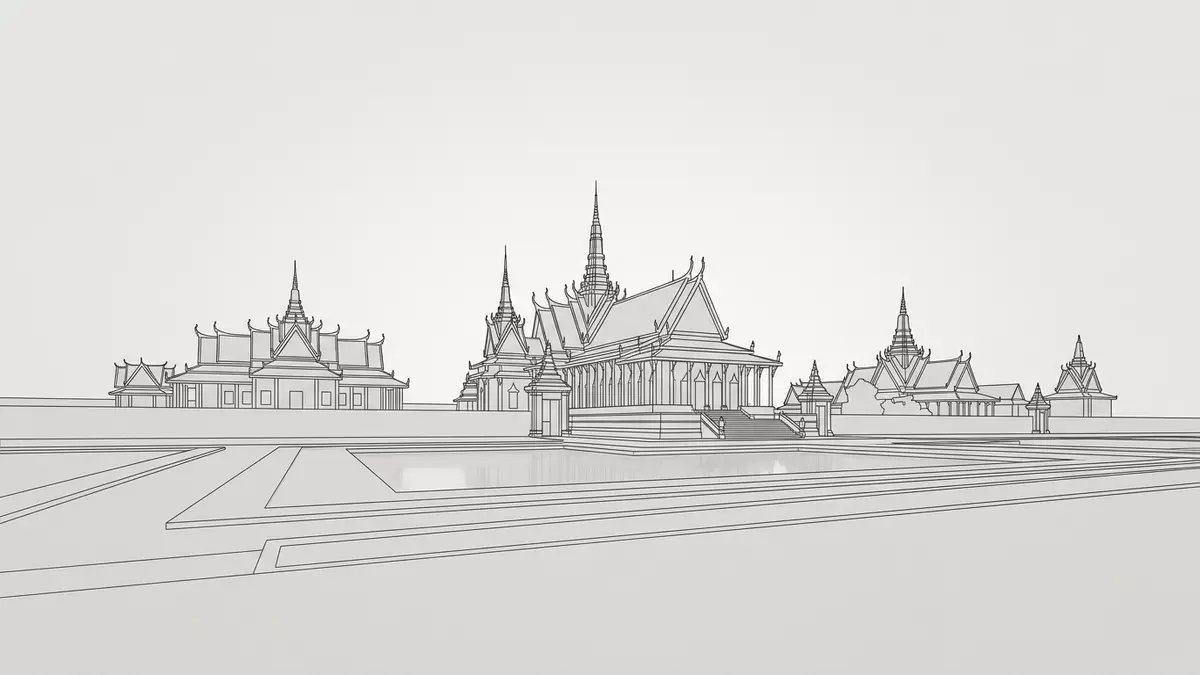
Preah Barum Reachea Veang Chaktomuk, known in English as the Royal Palace of Cambodia, is the walled royal compound on the riverside of Phnom Penh that serves as the official residence of the King of Cambodia. Rising behind pale boundary walls and tiered, gilded roofs, the palace anchors the Cambodian capital at the meeting point of the Mekong and Tonlé Sap rivers, a location that has long linked royal authority with water and trade in this part of Southeast Asia.Royal Palace of Cambodia
Khmer roofs, throne halls and pagodas within the palace walls
Within the enclosure of Preah Barum Reachea Veang Chaktomuk lies a sequence of halls, pavilions and pagodas built in Khmer architectural style, their multi-tiered roofs and pointed spires visible above the yellow-painted perimeter walls.multi-tiered roofs The central Throne Hall, rebuilt in the early twentieth century, stands as the ceremonial heart of the complex, used for coronations and formal state occasions and distinguished by its tall central tower and surrounding galleries.Throne Hall
To one side of the main axis, the Silver Pagoda, or Wat Preah Keo, forms a separate but connected compound with its own cloister and courtyard. Its floor is paved with thousands of silver tiles, and the interior houses a collection of Buddha images, including a figure of the Maitreya Buddha in precious metal described in many accounts of the site.Silver Pagoda with silver tiles Around these core structures, smaller pavilions, formal gardens and courtyards are arranged to create a series of distinct ceremonial and residential zones within the palace grounds.
A nineteenth-century royal residence shaped by Khmer and French influences
The present form of Preah Barum Reachea Veang Chaktomuk dates largely to the nineteenth and early twentieth centuries, when Phnom Penh became the capital of Cambodia and the court moved from Oudong under King Norodom I in the 1860s.move from Oudong Construction of the palace began in the late 1860s and continued into the early 1870s, with the compound expanding and being modified over subsequent reigns as buildings were added, rebuilt and refurbished.built from 1866 onwards The complex reflects Khmer architectural traditions in its roof forms and decorative details, while also incorporating elements influenced by French colonial planning, visible in the geometry of some gardens and the presence of European-style structures on the grounds.
The Throne Hall visitors see today dates from the period between 1913 and 1919, when a wooden predecessor was replaced by the current masonry structure under King Sisowath, giving the palace its now-familiar silhouette on the Phnom Penh skyline.present Throne Hall dates from 1919 Across political upheavals, including the era of the Khmer Rouge, the palace complex has remained the seat of the Cambodian monarchy, and its buildings continue to host rituals and state ceremonies even as parts of the compound are opened to visitors.
Riverside setting at Chaktomuk in Phnom Penh
Preah Barum Reachea Veang Chaktomuk stands along Samdech Sothearos Boulevard in central Phnom Penh, on the western bank of the Mekong and Tonlé Sap rivers at the junction known as Chaktomuk.western bank at Chaktomuk This confluence, where the Mekong divides into several branches including the Tonlé Bassac, has long been noted in descriptions of Phnom Penh and gives the palace its extended Khmer name referring to “four faces” or “four rivers”.full Khmer name
The palace compound forms a distinct edge between the riverfront promenade and the inland blocks of ministries, museums and commercial streets, with its eastern orientation aligning key halls towards the water.stands along Samdech Sothearos Boulevard Nearby landmarks include the National Museum of Cambodia and the landscaped riverfront, making Preah Barum Reachea Veang Chaktomuk part of a wider ensemble of civic, religious and cultural sites concentrated around Phnom Penh’s central riverside.
Visiting Preah Barum Reachea Veang Chaktomuk: what travellers from Western Europe should know
- Preah Barum Reachea Veang Chaktomuk stands in central Phnom Penh along Samdech Sothearos Boulevard on the western bank of the Mekong and Tonlé Sap rivers at the junction known as Chaktomuk.
- The palace compound is enclosed by boundary walls and includes large open courtyards, formal gardens and interior staircases; a visit involves walking between halls and across paved outdoor spaces.
- The National Museum of Cambodia lies close to the palace on the inland side of Samdech Sothearos Boulevard, and the riverside promenade runs immediately to the east along the Mekong and Tonlé Sap.
- The official language is Khmer and the currency is the Cambodian riel.
- Entry requirements depend on your nationality; UK travellers can check the FCDO travel advice at gov.uk/foreign-travel-advice, Irish travellers the Department of Foreign Affairs at ireland.ie.
Searching for Preah Barum Reachea Veang Chaktomuk on social platforms
These links open searches for Preah Barum Reachea Veang Chaktomuk on each platform.
Frequently asked questions about Preah Barum Reachea Veang Chaktomuk
Where is Preah Barum Reachea Veang Chaktomuk located?
Preah Barum Reachea Veang Chaktomuk stands along Samdech Sothearos Boulevard in central Phnom Penh, Cambodia, on the western bank of the Mekong and Tonlé Sap rivers at Chaktomuk.
What can visitors expect when entering the palace compound?
Visitors encounter Khmer-style throne halls, pagodas and pavilions arranged around courtyards and formal gardens, with parts of the compound accessible and others reserved for the Cambodian royal household.
What makes Preah Barum Reachea Veang Chaktomuk distinctive among royal palaces?
Its combination of Khmer ceremonial architecture, features such as the Silver Pagoda’s silver-tiled floor and its riverside position at the Mekong–Tonlé Sap confluence gives the palace a character closely tied to Phnom Penh’s royal riverfront.


