
Puente Romano de Salamanca and its two stone histories
Published on 09/22/2026 at 14:10 | Editorial responsibility: Rafael Müller, Editor-in-Chief AD HOC NEWS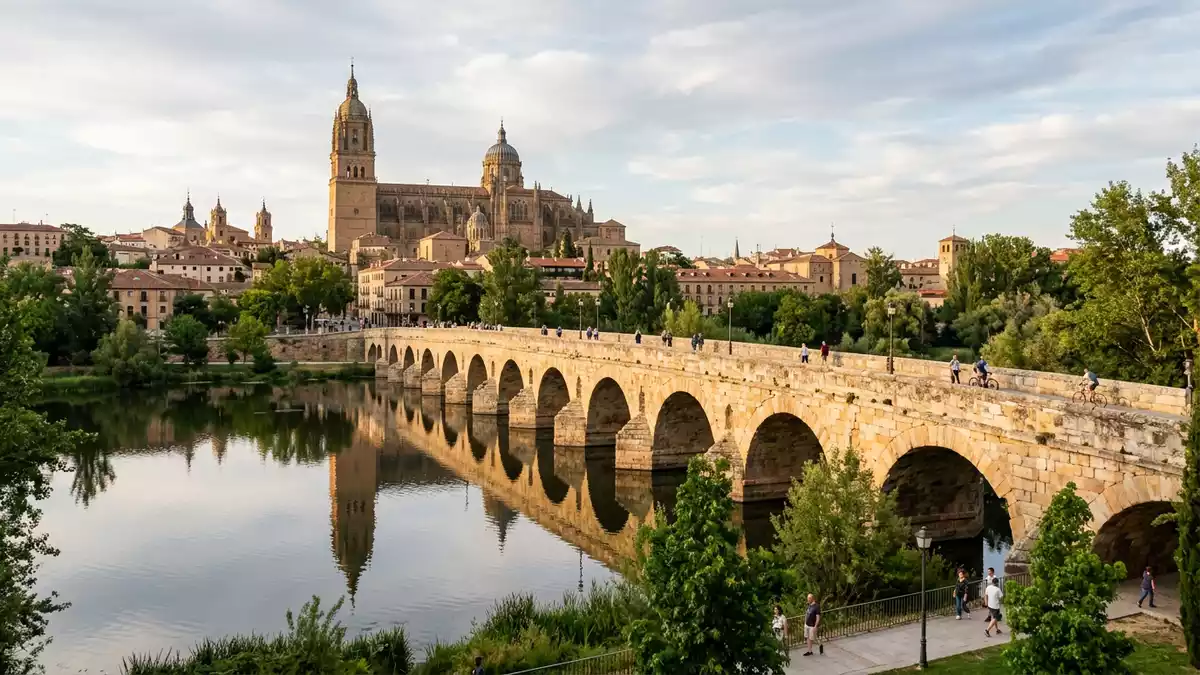
Puente Romano de Salamanca crosses the River Tormes beside Salamanca’s historic centre. Its long stone line combines Roman arches near the city with later masonry farther across the river, making the bridge a visible record of different periods.
Puente Romano de Salamanca: a Roman crossing beside Salamanca
The bridge belongs to Salamanca, in Castile and León, western Spain. It crosses the Tormes on the southern side of the city, where the river separates the old urban core from the Arrabal district and riverside paths.
Puente Romano de Salamanca forms part of the Vía de la Plata, the Roman road linking Mérida with Astorga. The route ran through western Hispania, and the bridge connected the road across the Tormes with Salmantica.
The bridge is included in the setting of Salamanca’s old city, whose historic fabric received UNESCO World Heritage status in 1988. The Roman crossing appears at the southern edge of that protected urban landscape.
Fourteen Roman arches and a later bridge
The surviving structure is made from granite and consists of a sequence of round arches supported by substantial piers. The section nearest the city preserves the Roman fabric, while the section farther from the city belongs to later rebuilding.
Sources give different totals for the bridge’s arches, with figures of 26 and 27 appearing in published descriptions. The stable feature is the division between the Roman section and the later section, not a single uncontested total.
The Roman portion is traditionally dated to the first century AD. Its construction falls within the Roman imperial period associated with Augustus and Vespasian, although the precise year remains uncertain.
The name of Emperor Trajan is also connected with the bridge in descriptions of the Vía de la Plata. The date and attribution should be kept separate: the Roman period is secure, while the exact imperial phase is less certain.
The Tormes, the city gate and the stone boar
Puente Romano de Salamanca is more than a crossing visible from the riverbank. Its position places the pedestrian route between the water, the old city and the road corridor that once continued through Hispania.
At the city entrance stands a granite verraco, an animal sculpture associated with the pre-Roman Vettones. The sculpture and the bridge both appear in Salamanca’s civic identity.
The bridge also belongs to the visual approach towards Salamanca’s historic centre. From the Tormes, the route leads towards the city’s monumental district, including the Old Cathedral, the New Cathedral and Casa Lis.
Its present form records repeated intervention without turning the whole structure into a modern copy. Roman masonry remains closest to Salamanca, while rebuilt arches continue the crossing towards the opposite bank.
Visiting Puente Romano de Salamanca: what travellers from Western Europe should know
- Puente Romano de Salamanca lies south of Salamanca’s historic centre, across the River Tormes. The address is Paseo del Rector Esperabé, near the river and the old city.
- The bridge is a pedestrian crossing. Its stone surface runs above the river, with the approach connecting the urban side to riverside paths and the Arrabal district.
- The crossing forms part of the Vía de la Plata route between Mérida and Astorga. The granite verraco stands at the city-side entrance.
- Salamanca is in Spain, where Spanish is the official language and the euro is the national currency.
Searching for Puente Romano de Salamanca on social platforms
These links open searches for Puente Romano de Salamanca on each platform.Frequently asked questions about Puente Romano de Salamanca
Where is Puente Romano de Salamanca?
It crosses the River Tormes on the southern side of Salamanca, beside the city’s historic centre. The route continues towards the Arrabal district and the riverside paths.
What can visitors expect from the bridge?
Visitors find a pedestrian stone crossing with Roman masonry near the city and later rebuilt arches towards the opposite bank. The route also includes the granite verraco at the city-side entrance.
What makes Puente Romano de Salamanca distinctive?
Its Roman origin, granite construction and place on the Vía de la Plata connect the Tormes with Salamanca’s old city. The surviving bridge visibly combines ancient and later sections.


