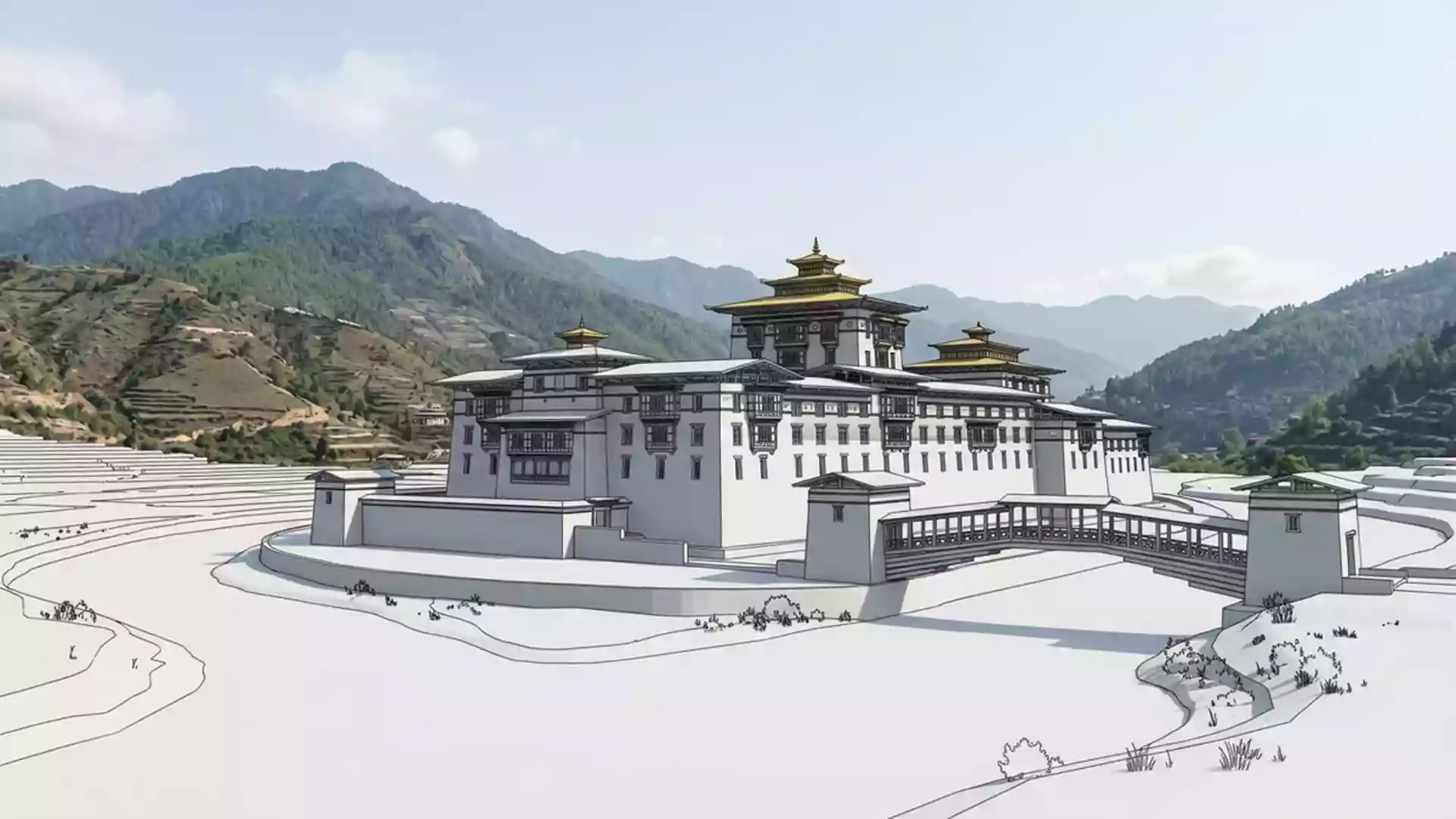
Pungthang Dewachen Phodrang between two rivers in Punakha
Published on 08/24/2026 at 13:54 | Editorial responsibility: Rafael Müller, Editor-in-Chief AD HOC NEWS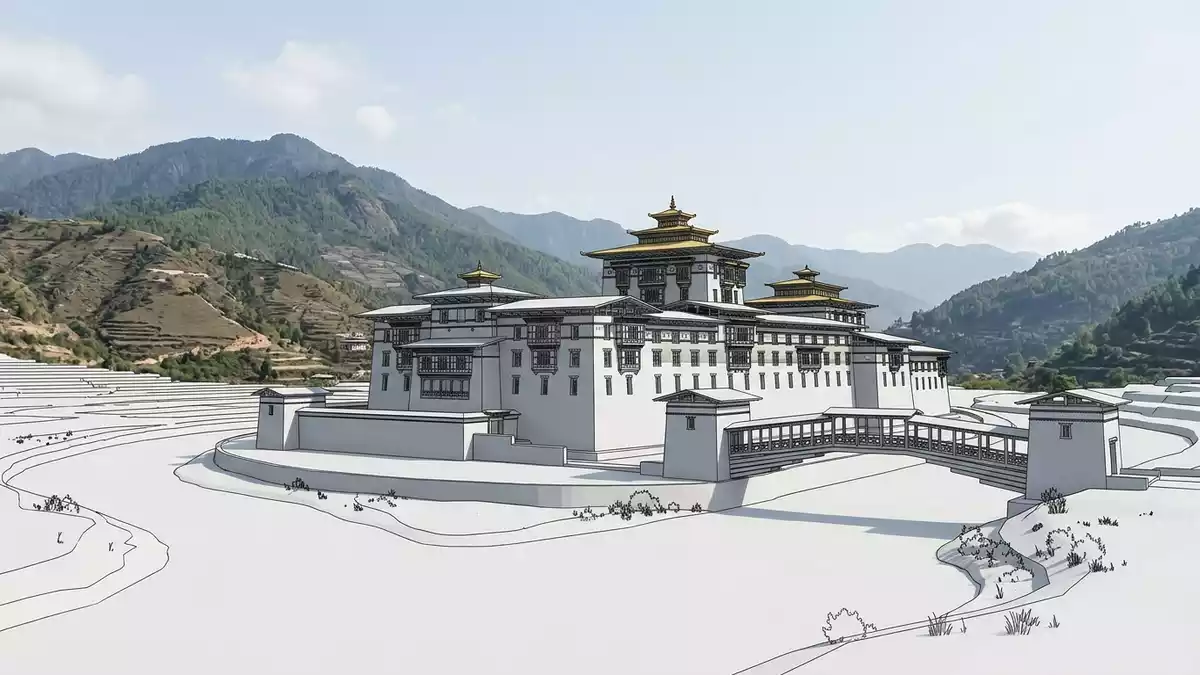
Pungthang Dewachen Phodrang, the “palace of great happiness or bliss”, is the monumental monastic fortress that dominates the valley at Punakha in Bhutan. Built in the seventeenth century under Zhabdrung Ngawang Namgyal, it stands at the meeting of two rivers and stretches out as a long, multi-level structure that has shaped Bhutanese religious and political life for centuries.
A fortressed palace of happiness
Pungthang Dewachen Phodrang is a dzong, the characteristic Bhutanese combination of fortress, monastery and administrative centre built in massive stone and timber. It was constructed in 1637–38 on the orders of Zhabdrung Ngawang Namgyal, the Tibetan lama who unified Bhutan and established it as a distinct polity.constructed in 1637–38 The building’s full formal name, often rendered as Pungtang Dechen Photrang Dzong, is commonly translated as “palace of great happiness or bliss”, and that idea of happiness is bound into its identity as both a spiritual and political centre.palace of great happiness
The dzong served as Bhutan’s capital and the seat of government until the mid twentieth century, before those functions moved to Thimphu.capital and seat of government It remains the administrative centre of Punakha District and the winter residence of the central monastic body, so the rhythms of state and religion still pass through its courtyards and assembly halls.administrative centre of Punakha District The dzong houses revered relics of the Drukpa Kagyu school of Buddhism, including the remains of Zhabdrung Ngawang Namgyal and artefacts associated with the tertön, or treasure revealer, Pema Lingpa, which give the site a particular religious gravity.
Architecture stretched between the Mo Chhu and Pho Chhu
The siting of Pungthang Dewachen Phodrang is as striking as its scale. The fortress stands on a tongue of land at the confluence of the Mo Chhu, the “mother river”, and the Pho Chhu, the “father river”, where the two waterways join in the Punakha valley.confluence of the Mo Chhu and Pho Chhu From the valley floor the structure appears to project between the rivers, its outer walls forming a continuous front that is reflected in the water during calmer seasons.
The dzong is notable for its dimensions: sources describe an overall length of about 180 m (590 ft) and a width of around 72 m (236 ft), with a central tower rising above the surrounding roofs.180 m in length and 72 m in width Inside, the complex is organised around three courtyards, a layout that sets it apart from many other dzongs, which more commonly have two. The outer courtyards are lined with administrative buildings and monks’ quarters, while the innermost spaces contain the great assembly halls and temples painted and carved in the bright colours associated with Bhutanese religious art.three courtyards within the dzong
A setting for coronations and ceremonies
Pungthang Dewachen Phodrang has long been a stage for major events in Bhutanese history. All Bhutanese kings have been crowned here before taking their throne in Thimphu, including Jigme Khesar Namgyel Wangchuck, the fifth Druk Gyalpo, whose coronation took place in 2008 within the dzong’s ceremonial spaces.site of royal coronations The first National Assembly of Bhutan was convened in the dzong in 1953, linking the building not only to monastic tradition but also to the development of modern Bhutanese governance.first National Assembly in 1953
The fortress function is still visible in the heavy walls, corner towers and defended gateways, but the atmosphere is shaped as much by ritual as by fortification. When the monastic community moves to Punakha for the winter, the inner courtyards become centres of chanting, processions and religious observance. Painted timber balconies overlook stone-paved squares, and large prayer flags and banners hang from the upper levels around the temples dedicated to different Buddhist figures.
Visiting Pungthang Dewachen Phodrang: what travellers from Western Europe should know
- Pungthang Dewachen Phodrang stands in the Punakha valley of western Bhutan, on land between the Mo Chhu and Pho Chhu rivers, and is reached by road from other Bhutanese towns.located in the Punakha valley
- The approach to the dzong involves crossing a traditional wooden bridge over one of the rivers and then walking through gateways into the courtyards, where surfaces are mainly stone and stepped.
- Punakha lies at an elevation of around 1,200 m (3,900 ft), so visitors experience a mid-altitude environment rather than high Himalayan conditions.about 1,200 m elevation
- The official language of Bhutan is Dzongkha and the currency is the Bhutanese ngultrum, which is used alongside the Indian rupee within the country.
- Entry requirements depend on your nationality; UK travellers can check the FCDO travel advice at gov.uk/foreign-travel-advice, Irish travellers the Department of Foreign Affairs at ireland.ie.
Searching for Pungthang Dewachen Phodrang on social platforms
These links open searches for Pungthang Dewachen Phodrang on each platform.
Frequently asked questions about Pungthang Dewachen Phodrang
Where is Pungthang Dewachen Phodrang located?
Pungthang Dewachen Phodrang stands in the Punakha valley of western Bhutan, on a strip of land at the confluence of the Mo Chhu and Pho Chhu rivers.
What can visitors expect inside the dzong?
Visitors encounter layered courtyards, temples and administrative buildings built in stone and timber, with painted timber balconies and a central tower rising above the roofs.
What makes Pungthang Dewachen Phodrang distinctive among Bhutanese dzongs?
Its location between two rivers, its role as former capital and coronation site, and its three-courtyard plan and great scale make it one of Bhutan’s most recognisable monastic fortresses.