
Pungthang Dewachen Phodrang between two rivers
Published on 09/23/2026 at 16:45 | Editorial responsibility: Rafael Müller, Editor-in-Chief AD HOC NEWS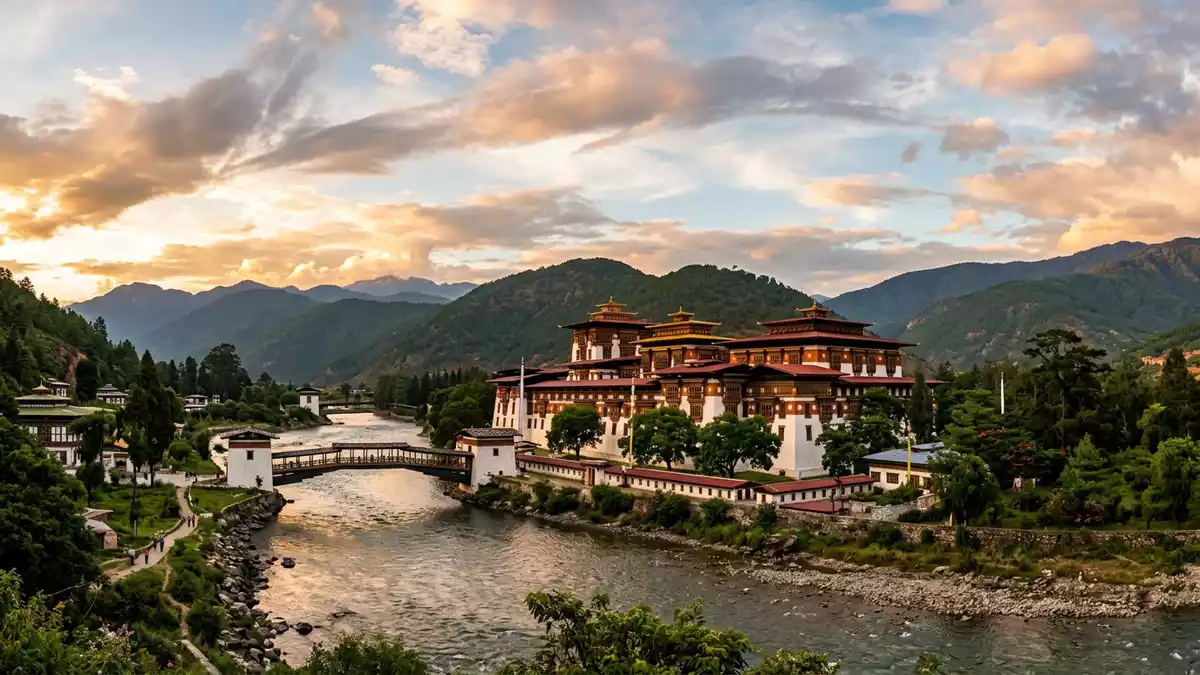
Pungthang Dewachen Phodrang rises on land between the Pho Chhu and Mo Chhu rivers in Punakha, Bhutan. Its massive walls, timber galleries and central tower form a fortress-monastery built under Zhabdrung Ngawang Namgyal in 1637–38.
Pungthang Dewachen Phodrang at the meeting of two rivers
The building occupies a narrow tongue of land at the confluence of the Pho Chhu and Mo Chhu. The setting places water, whitewashed walls and timber roofs within the same view, while the complex stretches across the river junction as a long fortified enclosure.
Pungthang Dewachen Phodrang is a dzong, the Bhutanese form that brings religious and administrative spaces into one compound. Its formal name is translated as “the palace of great happiness” or “the palace of great bliss”. The dzong remains the administrative centre of Punakha District and a major religious site.
Ngawang Namgyal and the seventeenth-century dzong
Construction began in 1637 under Zhabdrung Ngawang Namgyal, the leader who unified Bhutan, and the main structure was complete in 1638. The building belongs to the seventeenth-century development of Bhutanese dzongs as centres of Buddhist authority and government. Punakha Dzong in 1637 forms part of Bhutan’s tentative World Heritage listing for a group of historic dzongs.
The architecture combines high, inward-sloping walls with whitewashed surfaces, dark timber details and a broad red-brown band beneath the roofline. Wooden balconies and carved latticework break up the masonry. Inside, courtyards connect administrative rooms, monastic quarters and temples.
A fortress, monastery and seat of government
Pungthang Dewachen Phodrang served as Bhutan’s administrative capital and government seat until 1955, when the capital moved to Thimphu. Its historical role reflects the dual religious and temporal organisation associated with Ngawang Namgyal and the Drukpa Kagyu tradition.
The complex contains sacred objects linked with Bhutanese Buddhist history, including the Rangjung Kharsapani and relics associated with Ngawang Namgyal and Pema Lingpa. The central monastic body uses Punakha as its winter residence, maintaining the dzong’s religious function alongside district administration. sacred objects of the dzong include relics central to the southern Drukpa Kagyu lineage.
The site also carries royal significance. Ugyen Wangchuck was enthroned as Bhutan’s first king at Punakha in 1907, and the dzong has hosted the coronation ceremonies of Bhutanese kings. The courtyards therefore connect monastic life, district government and the history of the Bhutanese monarchy.
Visiting Pungthang Dewachen Phodrang: what travellers from Western Europe should know
- Pungthang Dewachen Phodrang is in Punakha District, central Bhutan, at the confluence of the Pho Chhu and Mo Chhu. Road journeys from western Bhutan approach Punakha through the Himalayan interior.
- The approach crosses a traditional cantilever bridge over the Mo Chhu. Inside, the route passes through courtyards, stone paving, steps and timber-built galleries.
- The complex combines district offices, monastic spaces and temples. Some inner religious rooms are reserved for devotional use.
- The official language is Dzongkha and the currency is the Bhutanese ngultrum.
- Entry requirements depend on your nationality; UK travellers can check the FCDO travel advice at gov.uk/foreign-travel-advice, Irish travellers the Department of Foreign Affairs at ireland.ie.
Searching for Pungthang Dewachen Phodrang on social platforms
These links open searches for Pungthang Dewachen Phodrang on each platform.
Frequently asked questions about Pungthang Dewachen Phodrang
Where is Pungthang Dewachen Phodrang?
It stands in Punakha District, Bhutan, where the Pho Chhu and Mo Chhu meet. The complex occupies a narrow riverside site reached across a cantilever bridge.
What is Pungthang Dewachen Phodrang?
It is a Bhutanese dzong combining fortress walls, Buddhist temples, monastic quarters and district administration. Zhabdrung Ngawang Namgyal founded it in 1637–38.
What makes the dzong distinctive?
Its river confluence setting places a large fortified monastery between two named waterways. Its sacred relics, royal ceremonies and seventeenth-century architecture give the complex several connected historical roles.


