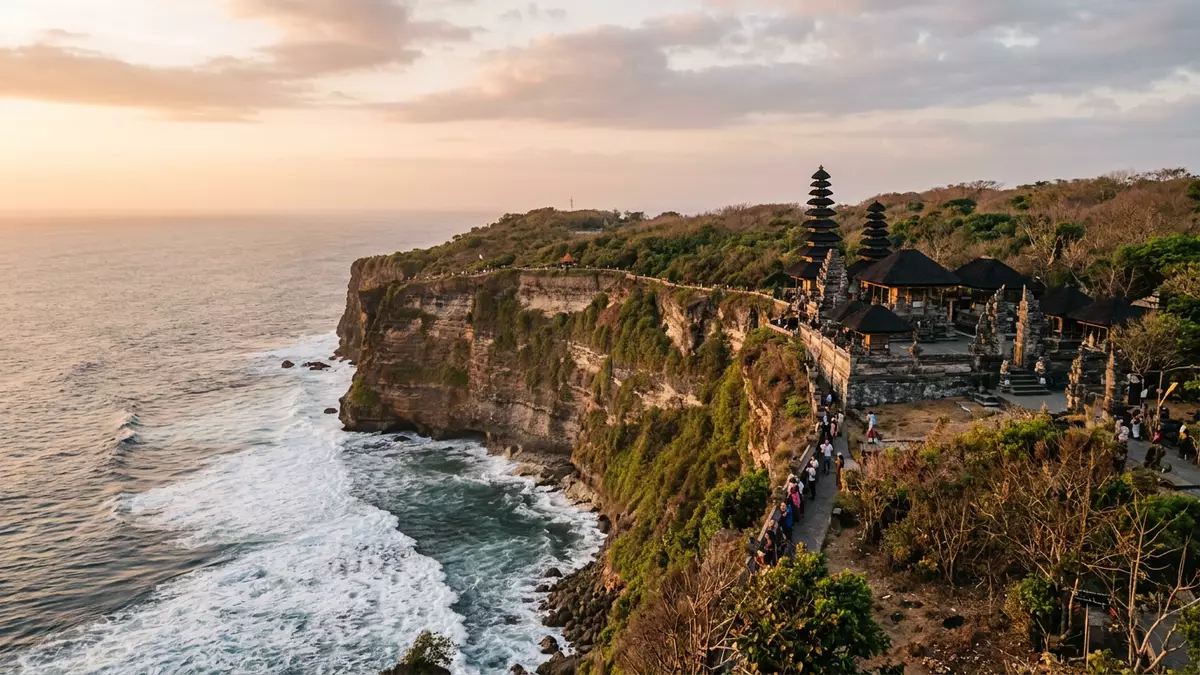
Pura Luhur Uluwatu on the cliff edge above Pecatu
Published on 08/12/2026 at 14:09 | Editorial responsibility: Rafael Müller, Editor-in-Chief AD HOC NEWS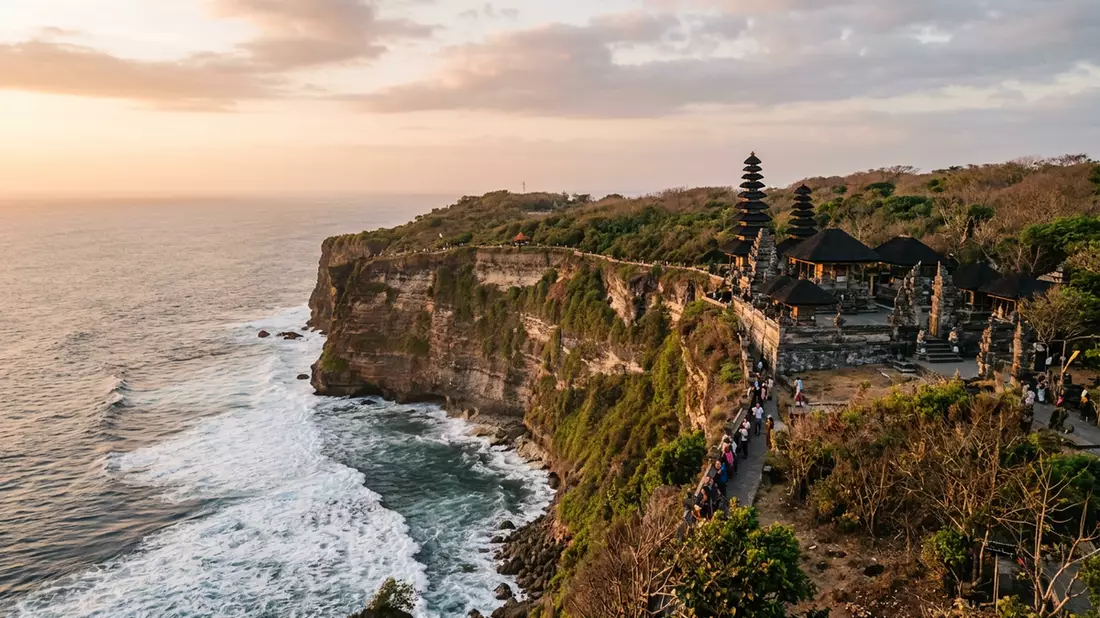
Pura Luhur Uluwatu is a Balinese sea temple set high on limestone cliffs above Pecatu in southern Bali, where Hindu shrines, rugged rock and the Indian Ocean share the same narrow edge. The temple complex developed as a major sanctuary in the 11th century under the Javanese sage Mpu Kuturan and still marks the south-western corner of Bali’s sacred landscape.
A sea temple on the edge of the Indian Ocean
Pura Luhur Uluwatu stands on the south-western tip of Bali’s Bukit Peninsula, on cliffs that drop steeply to the Indian Ocean below Pecatu.The temple is located in Pecatu village on the Bukit Peninsula The rocky headland curves gently, so from different points in the complex the coastline unfolds in both directions, with further cliffs and inlets visible along the shore.
The temple itself rises from dark stone set into the pale limestone of the peninsula, with walls and terraces tracing the outer contour of the headland.Descriptions of the site emphasise the temple’s position on limestone cliffs above the sea Waves break continuously against the base of the rock, and from the higher paths visitors see the white surf line wrapped around the foot of the promontory.
Layers of history and Balinese Hindu devotion
Archaeological and textual evidence places an early sanctuary at Uluwatu by around the 10th or 11th century, with major expansion in the 11th century under the Javanese priest Mpu Kuturan.Sources on the temple’s history link its significant development to Empu Kuturan in the 11th century His work helped shape the Balinese temple layout recognisable across the island, with courtyards arranged in sequence from outer to inner sanctum.
In Balinese classification, Pura Luhur Uluwatu is counted among the Sad Kahyangan, a group of six major temples regarded as spiritual anchors for Bali.Balinese sources describe Pura Luhur Uluwatu as one of the Sad Kahyangan temples It is also one of the island’s directional temples, associated with the south-west and the sea, and Balinese Hindus come here for ceremonies that honour deities linked with elemental forces.
Layout, gateways and the cliff path
The complex follows the usual Balinese pattern of three main courtyards, moving inward from the outer jaba sisi to the central jaba tengah and the holiest jeroan.Descriptions of Pura Luhur Uluwatu by Indonesia’s cultural authorities outline the three principal courtyards Stone walls separate these levels, with carved gates marking each transition and shrines rising on the inner platforms.
Along the outer edge of the complex, a paved path runs close to the cliff rim, bordered by low stone parapets and occasional pavilions set slightly back from the brink.Accounts of Uluwatu Temple describe a clifftop path overlooking the Indian Ocean From here the horizon line dominates the view, with the temple’s smaller shrines and meru towers framed against the sea and sky.
Visiting Pura Luhur Uluwatu: what travellers from Western Europe should know
- Pura Luhur Uluwatu stands near the village of Pecatu on the Bukit Peninsula in south Bali, reached by road from Denpasar and Ngurah Rai International Airport.
- The temple complex occupies the top of steep sea cliffs, and paths within the site include stone steps, uneven paving and sections that run close to the cliff edge.
- Inside the temple grounds, movement between the outer and inner courtyards involves passing through gateways and climbing steps, so flat footwear is more practical than heels.
- The official language is Indonesian and the currency is the Indonesian rupiah.
- Entry requirements depend on your nationality; UK travellers can check the FCDO travel advice at gov.uk/foreign-travel-advice, Irish travellers the Department of Foreign Affairs at ireland.ie.
Searching for Pura Luhur Uluwatu on social platforms
These links open searches for Pura Luhur Uluwatu on each platform.
Frequently asked questions about Pura Luhur Uluwatu
Where is Pura Luhur Uluwatu?
Pura Luhur Uluwatu stands on cliffs above Pecatu village on Bali’s Bukit Peninsula, in the Badung Regency of southern Indonesia.
What should visitors expect at the temple?
Visitors find a Balinese Hindu temple complex with multiple courtyards, stone shrines and a clifftop path that overlooks the Indian Ocean far below.
What makes Pura Luhur Uluwatu distinctive?
The combination of its role as a major Sad Kahyangan temple and its position on steep sea cliffs gives Pura Luhur Uluwatu a character closely tied to both faith and ocean landscape.