
Qal'at al-Bahrain, ancient harbour and layered capital of Dilmun
Published on 08/18/2026 at 13:08 | Editorial responsibility: Rafael Müller, Editor-in-Chief AD HOC NEWS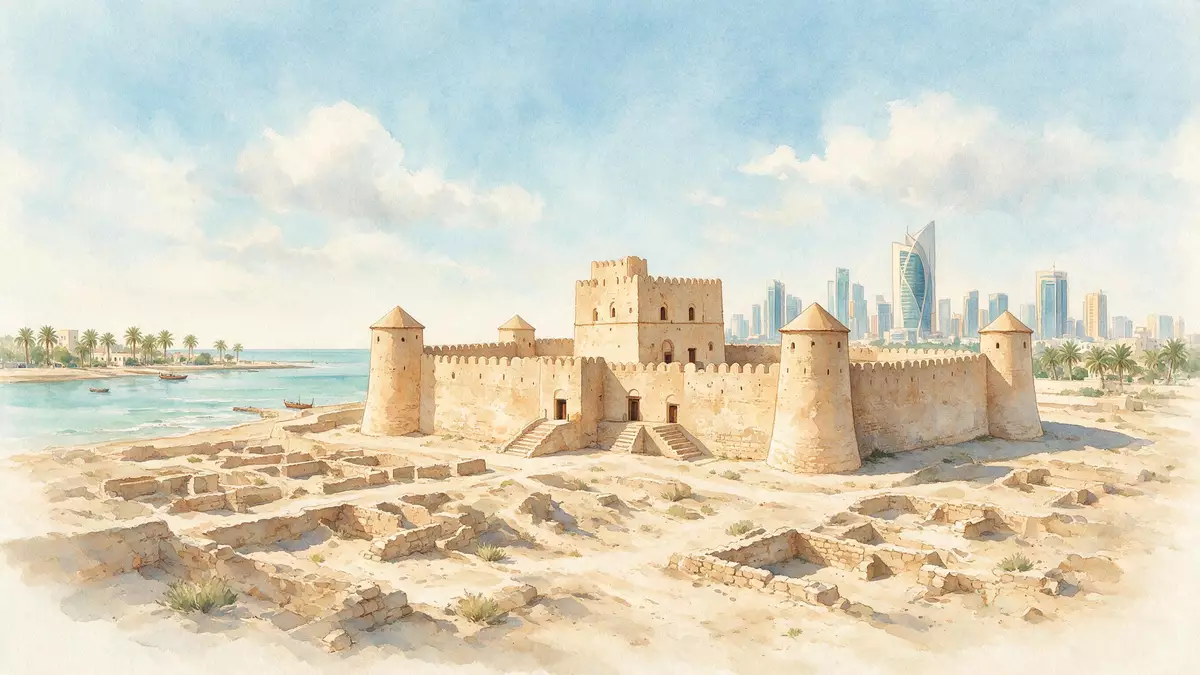
Qal'at al-Bahrain, on Bahrain Island’s northern shore west of Manama, is an archaeological mound crowned by a fort that compresses almost 4,500 years of settlement into one compact coastal site.Ancient Harbour and Capital of Dilmun is the formal World Heritage title, and it signals both the Bronze Age port city buried in the hill and the later fortress that still stands above it.
A tell where Dilmun meets a later fort
Qal'at al-Bahrain is a typical tell, an artificial hill built up by successive phases of human occupation that now rises as an elongated mound beside the sea.The tell extends over roughly 17.5 hectares, with its long axis reaching several hundred metres between the palm groves inland and the shore-facing side where the fort dominates the upper surface.Archaeological excavations have traced occupation from around 2,300 BC into the second millennium AD, each period adding its own stone and mud-brick structures to the growing mound.
The fort that gives the site its name occupies the summit of this hill and reflects a later chapter, when Portuguese forces established a stronghold on the ancient city’s remains in the sixteenth century.The fortress incorporates defensive walls and internal courtyards, laid out above earlier foundations that belong to Dilmun and subsequent cultures. Around the fort and across the slope of the tell, low walls and building outlines mark palaces, residential quarters, temples and workshops from different eras, giving the surface of the mound a patchwork character that reflects the long sequence of rulers and communities.
Ancient harbour city and the civilisation of Dilmun
The World Heritage inscription identifies Qal'at al-Bahrain as the harbour and capital of the Dilmun civilisation, a Bronze Age culture that traded across the Gulf and into Mesopotamia.Dilmun’s port city at this mound was a major centre for commerce and administration, and its remains underlie the later fortifications visible at the surface. The tell preserves traces of fortification lines and palatial complexes from Dilmun and later periods, showing how the same strategic position by the coast was reused across centuries.
Qal'at al-Bahrain’s coastal setting is central to its character. The archaeological property officially includes not only the main hill but also a sea tower out on the reef, a channel leading through the coral to deeper water, and cultivated palm groves on land.Together these elements define the ancient harbour landscape, linking the fortified mound to the maritime routes that sustained Dilmun and to the agricultural hinterland that supported its inhabitants.
World Heritage recognition and the site museum
Qal'at al-Bahrain was inscribed on the UNESCO World Heritage List in July 2005 on cultural criteria that emphasise its role as an ancient capital and harbour and its exceptionally long continuity of occupation.The listing highlights nearly 4,500 years of human presence layered within the tell, from early Dilmun through Kassite and Hellenistic phases to Islamic and Portuguese construction. The protected area covers the mound itself and a surrounding buffer zone, securing the wider coastal setting against intrusive development.
Across from the fort, a modern site museum presents artefacts and reconstructions from the excavations, setting ceramics, tools and architectural fragments into chronological galleries.Exhibition halls arranged around a substantial internal wall display hundreds of objects, giving visitors a sense of everyday life in Dilmun’s capital and in the subsequent communities that built over its remains. From the museum terrace, the view back towards the tell and fort makes the link between the artefacts and the structures on the mound tangible.
Visiting Qal'at al-Bahrain: what travellers from Western Europe should know
- Qal'at al-Bahrain stands on the northern coast of Bahrain Island in the Northern Governorate, a short distance west of Manama, and is reached by road through the Al Qalah district.
- The archaeological tell forms an uneven hill of packed earth and stone, and visiting the fort at its summit involves walking on sloping ground and negotiating steps and compacted paths.
- The site lies beside cultivated palm groves and the shoreline, so a visit combines views over the Gulf with close-up access to exposed walls, towers and excavated building outlines on the mound.
- The official language is Arabic and the currency is the Bahraini dinar.
- Entry requirements depend on your nationality; UK travellers can check the FCDO travel advice at gov.uk/foreign-travel-advice, Irish travellers the Department of Foreign Affairs at ireland.ie.
Searching for Qal'at al-Bahrain on social platforms
These links open searches for Qal'at al-Bahrain on each platform.
Frequently asked questions about Qal'at al-Bahrain
Where is Qal'at al-Bahrain located in relation to Manama?
Qal'at al-Bahrain lies on the northern coast of Bahrain Island in the Northern Governorate, around 5 km west of central Manama in the Al Qalah district.
What should visitors expect when exploring the site?
Visitors encounter an archaeological hill with exposed walls, building outlines and a fort at the summit, reached by walking on uneven ground, steps and sloping paths between stone remains.
What makes Qal'at al-Bahrain distinctive among Gulf heritage sites?
The site combines a Bronze Age harbour capital of the Dilmun civilisation with later fortifications on a single coastal tell, preserving nearly 4,500 years of occupation in one continuous archaeological landscape.


