
Qasr Al Watan, Abu Dhabi’s palace of the nation
Published on 08/15/2026 at 14:14 | Editorial responsibility: Rafael Müller, Editor-in-Chief AD HOC NEWS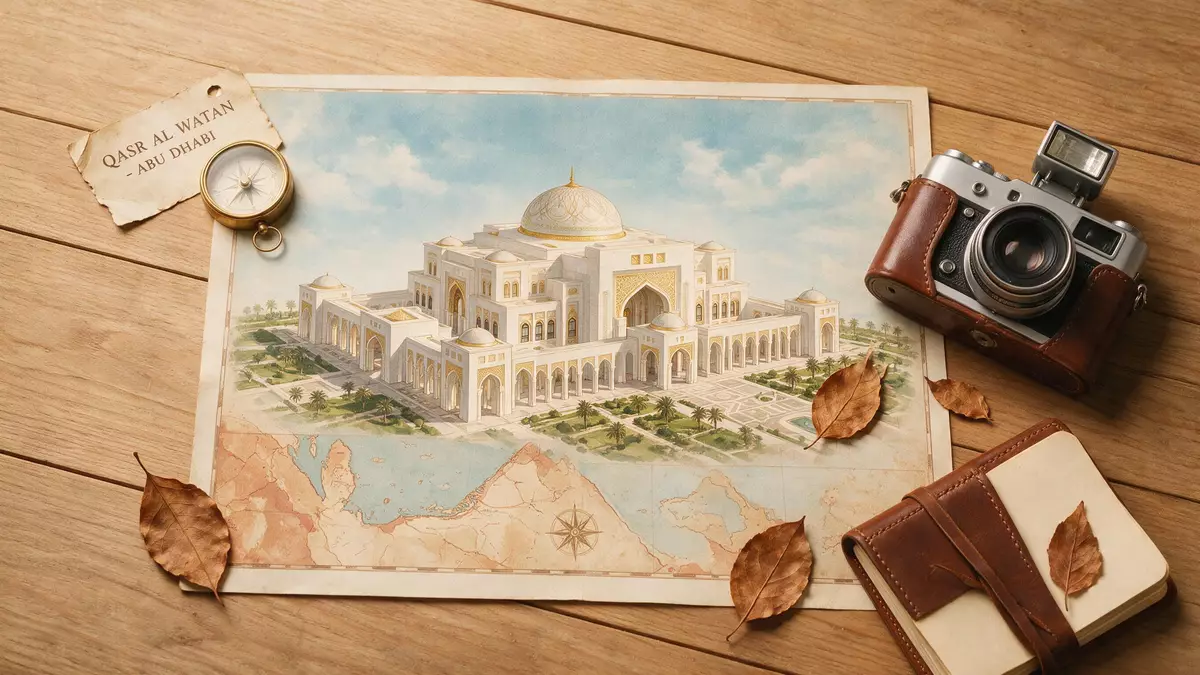
Qasr Al Watan in Abu Dhabi is a working presidential palace that presents the political heart of the United Arab Emirates through grand architecture and carefully curated interiors. Set within the wider Presidential Palace complex, it opened to visitors in 2019, turning a seat of government into a place of cultural discovery for travellers.presidential palace
A palace where government and spectacle share the same halls
Qasr Al Watan sits in the Ras Al Akhdar district at the western tip of Abu Dhabi island, close to the end of the Corniche and next to Emirates Palace. Within the Presidential Palace compound, its halls are used for cabinet meetings, sessions of the Federal Supreme Council and official state visits, while selected areas are accessible as a visitor experience.Ras Al Akhdar location The name translates from Arabic as “Palace of the Nation”, reflecting its role as a formal seat of governance rather than a private residence.
The palace forms part of a wider compound handed over by contractors in 2015 and completed in 2017, with Qasr Al Watan itself constructed over several years in the early twenty-first century.constructed over a period of seven years Inside, visitors move through spaces that continue to host diplomatic gatherings, with routes and galleries laid out so that ceremonial areas can function while remaining on show to the public.working government building
Architecture and decorative craft on a monumental scale
The architecture of Qasr Al Watan blends references to traditional Arabian palaces with contemporary construction techniques, resulting in a complex of domes, colonnades and courtyards arranged around a central palace building. The exterior uses pale stone and carefully composed volumes to create long perspectives from the entrance and along the ceremonial approaches, while the interiors are organised as a sequence of halls, galleries and reception rooms that gradually build in richness.
One of the most striking spaces is the Great Hall, a vast interior where visitors first encounter the palace’s decorative language. Here, elaborate geometric patterns, carved surfaces and chandeliers combine with towering columns to emphasise vertical scale. Across the palace, ornament draws on motifs from Islamic art and Arabian craftsmanship, including intricate mashrabiya-style latticework and inlaid surfaces. The craftsmanship on display is presented as part of the United Arab Emirates’ cultural heritage, with exhibits and explanatory displays highlighting calligraphy, textiles and other traditional arts.majestic cultural landmark
Collections, libraries and a narrative of the United Arab Emirates
Beyond the ceremonial architecture, Qasr Al Watan contains collections that centre on the political and cultural development of the United Arab Emirates. Exhibition spaces explain the structure of federal institutions, the role of the Cabinet and the Federal Supreme Council, and the process by which laws and policies are made.meeting place for the UAE Cabinet Displays include official gifts presented by visiting heads of state, manuscripts and documents that illustrate different moments in the country’s history, and objects that represent diplomatic relationships.
A key feature of the palace is its library, which holds a large collection of books and reference works about the United Arab Emirates and the wider Arab world. The library is arranged in long aisles and reading areas, designed to be accessible to researchers and visitors, and it is part of a broader emphasis on knowledge and learning that runs through the palace’s interpretive materials.Palace of the Nation venue Together, these elements present Qasr Al Watan not just as a backdrop for state occasions but as a place where the workings of government are explained through architecture, artefacts and text.
Visiting Qasr Al Watan: what travellers from Western Europe should know
- Qasr Al Watan stands at the western end of Abu Dhabi’s Corniche in the Ras Al Akhdar district, next to Emirates Palace and facing the Arabian Gulf, reached via Corniche Road and the dedicated visitor centre.next to Emirates Palace
- The approach from the visitor centre involves a transfer through the Presidential Palace grounds and passage through security controls, followed by a walk through large entrance halls and long corridors inside the palace.
- The complex is extensive, with wide paved areas outdoors and expansive interior spaces, so a visit usually involves covering significant distances on foot across polished floors and stairways.
- The official language is Arabic and the currency is the UAE dirham.
- Entry requirements depend on your nationality; UK travellers can check the FCDO travel advice at gov.uk/foreign-travel-advice, Irish travellers the Department of Foreign Affairs at ireland.ie.
Searching for Qasr Al Watan on social platforms
These links open searches for Qasr Al Watan on each platform.
Frequently asked questions about Qasr Al Watan
Where is Qasr Al Watan located?
Qasr Al Watan is part of the Presidential Palace compound in the Ras Al Akhdar district at the western end of Abu Dhabi’s Corniche, next to Emirates Palace and by the Arabian Gulf.
What can visitors expect during a visit?
Visitors pass through ceremonial halls, exhibition galleries and a palace library, seeing spaces used for state occasions alongside interpretive displays about the United Arab Emirates’ system of government and cultural heritage.
What makes Qasr Al Watan distinctive among Abu Dhabi landmarks?
Qasr Al Watan combines an active role in federal governance with public access, allowing travellers to experience monumental palace architecture while learning about the country’s political structures within the same complex.


