
Quinta da Regaleira and its inverted towers of stone
Published on 08/22/2026 at 13:55 | Editorial responsibility: Rafael Müller, Editor-in-Chief AD HOC NEWS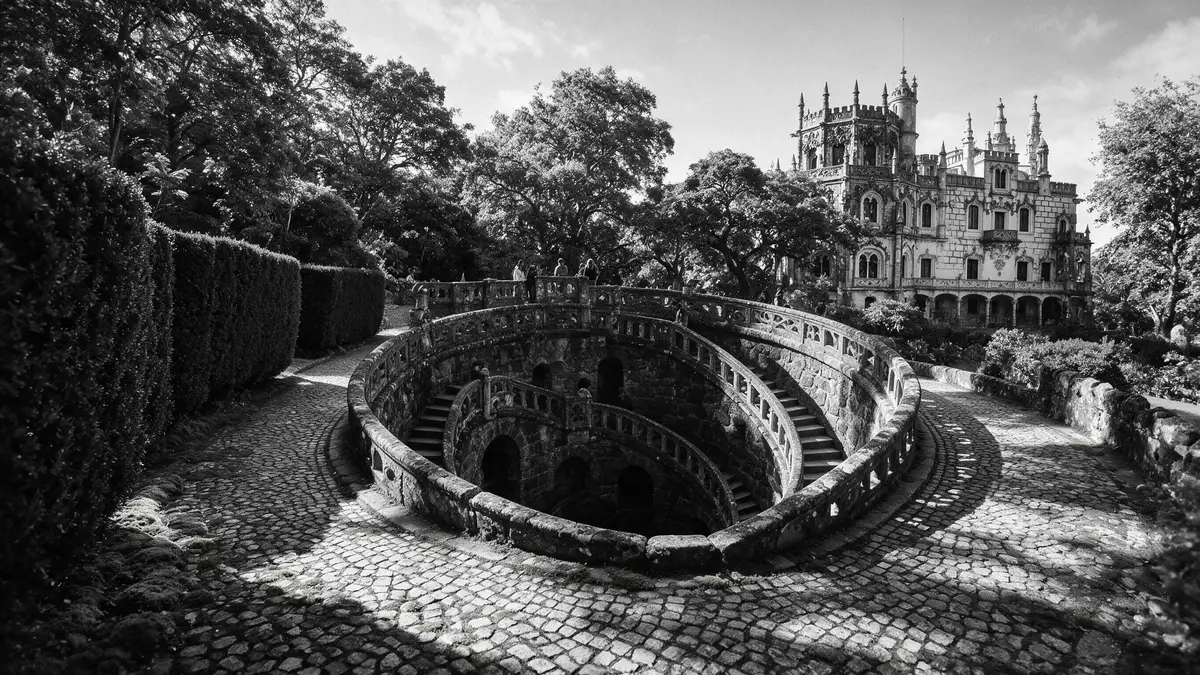
Quinta da Regaleira in Sintra is a Romantic estate where a neo?Manueline palace, a chapel and a garden filled with symbols are tied together by an underground “inverted tower” cut into the hillside. Built in the early twentieth century for António Augusto Carvalho Monteiro and designed by the Italian architect Luigi Manini, it forms part of the wider cultural landscape of Sintra that is recognised as World Heritage.
Palace, chapel and an estate of symbols
Quinta da Regaleira occupies a slope above Sintra, with a main palace, a chapel and gardens arranged around paths, terraces and concealed structures.Designed and built in the late 1800s, the ensemble reflects the interests of António Augusto Carvalho Monteiro, a Brazilian?Portuguese businessman born in 1848, and Luigi Manini, an Italian architect and scenographer born the same year.Quinta da Regaleira is described as a Romantic estate whose palace incorporates neo?Manueline motifs, echoing sixteenth?century Portuguese architecture in its sculpted stonework and ornamental details.
The estate developed from a property owned by the Viscountess of Regaleira and was purchased in 1892 by Carvalho Monteiro, who commissioned Manini to reshape it between 1904 and 1910.Construction of the palace, chapel and gardens is recorded as taking place from 1904 to 1910. The palace stands above the gardens with turrets and elaborate façades, while the chapel, though smaller in scale, continues the same revivalist vocabulary, with decorative stone carving and stained glass. Together they form one of several historic residences spread across Sintra’s hills, a group that helped secure recognition of the town and its mountain as a cultural landscape of World Heritage quality.Sintra and its mountain are recognised as a World Heritage cultural landscape
The Initiation Wells: inverted towers into the earth
The best?known structures at Quinta da Regaleira are the Initiation Wells, which take the form of shafts sunk into the rock that resemble underground towers lined with staircases.These “wells” never functioned as water sources; instead, they were constructed for ceremonial use. The larger Poço Iniciático descends around 27 m (about 88 ft) into the hillside,with a spiral staircase that runs down its inner wall. Visitors enter at the top and follow steps that curve along the masonry, passing a series of landings before reaching the patterned floor at the bottom.
From below, the well’s stone walls rise like the interior of a tower, reversing the usual direction of ascent and turning the descent itself into the central experience.The structure is referred to as an “inverted tower” carved into the bedrock, connecting to a network of subterranean passages. These underground routes link the well with other parts of the garden, including grottoes and a lake, so that routes on the surface and routes through the rock intersect. A second, smaller well stands elsewhere in the grounds, echoing the same vocabulary of stone, stair and depth while differing in scale.
Gardens, tunnels and the Sintra landscape
The gardens of Quinta da Regaleira spread around the palace as a park of paths, water features and constructed elements that turn a hillside into a layered landscape.The park is described as containing lakes, grottoes, wells, benches and fountains, with planting arranged to frame views and conceal entrances. Rock?cut tunnels run beneath parts of the site, emerging at viewpoints, artificial caves and near the edge of the grounds, so that progress alternates between open air and enclosed passage.
Sintra’s mountain setting contributes steep slopes, outcrops and woodland, and Quinta da Regaleira makes use of this terrain by placing the palace above and the wells and tunnels within the hillside.The estate is described as a park of around four hectares filled with esoteric symbols, caves and underground routes. Stone benches and small pavilions appear along the paths, sometimes beside water or near changes in level, and the combination of built structures and vegetation creates a sequence of confined and expansive spaces. From higher points, visitors see other historic properties of Sintra and the surrounding hills, setting Quinta da Regaleira within a broader panorama of palaces and forests.
Visiting Quinta da Regaleira: what travellers from Western Europe should know
- Quinta da Regaleira stands on Rua Barbosa du Bocage in Sintra, west of Lisbon, and is reached along local roads from the town centre. Rail services from Lisbon terminate in Sintra, with onward travel by local transport or on foot through the town.
- The estate is built on a hillside, with paths that rise and fall between the palace, chapel and garden structures, and staircases inside the Initiation Wells and tunnels that require steady footing.
- The official language is Portuguese and the currency is the euro.
Searching for Quinta da Regaleira on social platforms
These links open searches for Quinta da Regaleira on each platform.
Frequently asked questions about Quinta da Regaleira
Where is Quinta da Regaleira?
Quinta da Regaleira is an historic estate in Sintra in Portugal, set on Rua Barbosa du Bocage on the slopes above the town centre.
What should visitors expect on a visit?
Visitors encounter a neo?Manueline palace, a chapel, gardens with lakes, grottoes and tunnels, and the Initiation Wells, which descend deep into the hillside with spiral staircases.
What makes Quinta da Regaleira distinctive?
The combination of revivalist palace architecture, subterranean “inverted towers” and symbolic garden structures within Sintra’s World Heritage landscape gives the estate a character unlike other residences in the town.


