
Quinta da Regaleira’s palatial gardens and hidden symbolism
Published on 08/23/2026 at 14:11 | Editorial responsibility: Rafael Müller, Editor-in-Chief AD HOC NEWS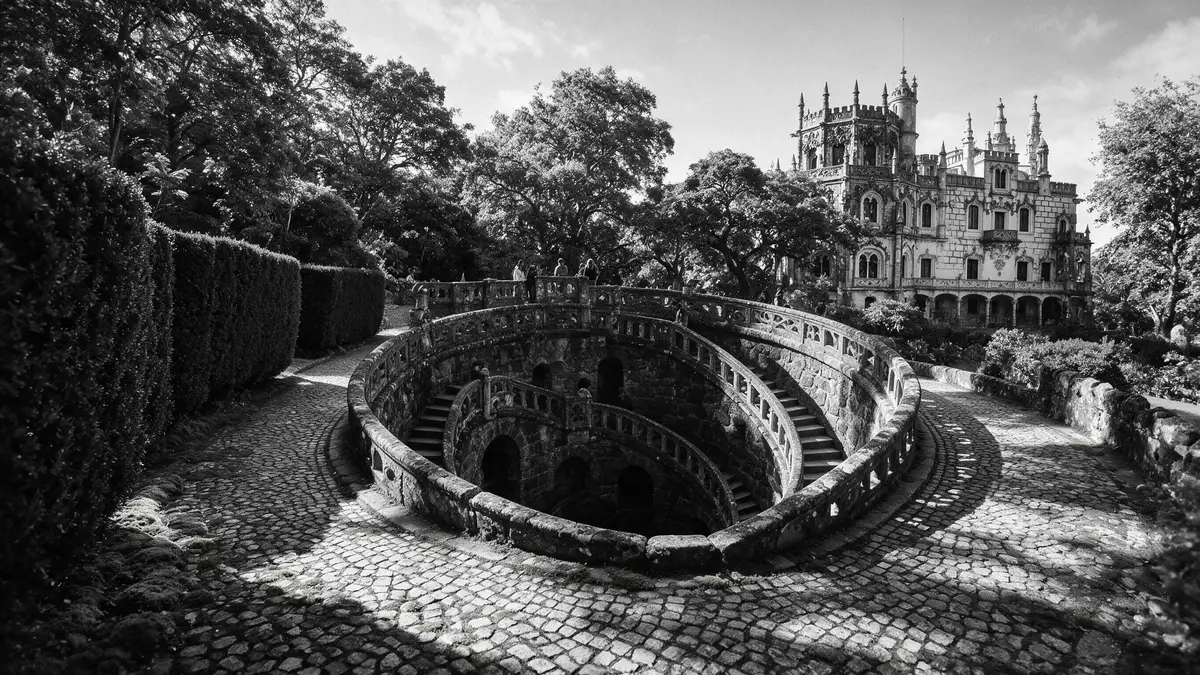
Quinta da Regaleira in Sintra is a turn-of-the-century estate centred on a palace, a chapel and gardens arranged across sloping ground. The work is linked with António Augusto Carvalho Monteiro and Luigi Manini, and the site belongs to the Cultural Landscape of Sintra, a UNESCO World Heritage area.
Neo-Manueline fantasy on the Sintra hills
The estate’s most striking feature is its mix of forms. Towers, terraces, stairways and carved façades sit beside garden paths, grottoes and small built structures, so the place reads as both residence and composed landscape.
Its architecture draws on Gothic, Manueline and Renaissance revival language, with decorative detail that gives the palace and chapel a dense, layered character. The association with Luigi Manini places Quinta da Regaleira within the wider world of Italian scenography and eclectic late revival design.
Carvalho Monteiro, Manini and the early twentieth century
António Augusto Carvalho Monteiro acquired the property in 1892, and the existing estate was transformed in the early decades of the twentieth century. The palace complex is generally dated to 1904–1910, with the finished ensemble tied to Monteiro’s name and Manini’s project.
The result is a carefully layered estate rather than a single isolated monument. The palace, chapel and grounds belong together, and the decorative programme extends from the façades into the gardens, where paths, wells and rock-cut spaces continue the same visual language.
The gardens, wells and underground passages
Among the estate’s best-known features are the Initiation Well and a network of underground passages. The well sinks beneath the ground in a sequence of stone landings and steps, while the gardens include carved openings, bridges, ponds and grottoes that give the estate its most memorable spaces.
The grounds also contain a chapel and a set of secondary buildings that make the estate feel more expansive than a single house. That combination of palace, park and hidden spaces has made Quinta da Regaleira one of Sintra’s most layered historic ensembles.
Visiting Quinta da Regaleira: what travellers from Western Europe should know
- Quinta da Regaleira stands near Sintra’s historic centre, with access from the town’s streets and local transport connections. The estate address is Rua Barbosa du Bocage, 2710-567 Sintra.
- The grounds slope, and the estate includes stairways, terraces and underground passages. The well and the garden paths involve changes in level throughout the site.
- The official language is Portuguese and the currency is the euro.
- Entry requirements depend on your nationality; UK travellers can check the FCDO travel advice at gov.uk/foreign-travel-advice, Irish travellers the Department of Foreign Affairs at ireland.ie.
Searching for Quinta da Regaleira on social platforms
These links open searches for Quinta da Regaleira on each platform.
Frequently asked questions about Quinta da Regaleira
Where is Quinta da Regaleira?
Quinta da Regaleira is in Sintra, on Rua Barbosa du Bocage near the historic centre. It belongs to the UNESCO-listed Cultural Landscape of Sintra.
What can be seen on a visit?
The estate includes a palace, a chapel, gardens, terraces and underground passages. The most distinctive outdoor features are the well, stone stairways and the network of garden spaces.
What makes it distinctive?
Its mixture of revivalist architecture and garden architecture gives the estate a layered character. The name of António Augusto Carvalho Monteiro and the work of Luigi Manini remain central to its identity.


