
Rapa Nui’s moai landscape around Hanga Roa
Published on 08/19/2026 at 22:10 | Editorial responsibility: Rafael Müller, Editor-in-Chief AD HOC NEWS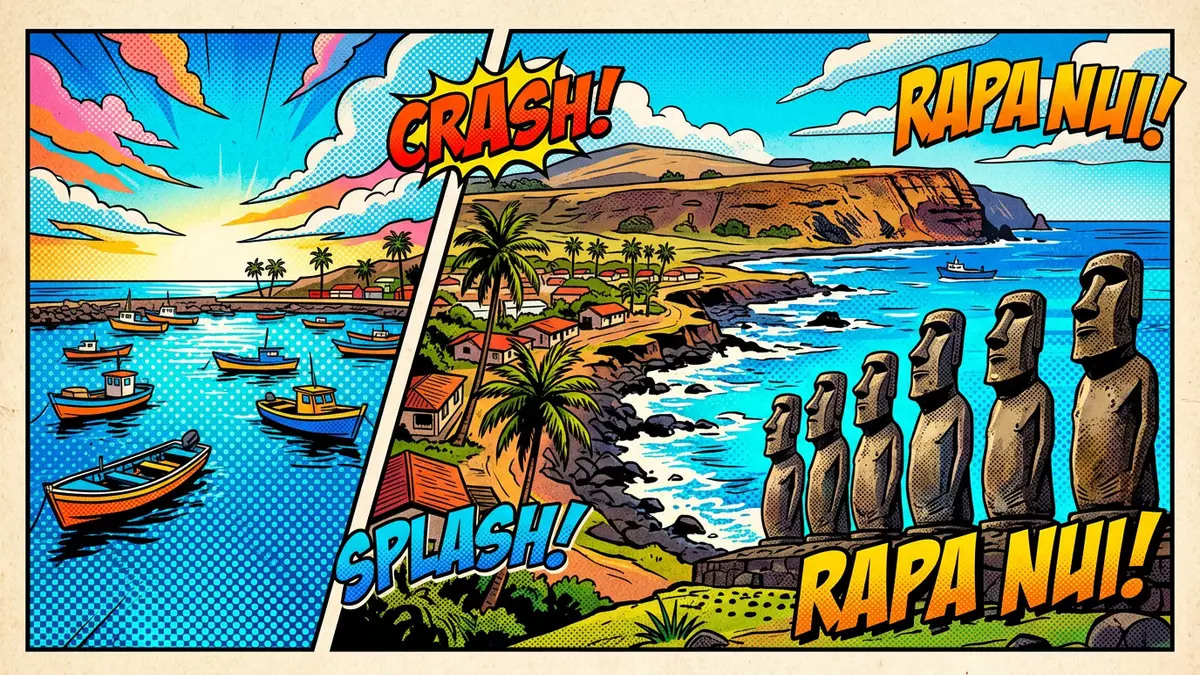
Rapa Nui, better known in English as Easter Island, rises from the Pacific Ocean as a triangle of volcanic rock far off the Chilean coast, with Hanga Roa as its only town. Across this small island, monumental stone figures known as moai stand on ceremonial platforms and lie scattered on grassy slopes, turning the entire landscape into an open-air gallery of ancestral sculpture.
Moai and ahu: a stone landscape shaped by ancestors
The defining feature of Rapa Nui is the concentration of moai, the carved stone figures created by the island’s Polynesian inhabitants between the tenth and sixteenth centuries.between the tenth and sixteenth centuries These figures, mostly with elongated heads and torsos, rise from low platforms called ahu that punctuate the coastline and interior. Many of the platforms line up with the ocean, so the statues form rows facing inland, while others stand alone beside lava fields or on gentle slopes.
The moai and their ahu are protected as part of Rapa Nui National Park, a cultural landscape recognised as a UNESCO World Heritage Site in the 1990s.Rapa Nui National Park Archaeological surveys across the island count close to 900 statues and more than 300 ceremonial platforms, together with stone structures linked to agriculture, funerary practices and daily life.close to 900 statues The stone used for many of the figures is volcanic tuff, a relatively soft rock that can be carved into crisp profiles before weathering into muted textures in the salt air.volcanic tuff
Quarries, platforms and a single town
One of the most striking places to see moai in their original context is the quarry at Rano Raraku, a volcanic crater whose slopes are dotted with figures in various stages of completion. Partly buried torsos rise from the grass, while half-carved silhouettes are still attached to the rock face, giving a sense of the carving techniques used by the Rapa Nui carvers.the quarry at Rano Raraku From this crater, statues were transported to platforms around the island, including the large ahu complexes that frame entire bays.
Hanga Roa, on the island’s south-western shore, is the only town and the hub for visiting Rapa Nui National Park.the only town Streets of low houses, shops and small churches stretch between the coast and the upland fields, with modern life unfolding within sight of stone figures set on coastal platforms. The commune that covers Rapa Nui belongs to Chile’s Valparaíso Region, and Hanga Roa serves as the administrative centre of this special territory.Chile’s Valparaíso Region
Volcanic origins and a Polynesian past
Geologically, Rapa Nui is formed from the overlapping cones and lava flows of several volcanoes, whose eroded slopes give the island its sweeping, treeless contours.volcanoes and lava flows The most prominent cones include Rano Kau above Hanga Roa and the crater of Rano Raraku in the island’s east, both containing crater lakes surrounded by steep walls of dark basalt and ash. Around the coast, black lava cliffs and small coves alternate with short stretches of pale sand, so many moai stand against a backdrop of surf and sky.
The culture that created the moai belongs to the wider world of Polynesia, and archaeological and oral traditions place the first settlers of Rapa Nui in the first millennium AD.first settlers of Rapa Nui Over centuries, communities organised themselves around clans and lineages, carving statues that represented important ancestors and placing them on ahu as part of ceremonial complexes. Rapa Nui National Park covers much of the island’s land area, preserving this network of platforms, quarries, rock carvings and foundations as a record of that society’s life.
Visiting Rapa Nui: what travellers from Western Europe should know
- Rapa Nui lies in the south-eastern Pacific Ocean and belongs to Chile, with Hanga Roa on the island’s south-western coast acting as the main gateway by air from the South American mainland.
- The terrain is volcanic and undulating, with low cliffs, grassy slopes and crater rims, so many archaeological sites involve walking on uneven ground and exposed paths without shade.
- Rapa Nui National Park covers a large part of the island, and visiting moai platforms, quarries and caves usually involves travelling out from Hanga Roa along paved roads and coastal tracks.
- The official language is Spanish and the national currency is the Chilean peso.
- Entry requirements depend on your nationality; UK travellers can check the FCDO travel advice at gov.uk/foreign-travel-advice, Irish travellers the Department of Foreign Affairs at ireland.ie.
Searching for Rapa Nui on social platforms
These links open searches for Rapa Nui on each platform.
Frequently asked questions about Rapa Nui
Where is Rapa Nui and how is it connected to Hanga Roa?
Rapa Nui is a Chilean island in the south-eastern Pacific Ocean, and Hanga Roa on its south-western coast is the island’s only town and administrative centre.
What should visitors expect when exploring the moai sites?
Visitors encounter stone statues on coastal platforms, in quarries and beside volcanic craters, with many sites reached by walking along uneven ground in exposed, treeless terrain.
What makes Rapa Nui distinctive among Pacific islands?
Rapa Nui combines a dense concentration of monumental moai statues, a protective national park recognised by UNESCO and a single town where contemporary life unfolds beside ancient stone platforms.


