
Rapa Nui’s stone faces and ocean-bound horizon
Published on 09/07/2026 at 11:20 | Editorial responsibility: Rafael Müller, Editor-in-Chief AD HOC NEWS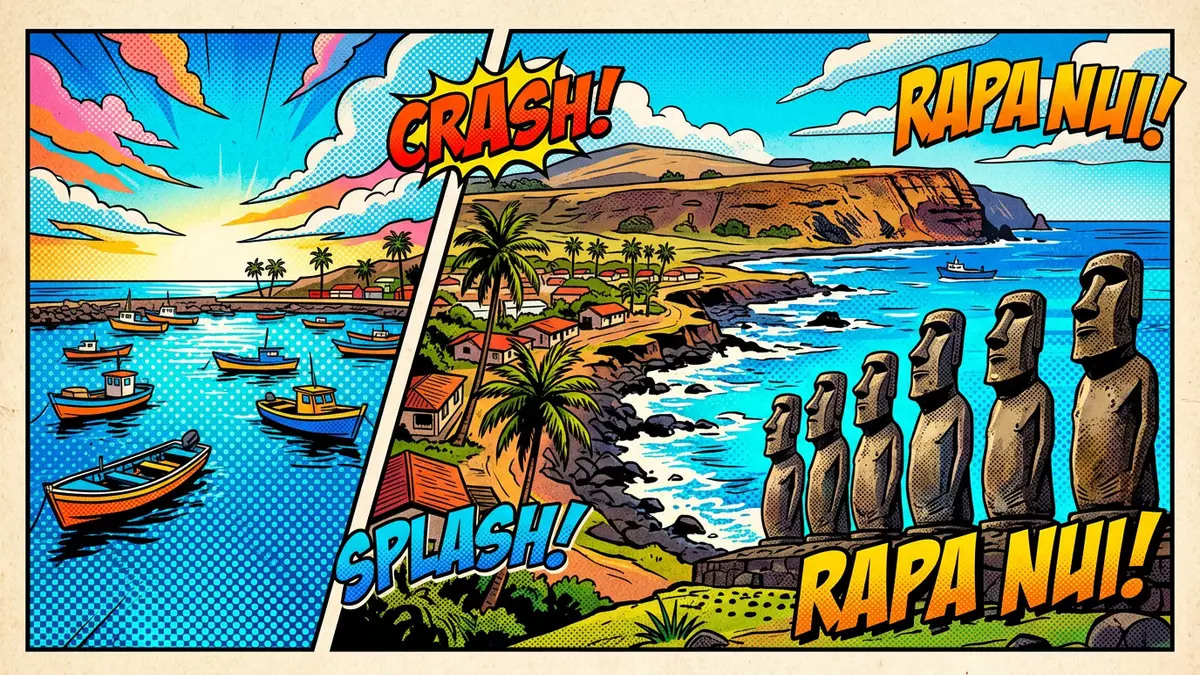
Rapa Nui, better known in English as Easter Island, is a small volcanic island in the Pacific whose stone statues and windswept headlands make it one of Chile’s most distinctive cultural landscapes. Set far from mainland South America and anchored by the settlement of Hanga Roa, the island’s moai and ceremonial stone platforms form a continuous thread between a Polynesian past and the present-day community that lives alongside them.
Stone ancestors in a volcanic landscape
Rapa Nui rises from the Pacific Ocean as a triangular shield of volcanic rock, with gentle slopes leading up to summits such as Terevaka and the older massifs around the island’s edges.Rapa Nui National Park wraps much of this terrain, framing grasslands, lava fields and coastal cliffs within a protected cultural and natural area.
The island is best known for its carved stone figures, the moai, whose elongated heads and torsos were hewn from volcanic tuff and other local rock and then set upright on low, stepped stone platforms called ahu.The moai in the park stand in different sizes, with some rising higher than a two-storey house and others half-buried where sculptors left them. Together with house foundations, petroglyphs and remains of agricultural structures, they form a landscape where almost every bay and headland carries traces of ancestral settlements.
Rapa Nui National Park and UNESCO recognition
Most of the island’s archaeological sites lie within Rapa Nui National Park, which Chile established as a national park before its inscription on the UNESCO World Heritage List in 1995.Rapa Nui National Park is a protected Chilean area that combines coastal cliffs, volcanic craters and archaeological features into a single managed unit. The protected area includes the main island and smaller islets scattered off its shores.
UNESCO recognised the park as a World Heritage Site for its outstanding concentration of ceremonial platforms, statues and associated remains, describing a cultural phenomenon that developed in isolation over many centuries.The World Heritage dossier notes several hundred ahu and around 900 statues, together with petroglyphs, wall paintings and evidence of houses and ritual villages. For visitors from Western Europe, the result is a place where archaeological sites are not confined to a single enclosure but spread across the island, from coastal headlands to inland slopes.
From quarry to shore: following the moai
One of the most striking ways to experience Rapa Nui is to trace the path of the moai from quarry to sea. On the eastern side of the island lies Rano Raraku, a volcanic crater of consolidated ash that served as the principal quarry for statue carving.Rano Raraku supplied the stone for most of the island’s sculptures, and its slopes still hold dozens of unfinished and partially buried figures, some lying prone and others standing on the hillside.
Archaeological research links the main period of moai carving and transport to the centuries between the thirteenth and seventeenth centuries CE, when Polynesian settlers and their descendants developed a complex network of coastal communities.Studies of the island’s settlement history identify Rano Raraku as the source for most of the statues, which were moved across uneven ground and raised on ahu that face the ocean or inland grasslands. Standing at an ahu where moai align along the platform, a visitor can see how the figures look towards the interior while the waves break below, an arrangement that ties together land and sea.
Visiting Rapa Nui: what travellers from Western Europe should know
- Rapa Nui lies in the south-eastern Pacific Ocean and forms part of Chile; the nearest town and service centre is Hanga Roa, which stretches along the island’s western coast.
- Approaches to the main archaeological sites involve walking over uneven volcanic ground, with sections of grass, rock and compacted earth rather than paved surfaces.
- Several of the most visited sites, including Rano Raraku and coastal ahu, stand in exposed positions where wind and sun are constant features of the terrain.
- Spanish is the official language of Chile and the currency is the Chilean peso.
- Entry requirements depend on your nationality; UK travellers can check the FCDO travel advice at gov.uk/foreign-travel-advice, Irish travellers the Department of Foreign Affairs at ireland.ie.
Searching for Rapa Nui on social platforms
These links open searches for Rapa Nui on each platform.
Frequently asked questions about Rapa Nui
Where is Rapa Nui and how is it connected to Hanga Roa?
Rapa Nui is an island in the south-eastern Pacific Ocean that forms part of Chile, with Hanga Roa as its principal town and administrative centre.
What should visitors expect when exploring the archaeological sites?
Visitors encounter moai on stone platforms, remnants of ceremonial villages and volcanic craters, with paths across grass, earth and rock rather than fully urban surroundings.
What makes Rapa Nui distinctive among Pacific islands?
Rapa Nui combines a dense concentration of monumental stone statues and platforms with a compact volcanic landscape, creating a cultural and natural setting that is closely tied to a single island.


