
Real Alcazar de Sevilla and its layered royal architecture
Published on 08/12/2026 at 13:38 | Editorial responsibility: Rafael Müller, Editor-in-Chief AD HOC NEWS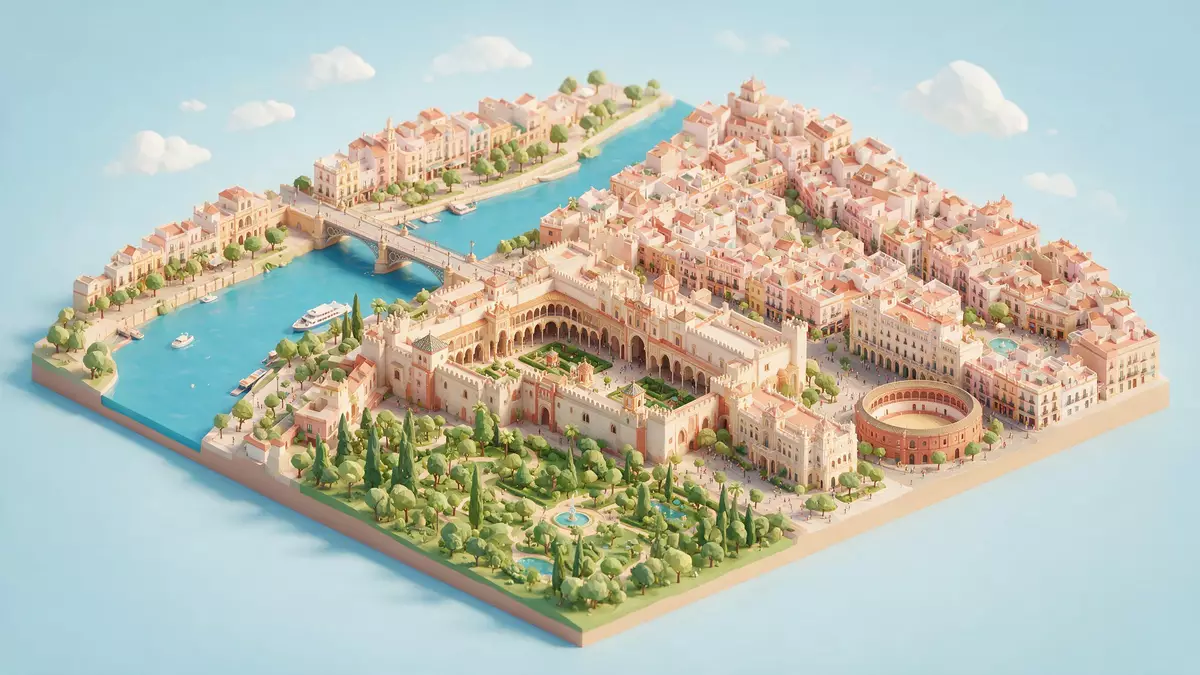
Real Alcazar de Sevilla is a fortified royal palace complex in Sevilla, where centuries of Islamic and Christian rule have left stone, stucco and gardens layered into a single residence. Its present form reflects work from the tenth century onwards, yet the heart of the complex is a fourteenth?century Mudéjar palace commissioned by Pedro I of Castile, framed by Gothic halls and Renaissance additions.
A royal palace shaped across eleven centuries
The story of Real Alcazar de Sevilla begins with an Islamic fortress built under the Umayyad rulers as a citadel close to the Guadalquivir river. The early nucleus of the complex dates to the tenth century, when a governor’s palace rose within defensive walls, forming the basis for later palatial buildings.The original nucleus of the Alcázar was constructed in the 10th century Subsequent dynasties, including the Abbadids and Almohads, expanded the complex with new residences and fortifications, creating a sequence of Islamic structures that still underpins the present layout.developed into a larger palace complex by the Abbadid dynasty and the Almohads
In 1248, Ferdinand III of Castile took Sevilla during the Reconquista, and Real Alcazar de Sevilla became a royal residence for the Castilian and later Spanish monarchs. Alfonso X added a Gothic palace with vaulted halls adjoining the earlier Islamic buildings, marking the first major Christian construction on the site.Alfonso X ordered the construction of the Gothic Palace In the fourteenth century Pedro I of Castile ordered an entirely new Mudéjar palace within the complex, between about 1356 and 1366, defining much of what visitors recognise today as the core of Real Alcazar de Sevilla.the Mudéjar Palace was built between 1356 and 1366 by King Pedro I
Mudéjar courts beside Gothic and Renaissance wings
Real Alcazar de Sevilla is best known for its Mudéjar architecture, a style that blends Islamic decorative techniques with a Christian royal setting. In the palace built for Pedro I, interiors are lined with intricate stucco, patterned tiles and carved wooden ceilings, organised around courtyards that open onto arcaded galleries.The dominant style is Mudéjar This Mudéjar palace stands within sight of older Almohad walls, Gothic halls and later Renaissance rooms, so that moving through the complex brings successive architectural languages into direct contact.
Alongside the Mudéjar palace, Real Alcazar de Sevilla contains substantial Gothic and Renaissance spaces that reflect changing tastes of the Spanish monarchy. Gothic halls linked to Alfonso X have heavy masonry and pointed vaults, in marked contrast to the fine plasterwork nearby.the Gothic Palace, built by Alfonso X, offers a completely different aesthetic In the sixteenth century Charles V ordered a Renaissance palace within the complex, adding symmetrical facades and new residential rooms to the sequence of existing buildings.Emperor Charles V orders the construction of his own palace in the Renaissance style Later Baroque and Romantic interventions introduced further decorative schemes, but the underlying mix of Islamic fortifications, Mudéjar courts and Gothic halls remains visible in the way these structures meet.
Gardens, UNESCO status and a working royal residence
Beyond its palaces, Real Alcazar de Sevilla is set within extensive gardens laid out and replanted over successive periods. Paths pass pavilions, water features and planted terraces, with views back to crenellated walls and palace facades that underline the complex’s origins as both fortress and residence.a group of palatial buildings and extensive gardens The gardens and buildings together make the Alcazar a rare example of a palace complex that has grown continuously while retaining its defensive outlines.
Real Alcazar de Sevilla forms part of a UNESCO World Heritage ensemble alongside Sevilla Cathedral and the Archivo de Indias, recognised for the way these three monuments reflect key phases of the city’s history.UNESCO declared the Cathedral, the Archive of Indias and the Real Alcázar a World Heritage Site in 1987 It is also a working royal residence: the Spanish Royal Family uses the palace during visits to Sevilla, continuing the original function of the Alcazar as a home for monarchs and heads of state.it is used even today as the Spanish royal family's residence in this city That combination of fortified origins, layered architecture and ongoing royal use gives Real Alcazar de Sevilla a distinctive status among European palaces.
Visiting Real Alcazar de Sevilla: what travellers from Western Europe should know
- Real Alcazar de Sevilla stands in the historic centre of Sevilla, close to the cathedral, and is reached on foot from the surrounding streets and squares.
- Within the complex, palace interiors link to gardens by staircases and stone paths, and some routes include uneven surfaces and changes of level.
- The official language is Spanish and the currency is the euro.
Searching for Real Alcazar de Sevilla on social platforms
These links open searches for Real Alcazar de Sevilla on each platform.
Frequently asked questions about Real Alcazar de Sevilla
Where is Real Alcazar de Sevilla?
Real Alcazar de Sevilla stands in the historic centre of Sevilla in southern Spain, beside Sevilla Cathedral and close to the Archivo de Indias.
What can visitors expect inside Real Alcazar de Sevilla?
Visitors encounter fortified walls, Mudéjar courts, Gothic halls, Renaissance rooms and extensive gardens, all arranged within a single royal palace complex.
What makes Real Alcazar de Sevilla distinctive among European palaces?
Real Alcazar de Sevilla combines an Islamic fortress origin, a fourteenth?century Mudéjar palace, later Gothic and Renaissance additions and continuing use as a royal residence.


