

Reserva Nacional de Paracas where desert meets the Pacific Ocean
Published on 08/18/2026 at 13:02 | Editorial responsibility: Rafael Müller, Editor-in-Chief AD HOC NEWS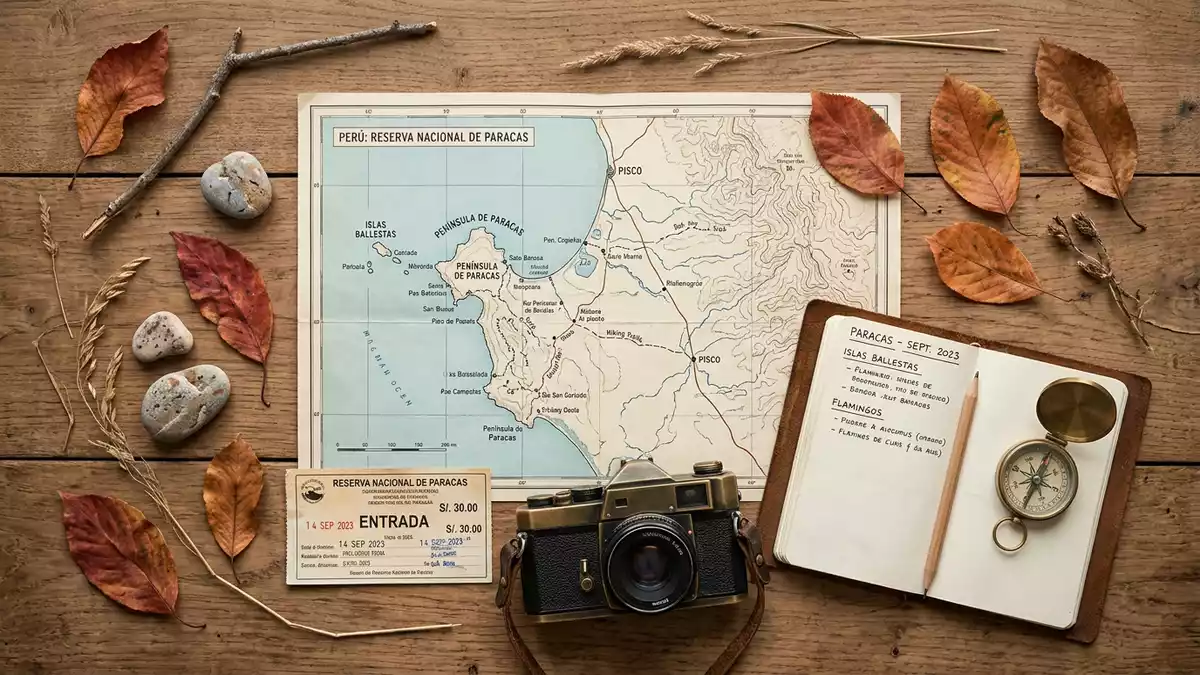
Reserva Nacional de Paracas on Peru’s southern coast sets an austere desert of ochre and red cliffs directly against the Pacific Ocean, creating a landscape where rock, sand and sea form one continuous horizon. Established on 25 September 1975 as a national reserve, it protects both the Paracas Peninsula and surrounding waters near the town of Paracas in the Ica region of Peru.
Desert headlands above the Pacific
Reserva Nacional de Paracas occupies the coastal desert of south?western Peru, including the Paracas Peninsula and adjoining shoreline in the province of Pisco. The reserve stretches along the Pacific with bays, rocky headlands and long beaches lying beneath high, wind?sculpted plateaus of sand and gravel that belong to the Pacific coastal desert of Peru.Coastal bays and plateaus The area covers about 335,000 hectares (around 3,350 km²), with a large share of this surface classified as marine habitat, so that the reserve spans both land and sea in a single protected unit.About 335,000 hectares
The cliffs and headlands give way to sandy coves and open beaches where the desert meets the water in clean lines of rock and surf. In many places the plateau ends abruptly at the sea in steep faces, their layers of sediment forming visible bands of colour above the breaking waves. Inland, the terrain consists of undulating plains of sand and stone with very sparse vegetation, expressing the arid character of the Peruvian coastal desert that frames the Pacific at this latitude.
A protected meeting of ocean current and coastal desert
Reserva Nacional de Paracas is recognised as Peru’s first marine?coastal protected area, reflecting the way its boundaries deliberately combine desert peninsula, islands and productive ocean.Marine?coastal protected area Cold water from the Humboldt Current wells up along this stretch of coast, feeding dense blooms of plankton that form the base of a substantial marine food web in the reserve’s waters.Humboldt Current influences The combination of nutrient?rich sea and almost rainless coastal desert is unusual on the South American Pacific shore.
The reserve’s protection status extends over both terrestrial and marine zones, encompassing bays, shallow marine waters, rocky shores, sandy beaches and offshore islands inside a single management framework.Bays, shores and islands It is designated as a Ramsar wetland of international importance, underlining its role as a representative example of the cold sea of the Peruvian current and the Pacific coastal desert, and as a habitat for a particularly rich coastal biodiversity.Ramsar wetland recognition
Wildlife on the cliffs, islands and shore
Reserva Nacional de Paracas shelters a wide range of wildlife, from seabirds on the cliffs to marine mammals in the offshore waters. Surveys in the protected area have recorded 216 species of birds, 36 species of mammals, 10 reptiles and 168 species of fish, along with further invertebrates and plants adapted to the desert and marine environments.Recorded bird and mammal species The reserve’s position along a migration route means that large numbers of migratory shorebirds rest and feed on its beaches and shallow bays during their seasonal movements.Migratory shorebird stopover
Among the better known species present are sea lions, Humboldt penguins and various species of terns, cormorants and pelicans, which gather on islands and rocky coasts inside the reserve.Sea lions and Humboldt penguins Offshore, the waters provide habitat for cetaceans such as humpback whales and several dolphin species, while endangered marine turtles, including the Hawksbill turtle and leatherback turtle, appear in the broader marine area recognised under the Ramsar designation.Whales, dolphins and turtles
Visiting Reserva Nacional de Paracas: what travellers from Western Europe should know
- Reserva Nacional de Paracas lies in the Ica region on Peru’s southern coast, close to the small town of Paracas and within reach of the Panamericana Sur highway that links Lima with the south.
- The terrain inside the reserve consists largely of exposed desert plateaus and coastal cliffs, with unshaded stretches and unpaved tracks where wind and blowing sand are a constant presence.
- Beaches, viewpoints and other stops in the reserve are separated by open desert distances, so visiting commonly involves travelling by vehicle between points and walking on uneven sandy or rocky ground at each stop.
- The official language is Spanish and the currency is the Peruvian sol.
- Entry requirements depend on your nationality; UK travellers can check the FCDO travel advice at gov.uk/foreign-travel-advice, Irish travellers the Department of Foreign Affairs at ireland.ie.
Searching for Reserva Nacional de Paracas on social platforms
These links open searches for Reserva Nacional de Paracas on each platform.
Frequently asked questions about Reserva Nacional de Paracas
Where is Reserva Nacional de Paracas located?
Reserva Nacional de Paracas is in the Ica region of southern Peru, on and around the Paracas Peninsula near the town of Paracas on the Pacific coast.
What kind of landscape and wildlife can visitors expect?
The reserve combines desert plateaus, cliffs, beaches and Pacific waters, with seabird colonies, sea lions, Humboldt penguins and other marine and coastal species visible in different areas.
What makes Reserva Nacional de Paracas distinctive among Peru’s protected areas?
The reserve stands out for the direct meeting of hyper?arid coastal desert and a highly productive stretch of the Pacific Ocean, protected together as a single marine?coastal reserve.


