
Ribeira in Porto where the hillside meets the Douro
Published on 09/24/2026 at 08:52 | Editorial responsibility: Rafael Müller, Editor-in-Chief AD HOC NEWS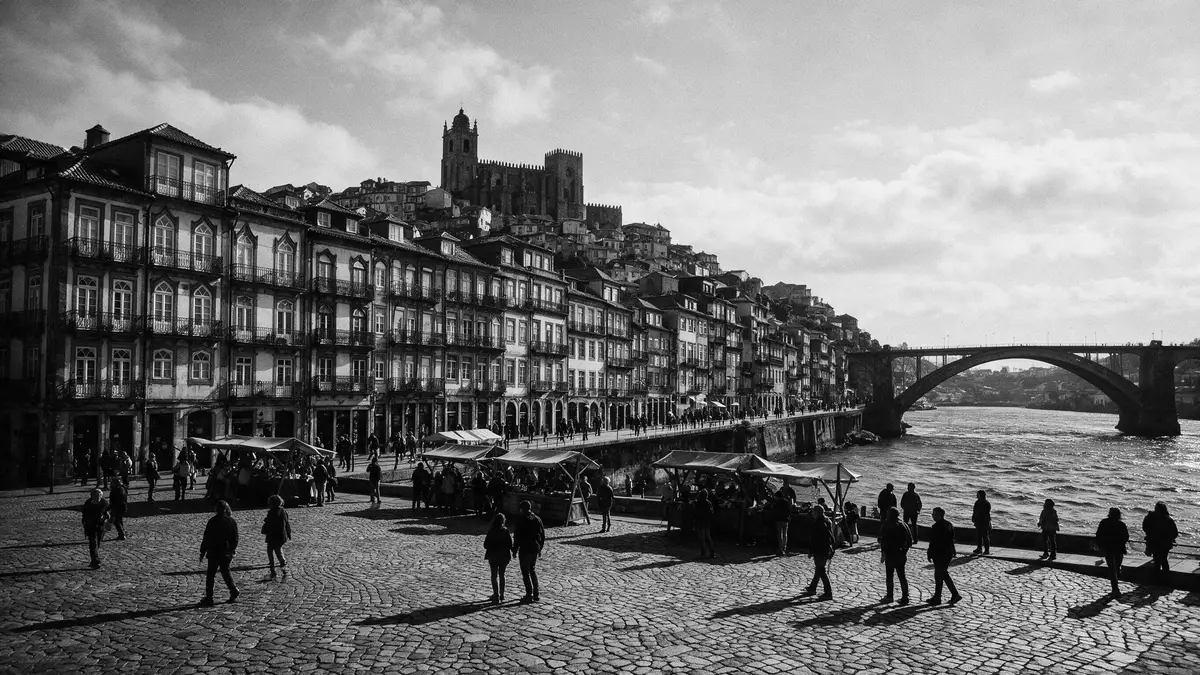
Ribeira occupies Porto’s northern bank of the Douro, where steep streets, tall houses and a working riverside square form a layered urban landscape. The quarter belongs to the Historic Centre of Oporto, Luiz I Bridge and Monastery of Serra do Pilar, inscribed on the UNESCO World Heritage List in 1996.
Ribeira’s houses descend towards the Douro
The district is defined by the relationship between slope and river. Narrow lanes run downhill towards the quays, while rows of townhouses rise above them in uneven terraces. Their façades combine painted plaster, granite details, balconies and tiled surfaces, creating a dense frontage rather than a single monumental avenue.
Ribeira grew around Porto’s historic harbour area. River trade, fishing and maritime commerce shaped the streets beside the Douro, while the surrounding hillside retained the irregular plan of medieval Porto. The quarter remains part of a living city, with homes, cafés, restaurants, small businesses and public spaces occupying the historic fabric.
Praça da Ribeira records medieval and eighteenth-century Porto
Praça da Ribeira is the district’s principal square beside the river. It is recorded in 1389 as a medieval space, and its history includes commercial activity, market stalls and a fish market. In the eighteenth century, João de Almada e Melo oversaw a remodelling associated with Porto’s expanding civic landscape.
The square contains the Ribeira fountain and the sculpture known as the Cube of the Ribeira by José Rodrigues. A seventeenth-century fountain discovered during archaeological work was reconstructed in its original position. A statue of Saint John the Baptist by João Cutileiro was placed in a niche in the fountain on 24 June 2000. The square’s surviving façades connect medieval traces with later urban design, as Praça da Ribeira’s history records.
From Fernandine walls to UNESCO-listed cityscape
Ribeira lies within the wider historic centre associated with Porto’s Fernandine walls. These fortifications were completed in 1376 during the reign of Dom Fernando, and surviving sections remain among the visible remains of medieval Porto.
The district’s surroundings contain buildings from several architectural periods. Porto Cathedral has a Romanesque core dating to the twelfth century, while churches, civic buildings and later commercial structures add Gothic, Renaissance, Baroque and neoclassical elements. The Luís I Bridge connects Porto with Vila Nova de Gaia across the Douro, and the Monastery of Serra do Pilar forms part of the same World Heritage property. The UNESCO-listed historic centre covers an urban landscape with a history reaching back two millennia.
Ribeira’s identity comes from the coexistence of these layers. Medieval streets meet eighteenth-century façades, ironwork crosses the river, and the quays preserve the district’s direct relationship with the Douro. The result is an urban quarter read through changes in level, material and use.
Visiting Ribeira: what travellers from Western Europe should know
- Ribeira lies on Porto’s north bank beside the Douro. The Luís I Bridge crosses to Vila Nova de Gaia, while the Funicular dos Guindais links the upper city with the riverside quays.
- The quarter is built on a hillside. Its approach includes cobbled lanes, uneven paving, stairways and steep streets descending towards the water.
- Praça da Ribeira, the Douro quays, Porto Cathedral, Casa do Infante and the Luís I Bridge are closely connected within the historic centre.
- The official language is Portuguese and the currency is the euro.
Searching for Ribeira on social platforms
These links open searches for Ribeira on each platform.
Frequently asked questions about Ribeira
Where is Ribeira?
Ribeira is Porto’s historic riverside quarter on the northern bank of the Douro. It forms part of the city’s UNESCO-listed historic centre.
What can visitors expect on a visit?
Visitors encounter steep cobbled lanes, dense façades, Praça da Ribeira, river quays and views towards the Luís I Bridge and Vila Nova de Gaia.
What makes Ribeira distinctive?
Its character comes from the visible layering of medieval street patterns, later houses, historic waterfront activity and the Douro within one hillside district.


