
Rio Celeste in Upala, Costa Rica: the sky?blue river of Tenorio Volcano
Published on 08/18/2026 at 14:26 | Editorial responsibility: Rafael Müller, Editor-in-Chief AD HOC NEWS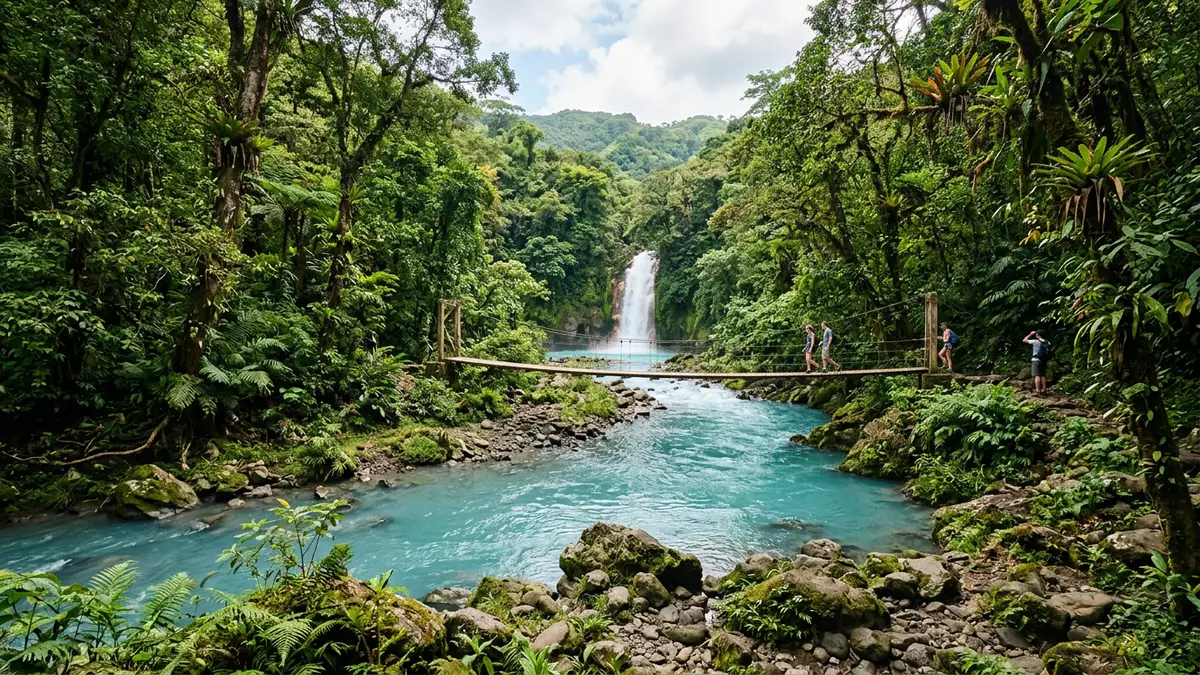
In the northern plains of Costa Rica, near the town of Bijagua in the Upala region, Rio Celeste runs through dense rainforest with an unmistakable sky?blue colour that looks almost unreal against the surrounding green. The river and its waterfall lie inside Tenorio Volcano National Park, where clear mountain streams coming off the volcanic slopes suddenly turn a vivid turquoise at a single bend in the forest.
A sky?blue river born from two clear streams
Rio Celeste flows within Tenorio Volcano National Park, part of the volcanic highlands in northern Costa Rica, reached from communities such as Bijagua in the broader Upala area.Rio Celeste inside Tenorio Volcano National Park The river begins as two separate, colourless streams draining the Tenorio volcano complex, known as Río Buenavista and Quebrada Agria. These waters meet at a point in the forest called Los Teñideros, sometimes simply Teñidero, whose name in Spanish refers to a place where something is dyed.the confluence called Los Teñideros
Upstream of Los Teñideros, both tributaries appear transparent, more like typical mountain creeks than a coloured river. At the confluence, the mixed water turns opaque and takes on a bright sky?blue to turquoise tone that carries downstream along Rio Celeste and into the basin of its waterfall.the colour arising after the streams mix That sudden change in colour at one specific spot in the forest has become one of the defining features of the river, adding a sense of drama to what would otherwise be a secluded stretch of tropical waterway.
The science behind Rio Celeste’s vivid colour
For many years the unusual colour of Rio Celeste was explained in folklore, including the idea that a divine painter washed brushes there after colouring the sky, but scientific studies have identified a precise physical cause involving suspended minerals and light. Researchers working on the Tenorio volcano complex showed that when the acidic water of Quebrada Agria mixes with the more neutral Río Buenavista, aluminosilicate particles suspended in the streams rapidly clump together and increase in size.colloidal aluminosilicate particles enlarging at the confluence Measurements published in scientific work on the river report particle diameters distributed around hundreds of nanometres after mixing, large enough to interact strongly with sunlight.
The key to the blue lies not in a dye dissolved in the water but in an optical effect known as Mie scattering, the same type of physics that can make the sky look blue. As the aluminosilicate particles grow, they scatter incoming sunlight so that shorter wavelengths in the blue part of the spectrum dominate the light reflected back towards an observer.Mie scattering by aluminosilicate particles The result is that the river appears intensely blue or turquoise when viewed along its length, even though a small sample of the water taken in isolation may look more cloudy than strongly coloured.water appearing less vivid when held in a container
Waterfall, rainforest and volcanic landscape
Within Tenorio Volcano National Park, Rio Celeste forms a waterfall where the sky?blue water drops into a pool enclosed by forested slopes.Rio Celeste waterfall listed among park attractions Around the river and falls, the terrain is covered by humid tropical forest typical of the northern plains of Costa Rica, with trees, lianas and undergrowth enclosing the trail corridors. The Tenorio volcano complex itself is part of the Central American volcanic arc, and the streams feeding Rio Celeste carry minerals derived from that volcanic geology.
The park is managed by SINAC, Costa Rica’s national system of conservation areas, and protects both the river and a broader mosaic of volcanic peaks, forest and wildlife habitats.Tenorio Volcano National Park under SINAC Within the Upala canton, the area around Bijagua acts as a gateway settlement for visitors heading to the park, with roads leading towards the park entrance and then into the protected landscape on foot. The juxtaposition of bright water, dark volcanic rocks on the riverbed and dense vegetation gives Rio Celeste a distinctive character among Central American rivers, firmly anchored in its specific physical setting.
Visiting Rio Celeste: what travellers from Western Europe should know
- Rio Celeste lies inside Tenorio Volcano National Park in northern Costa Rica, reached by road from towns such as Bijagua in the Upala region.
- The main trail within the park follows forest paths with steps and uneven, sometimes muddy ground, and includes stretches alongside steep slopes near the river and waterfall.
- The area sits in the tropical northern plains, so rain can make surfaces slick and river levels variable; sturdy footwear suited to wet, humid conditions is important for walking the route.
- The official language is Spanish and the currency is the Costa Rican colón.
- Entry requirements depend on your nationality; UK travellers can check the FCDO travel advice at gov.uk/foreign-travel-advice, Irish travellers the Department of Foreign Affairs at ireland.ie.
Searching for Rio Celeste on social platforms
These links open searches for Rio Celeste on each platform.
Frequently asked questions about Rio Celeste
Where is Rio Celeste?
Rio Celeste is in northern Costa Rica, inside Tenorio Volcano National Park in the Upala canton, with access from nearby towns such as Bijagua.
What can visitors expect on a visit?
Visitors follow a forest trail inside the national park to viewpoints along the bright blue river and towards its waterfall, passing humid tropical vegetation and volcanic terrain.
What makes Rio Celeste distinctive?
Rio Celeste is distinctive because two clear mountain streams meet at Los Teñideros and, through mineral?driven light scattering, suddenly form a sky?blue river and waterfall in a dense rainforest setting.


