
Robben Island and the prison landscape of Cape Town
Published on 09/22/2026 at 20:31 | Editorial responsibility: Rafael Müller, Editor-in-Chief AD HOC NEWS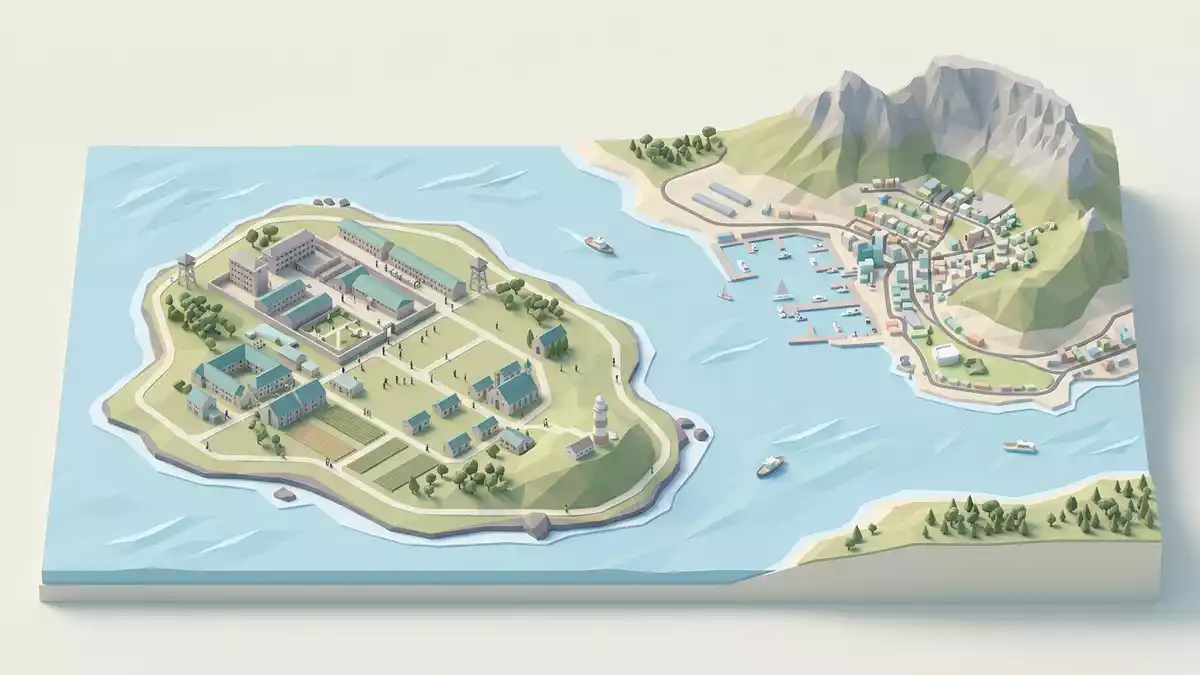
Robben Island lies in Table Bay, offshore from Kapstadt, with prison buildings, a lighthouse, churches and open island terrain gathered within one historic landscape. Its best-known spaces are linked to Nelson Mandela and the apartheid prison system, but the island’s story reaches from the seventeenth century through military, medical and penal uses.
Robben Island between sea, city and island buildings
Robben Island is a low island in Table Bay, north-west of Cape Town and west of the mainland. Its position places the prison complex, the settlement and the surrounding sea within a single view across the bay.
The island’s buildings include the maximum-security prison, former residences, churches, workshops and a lighthouse. The lighthouse was built on Minto’s Hill in 1864, and the settlement contains structures associated with British administration during the nineteenth century. The landscape is open and low, with roads, walls, quarry areas and scattered buildings rather than a dense urban plan.
The island is reached by ferry from Cape Town’s waterfront. Table Mountain forms a prominent mainland reference across the water, while the island’s own buildings remain separate from the city’s streets and neighbourhoods.
From prison island to a World Heritage site
Robben Island served as a place of imprisonment and banishment from the seventeenth century. Its uses also included a hospital and a military base, giving the island a history that extends beyond the prison associated with apartheid. UNESCO World Heritage status was inscribed in 1999.
The island’s institutional history is visible in its surviving buildings. A British prison settlement developed during the nineteenth century, while churches, barracks, administrative houses and service buildings formed a small community. The lighthouse, completed in 1864, remains a distinct landmark on the island’s elevated ground.
During the twentieth century, Robben Island became a maximum-security prison for political prisoners under apartheid. The prison was formally closed in 1996, and Robben Island Museum was established in 1997. The museum presents the island as a historic site rather than as a single building.
Nelson Mandela, the quarry and the prison cells
Nelson Mandela arrived on Robben Island after the Rivonia Trial in 1964. He spent eighteen of his twenty-seven years in prison on the island, including many years in the maximum-security complex. His cell forms part of the prison visit, while the wider site includes courtyards, corridors and communal areas.
The prison held political prisoners from South Africa and other parts of southern Africa. Kgalema Motlanthe and Jacob Zuma were also imprisoned on Robben Island before becoming presidents of South Africa. Mandela’s Robben Island years belong to the wider history of political imprisonment on the island.
A limestone quarry is another important part of the visit. Prisoners worked there, and the quarry became associated with political discussion and education among inmates. The quarry’s pale rock, the prison walls and the open sea form a connected landscape of labour, confinement and distance.
The island’s heritage therefore rests in its combination of buildings and places. The cell conveys personal scale, the prison complex shows institutional control, and the quarry records a different part of daily life. Together they connect the island’s physical setting with South Africa’s twentieth-century political history.
Visiting Robben Island: what travellers from Western Europe should know
- Robben Island lies in Table Bay offshore from Kapstadt. Ferries connect the island with the Nelson Mandela Gateway at the V&A Waterfront.
- The visit includes outdoor walking between the prison, the quarry and other island buildings. The terrain is generally low, but the site includes paved roads, uneven ground and historic structures.
- The island’s cultural landscape includes the maximum-security prison, the lighthouse on Minto’s Hill, churches and former administrative buildings.
- The official language is English, Afrikaans and isiXhosa, and the currency is the South African rand.
- Entry requirements depend on your nationality; UK travellers can check the FCDO travel advice at gov.uk/foreign-travel-advice, Irish travellers the Department of Foreign Affairs at ireland.ie.
Searching for Robben Island on social platforms
These links open searches for Robben Island on each platform.Frequently asked questions about Robben Island
Where is Robben Island?
Robben Island is in Table Bay, offshore from Kapstadt in South Africa. Ferries reach it from the Nelson Mandela Gateway at the V&A Waterfront.
What can visitors see there?
The visit includes the maximum-security prison, Mandela’s cell, the quarry, the lighthouse and historic settlement buildings. Walking takes place across roads, open ground and former institutional areas.
What makes Robben Island distinctive?
Robben Island combines a prison museum with a lighthouse, churches, military remains and a layered history of imprisonment. Its connection with Nelson Mandela gives the island a central place in South Africa’s democratic history.


