
Rocamadour and its cliffside sanctuary
Published on 09/09/2026 at 16:33 | Editorial responsibility: Rafael Müller, Editor-in-Chief AD HOC NEWS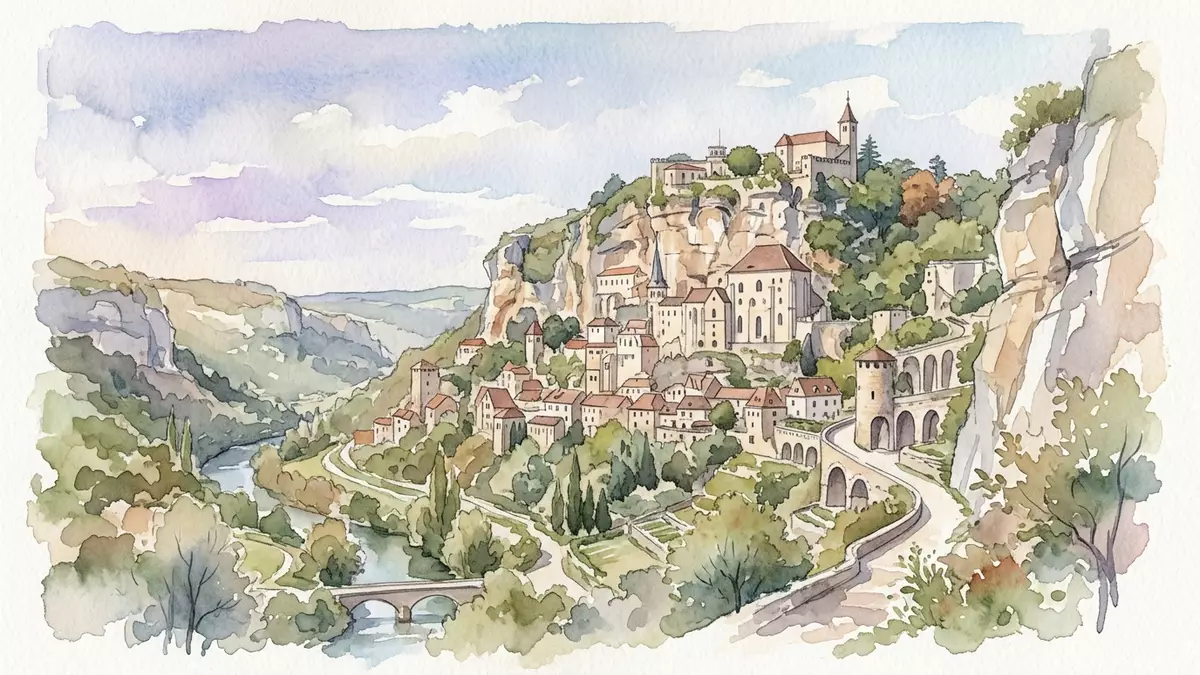
Rocamadour rises in three stacked levels above the Alzou Canyon, with stone houses below and a sanctuary cut into the cliff. Its most memorable feature is the vertical arrangement of the village, castle and religious buildings.
Rocamadour’s cliffside layers and stone gates
The village stands southwest of Padirac in the Causses du Quercy Regional Nature Park and belongs to the Lot department in south-western France. The built form is severe and compact, with lauzé roofs, arched stone gates and a car-free main street below the religious complex.
Rocamadour is linked to the Alzou Canyon and to the wider Dordogne valley, which frames the cliff settlement in a landscape of limestone and ravines. The lower town, the sanctuary and the castle occupy separate levels on the rock face.
The sanctuary above the village
The sanctuary is the place most closely associated with Rocamadour. It includes the Basilica of Saint-Sauveur, the crypt of Saint-Amadour and the Chapel of Our Lady, where the Black Madonna stands at the centre of devotion.
Its religious identity is tied to the medieval cult of the Virgin Mary and to Saint Amadour, whose name is attached to the site’s origins. The ensemble is also part of the routes of Santiago de Compostela in France, a connection that has long linked the village to pilgrimage across western Europe.
Rocamadour appears in the record of medieval pilgrimage in the twelfth century, and the cliff sanctuary grew around a major place of worship in that period. The basilica Saint-Sauveur and the crypt anchor the site’s religious core.
Faith, legend and medieval memory
Rocamadour’s story combines a stone-built settlement with a strong pilgrimage tradition. The black wooden statue in the chapel, the crypt below the basilica and the cliffside position give the place a closely layered identity that is visible from the approach and from within the sanctuary.
The name Rocamadour is linked with Saint Amadour, and the settlement’s identity has long been shaped by the religious complex rather than by the village alone. The medieval character remains clear in the gates, stairways, chapels and rock-cut placement of the buildings.
The Great Staircase links the lower town with the sanctuary, and the climb is one of the village’s defining features. The castle crowns the upper level, completing the three-part arrangement that gives Rocamadour its profile.
Visiting Rocamadour: what travellers from Western Europe should know
- Rocamadour lies in the Lot department, southwest of Padirac, in the Causses du Quercy Regional Nature Park. The village is reached by road, with the lower town and sanctuary arranged on separate levels.
- The settlement is built on a cliff above the Alzou Canyon. The Great Staircase climbs between the lower level and the sanctuary, and the site is spread across steep stone terraces.
- The sanctuary includes the Basilica of Saint-Sauveur, the crypt of Saint-Amadour and the Chapel of Our Lady. The Black Madonna is the most closely associated image in the complex.
- The village has stone gates, a castle and a car-free lower street. Its medieval layout is visible in the stacked arrangement of houses, chapels and ramparts.
Searching for Rocamadour on social platforms
These links open searches for Rocamadour on each platform.
Frequently asked questions about Rocamadour
Where is Rocamadour?
Rocamadour is in the Lot department in south-western France, above the Alzou Canyon and near Padirac. It sits within the Causses du Quercy Regional Nature Park.
What does a visit involve?
The place is defined by a climb through stone levels, a sanctuary complex and a cliffside village street. The Great Staircase, the basilica and the upper castle shape the route through the settlement.
What makes Rocamadour distinctive?
The site combines a medieval pilgrimage complex with a village built in tiers on the rock. The Black Madonna, the crypt of Saint-Amadour and the cliff position give it a clear identity.


