

Rottnest Island’s limestone shores and quokka habitat
Published on 08/20/2026 at 12:13 | Editorial responsibility: Rafael Müller, Editor-in-Chief AD HOC NEWS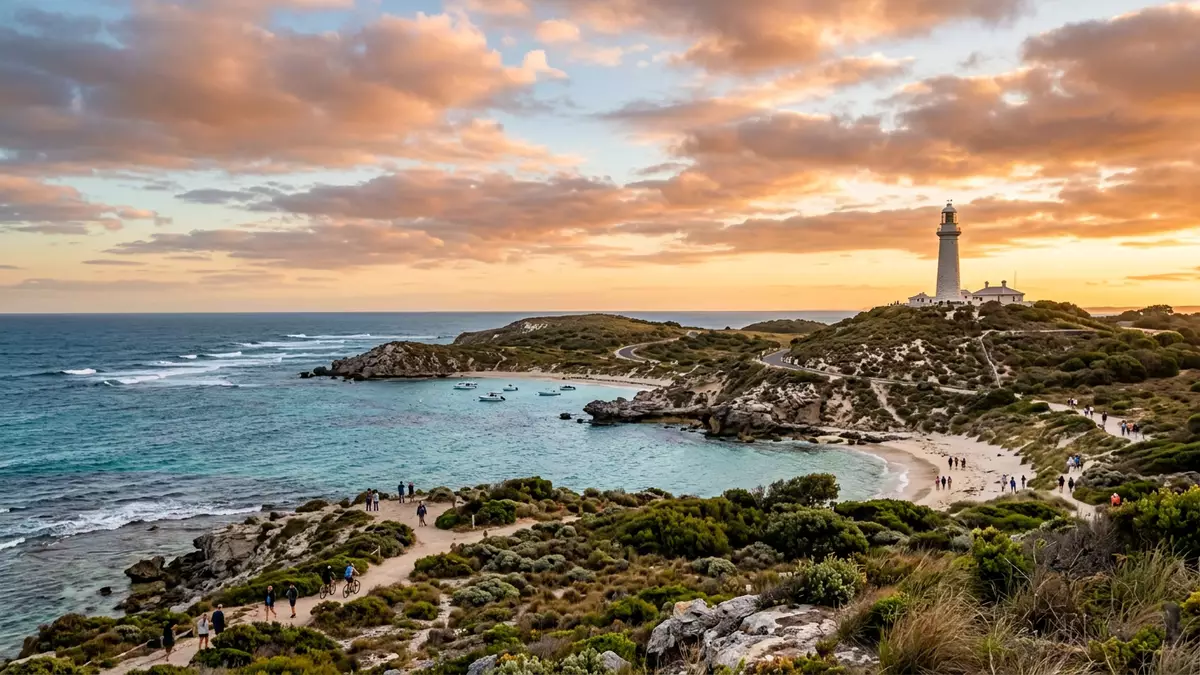
Off the coast of Perth in Western Australia, Rottnest Island presents a compact landscape of limestone shores, inland salt lakes and low coastal dunes shaped over tens of thousands of years. It is set aside as an A-class reserve under Western Australian law, a formal status that places conservation and public recreation at the centre of its identity.Rottnest Island is an A-class reserve
Limestone island on the Swan Coastal Plain
Rottnest Island lies on the continental shelf off Perth, forming the largest link in a chain of islands and reefs on the Swan Coastal Plain of Western Australia.It is the largest island in a chain near Perth The island itself covers around 1,900 hectares of land, rising only modestly above sea level and fringed by shallow marine platforms cut into its bedrock.Rottnest Island extends over about 1,900 hectares
The bedrock is dominated by Tamala Limestone, a calcareous dune limestone formed from wind-blown sands during the late Pleistocene, with marine facies such as the Rottnest Limestone exposed around Thomson Bay and Fairbridge Bluff.Tamala Limestone and Rottnest Limestone form the island Geological studies place much of this limestone formation within the last interglacial period, known to geologists as Marine Isotope Stage 5, with fossil corals at Fairbridge Bluff dated to roughly 132,000 years ago by uranium–thorium methods.Corals at Fairbridge Bluff date to about 132,000 years ago The island stands as a visible record of fluctuating sea levels, with ancient shorelines and elevated coral terraces showing periods when the ocean stood several metres higher than at present.Elevated coral terraces record higher sea levels
Salt lakes, coastal bays and quokka country
The interior of Rottnest Island is marked by a cluster of shallow salt lakes occupying former marine inlets, separated from the surrounding Indian Ocean by low limestone ridges and dunes.Salt lakes lie in the centre of the island Around the margins, bays such as Thomson Bay provide sheltered anchorages with sandy beaches, while more exposed shores show wave-cut platforms in Tamala Limestone and patches of beach sand overlying the rock.
Rottnest Island is also known for the quokka, a small wallaby native to south-western Australia, which lives in the island’s scrub and woodland and is one of the most visible native mammals there.The quokka is a prominent native mammal on Rottnest Island Vegetation around the lakes and dunes includes coastal shrubs and low woodland adapted to calcareous soils and salt influence, giving many walking routes a characteristic mix of pale rock, green thickets and open views over water.
From connected mainland to offshore reserve
During the Last Glacial period, when global sea levels stood far lower than today, the land that now forms Rottnest Island was connected to the mainland west of Perth, with dunes and limestone ridges extending across what is now the continental shelf.Rottnest Island was once connected to the mainland As sea levels rose again towards the start of the Holocene roughly 7,000 years ago, the higher parts of these formations became isolated as separate islands, leaving Rottnest Island as a low-lying remnant with its interior depressions turned into salt lakes.
In the nineteenth century, British colonial authorities used Rottnest Island as an Aboriginal prison, with a penal settlement established in 1838 and maintained until the early twentieth century, when the prison was closed and the island’s use shifted towards tourism and recreation.An Aboriginal prison operated on Rottnest Island until 1903 The land is reserved as A-class Reserve Number 16713 for public recreation purposes and is vested in the Rottnest Island Board, reflecting its long-standing role as a coastal destination for residents of Perth and visitors from further afield.All land on Rottnest Island is classed as an A-class reserve
Visiting Rottnest Island: what travellers from Western Europe should know
- Rottnest Island lies off the coast of Perth in Western Australia, reached by ferries that run across the sea from ports such as Fremantle, Barrack Street Jetty in central Perth and Hillarys Boat Harbour.
- The terrain combines low coastal dunes, limestone ridges and shoreline platforms, with walking routes that include stretches of soft sand, uneven rock and occasional stairways.
- Rottnest Island sits in the Indian Ocean off the Swan Coastal Plain; views from the shore take in offshore reefs, neighbouring islets and, on clear days, distant outlines of the mainland to the east.
- Australia’s official language is English and the currency is the Australian dollar.
Searching for Rottnest Island on social platforms
These links open searches for Rottnest Island on each platform.
Frequently asked questions about Rottnest Island
Where is Rottnest Island in relation to Perth?
Rottnest Island lies offshore on the continental shelf west of Perth in Western Australia, forming the largest island in a chain on the Swan Coastal Plain.It sits on the continental shelf near Perth
What can visitors expect when walking on Rottnest Island?
Visitors encounter a mix of sandy beaches, low dunes, limestone ridges and inland salt lakes, with paths ranging from compacted tracks to sections of softer sand and uneven rock.
What makes Rottnest Island distinctive among Australian coastal destinations?
Rottnest Island combines late Quaternary limestone geology, elevated fossil coral terraces recording ancient sea levels, an interior of salt lakes and free-roaming quokkas within a single A-class reserve.Elevated coral terraces record ancient sea levels


